
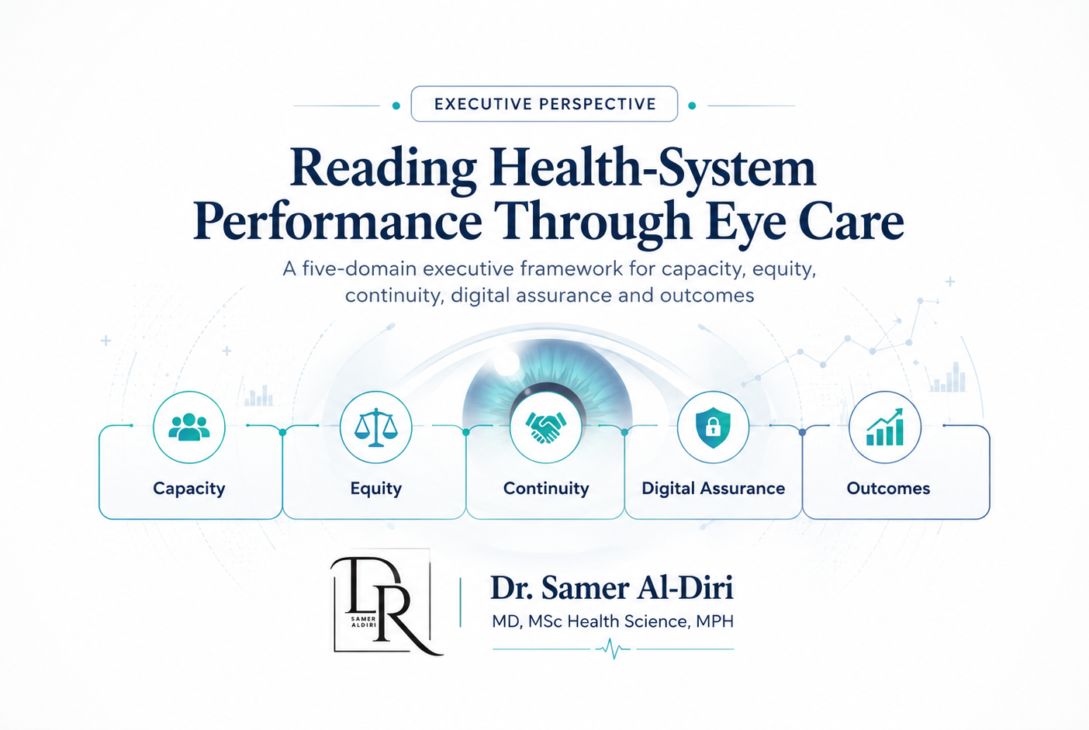
A five-domain executive framework for capacity, equity, continuity, digital assurance and outcomes
Dr Samer Al-Diri, MD, MSc Health Science, MPH
UK-trained ophthalmologist and public-health professional | Healthcare strategy, governance, service transformation and health-system strengthening
Official author profile | ORCID | LinkedIn | ResearchGate | Google Scholar
Executive summary
Eye care cannot stand in for the health system as a whole. Yet its queues, missed follow-up, unequal access, digital hand-offs and patient outcomes can expose weaknesses in the capabilities on which reliable care depends. Read alongside operational and population-health data, these measures provide a disciplined prompt for inquiry rather than a prediction.
This Executive Perspective presents a five-domain framework for reading health-system performance through capacity, equity, integration and continuity, digital assurance, and outcomes and resource stewardship .
Framework status: Conceptual framework — not a validated predictive index.
The proposition: an operational lens, not a system-wide proxy
A cataract backlog, an overdue glaucoma clinic and a referral that never reaches treatment may look like separate specialty problems. Read together, they raise the same management questions: can the organisation match need to capacity, preserve continuity across boundaries, govern technology and deliver effective care fairly?
This article uses eye care as an operational lens: routine measures are interpreted to prompt questions about the capabilities beneath them. The framework is neither a composite score nor a validated prediction of whole-system failure. An eye-care indicator does not supply its own explanation; it tells leaders where disciplined inquiry may be warranted.
A rise in cataract cancellations, for example, could reflect theatre capacity, equipment availability, anaesthetic support, workforce gaps or pathway design. Persistent glaucoma follow-up gaps may arise from recall systems, risk stratification or barriers faced by patients. Unequal access to spectacles or cataract surgery can make financial and geographic constraints visible. Each finding needs context before action.
Eye care is not uniquely informative. Maternity, renal, cancer and emergency services can expose similar weaknesses. Its particular value lies in the combination of high-volume planned care, time-critical treatment, lifelong surveillance, cross-boundary referral, technology-rich workflows and measurable functional outcomes. That combination supports a bounded five-domain reading of capacity, equity, integration and continuity, digital assurance, and outcomes.
Why eye care can inform health-system performance
The World Health Organization estimates that at least 2.2 billion people live with near or distance vision impairment, including at least 1 billion cases that could have been prevented or remain unaddressed.[1] The service response is unusually varied: low-cost refractive correction, high-throughput surgery, complex retinal treatment, chronic glaucoma monitoring, emergency care and rehabilitation. These pathways provide a practical view of whether different levels of need can be matched to the right workforce, setting and interval.
The same system-level pressures become particularly visible in long-term retinal care. In Dr Samer Al-Diri’s analysis of age-related macular degeneration, population ageing and sustainable vision care, retinal disease is examined not only as a clinical challenge but also through the connected demands it places on treatment capacity, workforce, technology, equitable access and long-term health-system sustainability. This wider systems perspective reinforces why eye-care measures can provide useful operational signals when interpreted alongside broader health-system evidence.
Many eye-care outcomes are measurable in routine practice. Waiting time, referral completion, visual acuity, complications, loss to follow-up, patient-reported visual function and resource use can all be examined. Effective cataract surgical coverage (eCSC) is especially useful because it combines population access with a visual-outcome threshold; it was proposed as a tracer indicator for universal health coverage rather than a simple count of activity.[2] WHO’s Eye Care Indicator Menu and 2030 monitoring framework similarly place effective coverage, equity and data quality at the centre of improvement.[3], [4]
An ophthalmologist sees the consequence patient by patient; a public-health lens asks how often it occurs, to whom and why. Health-system leadership requires both views.
WHO already provides an integrated people-centred eye-care model, a situation-analysis tool, an indicator menu, an intervention package and a workforce competency framework.[5] Building on a brief ophthalmology example in my earlier analysis of Integrated Care Is Strategy: The Executive Operating Model for High-Performance Health Systems,[6] this perspective also sits within recent literature describing eye health as a sensitive marker of health-system performance.[7] Its contribution is narrower: a disciplined way to read established and locally relevant eye-care measures together across five organisational capabilities, alongside enterprise data.
The five-domain reading framework
The framework is not a score. Its unit of interpretation is the pattern across domains: what is changing together, for whom, where in the pathway and over what time horizon.
| Domain | Leadership question | Illustrative indicators |
|---|---|---|
| Capacity | Can the service meet need reliably? | Demand-to-capacity balance; overdue review; vacancies; cancellations |
| Equity | Who reaches effective care? | Population eCSC/eREC where valid; waits and outcomes by population group; financial burden |
| Integration and continuity | Does information lead to completed care? | Referral completion; time to treatment; confirmed follow-up; missed hand-offs |
| Digital assurance | Is technology safe and reliable in routine care? | Ungradable rate; subgroup performance; drift; escalation; downtime |
| Outcomes and stewardship | Are meaningful outcomes achieved with responsible resource use? | Visual function; PROMs; safety; complete-episode cost; variation |
Author’s synthesis. These domains complement, rather than replace, WHO eye-care indicators and established health-system assessment frameworks.
Data quality is a prerequisite rather than a sixth domain. Completeness, denominator validity, coding changes, case mix and missingness should be examined before operational variation is interpreted as system pressure.
The measures also operate on different time horizons. Same-week cancellations, ungradable images and failed referrals can expose immediate friction. Growth in overdue follow-up, staff turnover or geographic variation may show pressure accumulating over months. Effective coverage indicates population reach combined with outcome, whereas patient-reported measures describe experienced benefit among the patients represented in the data. Keeping those horizons separate helps leaders match the response to the measure.
1. Capacity and workforce
Workforce density matters, but a national headcount is not an operational diagnosis. A 2026 analysis estimated 275,551 ophthalmologists for 2023, or about 34 per million people, alongside 306,711 optometrists. Ophthalmologist density remained highly unequal, averaging approximately 76 per million in high-income countries and four per million in low-income countries.[8] These survey-based estimates are the most complete global snapshot available, not a definitive census. Distribution, competencies and team design remain as important as total supply.
At service level, the useful questions are practical. Is demand outgrowing scheduled capacity? Which clinics are accumulating overdue review? Are cancellations driven by staffing, theatre access, equipment or patient barriers? Vacancy, turnover, skill mix, training throughput and avoidable administrative work add context. Trends against a local baseline, unexplained variation between sites and deterioration across several measures are more informative than an isolated threshold.
2. Equity and effective coverage
Activity can rise while inequity persists. Cataract surgical rate describes volume, but it does not show whether people who need surgery receive it, regain useful vision or encounter different access by sex, income, disability or place. eCSC and effective refractive error coverage (eREC) are more informative than activity counts for assessing effective population coverage because they connect need, service use and outcome. Recent global analyses drew on population-based surveys across 68 countries for eCSC and 76 countries for eREC, reinforcing their value while also showing persistent geographic and demographic gaps.[9], [10]
Both measures are population-level. They should not be presented as provider-level dashboard indicators without a valid population denominator and appropriate outcome data. Within a service, leaders can instead disaggregate waiting time, non-attendance, treatment completion, outcomes and out-of-pocket burden. The practical question is direct: who reached effective care, who did not, and where were people lost?
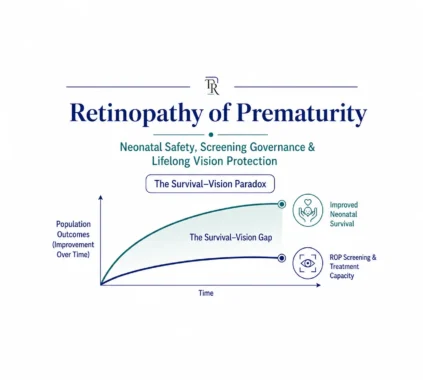
This distinction between activity and completed, equitable care is also central to Dr Samer Al-Diri’s flagship analysis of diabetic retinopathy, preventable blindness and vision-system resilience, which examines how prevention, screening, treatment, workforce, equity and responsible innovation depend on the performance of the entire vision-care pathway rather than any single intervention.
3. Integration and continuity
Eye care crosses organisational boundaries in different ways. A cataract pathway may begin in community optometry, move through surgical assessment and return to community follow-up. Glaucoma depends on reliable recall over years. Low-vision rehabilitation may connect clinical care with social services, education, employment and community support.
Useful measures include referral completion, elapsed time from an actionable finding to care, confirmation that results reached the referring team, and the proportion of hand-offs with a documented receiving service and follow-up plan. Technical connectivity is only one part of continuity. The real test is whether relevant information reaches the right team, produces a documented decision and closes the loop with the patient and referrer.
4. Digital assurance
Large volumes of structured images have made ophthalmology fertile ground for artificial intelligence, telehealth and remote review. A tool can perform well technically and still fail in routine care. Reviews of digital eye health identify concerns involving generalisability, bias, infrastructure, workflow and regulation.[11] WHO’s guidance places autonomy, safety, transparency, accountability, equity and sustainability at the centre of AI governance.[12]
A governance dashboard should therefore examine more than deployment. Relevant measures include ungradable-image rates, turnaround time, performance across demographic and clinical groups, model drift, overrides, incidents, human escalation, interoperability and downtime. Leaders also need to know whether a positive finding was followed by appropriate care.
Digital assurance rests on four practical questions: does the technology remain safe in the local population; can staff detect degradation; does human escalation work; and can the organisation intervene when the system fails?
These principles connect directly with Dr Samer Al-Diri’s Healthcare AI Governance framework, which positions responsible AI as a leadership, workforce, safety, accountability and health-system resilience challenge rather than a technology-only implementation decision.
5. Outcomes and resource stewardship
Eye care can pair objective clinical outcomes with validated patient-reported outcome measures (PROMs). Stewardship becomes meaningful when those outcomes are considered alongside resources consumed over a complete episode and equitable access.
A 2024 scoping review of literature published through 31 December 2023 found no reported ophthalmology provider or health system that had implemented every component of the authors’ complete value-based healthcare agenda.[13] The finding prevents isolated initiatives from being mistaken for a complete model.
Thirty years of Swedish cataract-registry data covering 2.4 million operations documented endophthalmitis falling from 0.10% to below 0.02%, alongside other changes.[14] At one Singapore hospital, an interrupted time-series analysis associated programme implementation with an adjusted immediate reduction of S$327.23 in mean total cost, expressed in 2018 Singapore dollars, and a 0.028-point improvement in a ten-point composite quality score; the study had no contemporaneous control group.[15]
The Swedish findings show how longitudinal registry data can document change. The Singapore study illustrates an association between structured measurement, service redesign, cost and quality. Neither establishes automatic transferability to other specialties or systems.
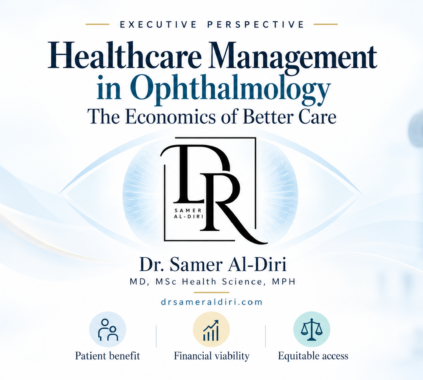
For a focused examination of how patient benefit, cost, payment and equitable access should be considered together in eye-care investment decisions, see Healthcare Management in Ophthalmology: The Economics of Better Care by Dr. Samer Al-Diri.
From dashboard to governance
A dashboard earns its place only when it changes a decision. Four habits keep the framework connected to governance:
- Balance the measures. Combine input, process, outcome, equity and patient-reported information; activity alone does not show effectiveness.
- Read direction and variation together. A stable but unacceptable gap differs from rapid deterioration, and an average can conceal where harm concentrates.
- Triangulate explanations. Test an eye-care finding against workforce, finance, theatre, primary-care, digital and population-health evidence before inferring cause.
- Name the owner and next action. Every threshold for review needs an accountable team, an agreed diagnostic step and a date for reassessment.
This changes the leadership conversation. An overdue treatment list is not solely an ophthalmology problem when its causes include referral design, data exchange, transport, procurement or financial barriers. Equally, deterioration does not automatically indicate system-wide failure; a coding change, altered case mix or clinical-policy decision may explain it. The discipline lies in treating the measure as a prompt for structured inquiry rather than proof of a preferred narrative.
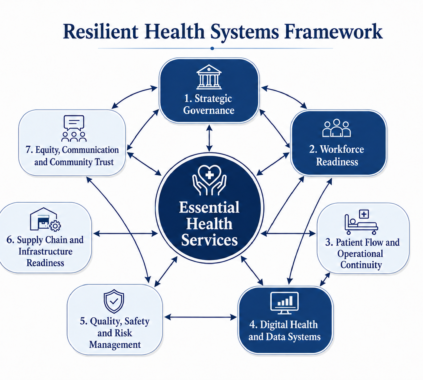
The need to connect performance signals with accountable action also aligns with Dr Samer Al-Diri’s Resilient Health Systems Framework, which treats governance, workforce readiness, operational continuity, digital transformation and institutional resilience as interconnected healthcare-management capabilities.
Limits and a validation agenda
This is a conceptual framework, not a validated predictive index.
The literature supports eye care as part of universal health coverage, a field with measurable effective-coverage indicators, and a demanding setting for integrated and digitally enabled care. [2]–[5], [7]–[12], [16] It does not support a universal claim that eye care fails first, improves first or forecasts broader workforce and capacity crises within a fixed period.
Prospective, multi-system research would need clear indicator definitions, testing for reliability and missing-data bias, adjustment for case mix and policy context, and comparison with independently defined measures of health-system pressure. It would then need to establish whether the combined view adds useful information beyond existing dashboards. Until that work is done, interpretation should remain transparent, locally calibrated and explicitly non-causal.
These limits define what leaders may reasonably infer today and what future research still needs to test. The framework’s immediate value is to organise inquiry.
The leadership implication
Eye care is a vital service in its own right and a revealing place to examine how care is organised. It brings capacity, access, continuity, technology and outcomes together in pathways that patients experience directly. When those pathways are measured thoughtfully, they help leaders locate the capability beneath the metric.
The practical invitation is simple: place a small, evidence-based set of eye-care measures beside the organisation’s core performance data. Ask what changed, for whom, where and why. Then act on the underlying capability. Used alongside wider system evidence, eye-care indicators can help leaders move from recognising pressure to understanding where closer examination should begin.
References
- World Health Organization. Blindness and vision impairment . Fact sheet. 10 February 2026.
- Ramke J, Gilbert CE, Lee AC, et al. Effective cataract surgical coverage: an indicator for measuring quality-of-care in the context of universal health coverage. PLoS One. 2017;12:e0172342. DOI .
- World Health Organization. Eye care indicator menu: a tool for monitoring strategies and actions for eye care provision . 2022.
- World Health Organization. Report of the 2030 targets on effective coverage of eye care . 2022.
- World Health Organization. Eye care in health systems: guide for action . 2022.
- Al-Diri S. Integrated Care Is Strategy: The Executive Operating Model for High-Performance Health Systems . Scholarly Manuscript Version 1.0. 2026. DOI: 10.13140/RG.2.2.36314.71362 .
- Arazi M, Zondervan M, Israeli A, et al. The Israeli eye care system through a public and global health lens. Israel Journal of Health Policy Research. 2025;14:74.
- Resnikoff S, Block SS, Chai S, et al. The global eye care workforce: 2023 estimates across ophthalmologists, optometrists, and allied personnel. AJO International. 2026;3:100260.
- Bourne RRA, Cicinelli MV, Selby DA, et al. Effective refractive error coverage in adults: updated estimates from population-based surveys in 76 countries. Lancet Global Health. 2025;13:e1396-e1405.
- McCormick I, Ouchtar Y, Macleod D, et al. Effective cataract surgical coverage in adults aged 50 years and older: empirical estimates from population-based surveys in 68 countries and modelled estimates for 2000-30. Lancet Global Health. 2026;14:e367-e377.
- Tan TF, Thirunavukarasu AJ, Jin L, et al. Artificial intelligence and digital health in global eye health: opportunities and challenges. Lancet Global Health. 2023;11:e1432-e1443.
- World Health Organization. Ethics and governance of artificial intelligence for health . WHO guidance. 2021.
- Abubakar Z, Sjaaf AC, Gondhowiardjo TD, Makkaraka MAG. Implementation of value-based healthcare in ophthalmology: a scoping review. BMJ Open Ophthalmology. 2024;9:e001654.
- Bro T, Behndig A, Viberg A, et al. Two point four million cataract surgeries: 30 years with the Swedish National Cataract Register, 1992-2021. Journal of Cataract & Refractive Surgery. 2023;49:879-884.
- Hoong JM, Gibbons B, Loh B, et al. Impact of the value driven outcomes program among cataract surgery patients in Singapore: an interrupted time series analysis. BMC Health Services Research. 2023;23:486.
- Burton MJ, Ramke J, Marques AP, et al. The Lancet Global Health Commission on Global Eye Health: vision beyond 2020. Lancet Global Health. 2021;9:e489-e551.
Disclosure
This conceptual perspective is informed by a targeted narrative review of authoritative and illustrative sources. It is neither a systematic review nor a prospectively validated predictive instrument.
The author independently conceived and developed the article’s conceptual argument and framework. AI-assisted tools may have been used for limited editorial, language, formatting or technical support. Responsibility for the content, interpretation, source selection and final publication remains with the author.
This publication is intended for professional education, healthcare leadership discussion, public-health analysis and health-system strategy. It does not constitute individual clinical, legal or regulatory advice.
Suggested citation
Al-Diri S.
Reading Health-System Performance Through Eye Care:
A Five-Domain Executive Framework for Capacity, Equity,
Continuity, Digital Assurance and Outcomes.
DrSamerAlDiri.com.
Published 31 August 2026.
Available at:
Reading Health-System Performance Through Eye Care
Author ORCID: 0009-0004-1908-0714
Open-access licence: © 2026 Dr Samer Al-Diri. This article is licensed under the Creative Commons Attribution-NonCommercial-NoDerivatives 4.0 International Licence (CC BY-NC-ND 4.0) .
The article may be shared and redistributed for non-commercial purposes with appropriate attribution to Dr Samer Al-Diri and a link to the original publication. Modified, adapted or derivative versions are not permitted under this licence.
Original publication: DrSamerAlDiri.com | Author: Dr Samer Al-Diri | Publication date: 31 August 2026 | Open Access