
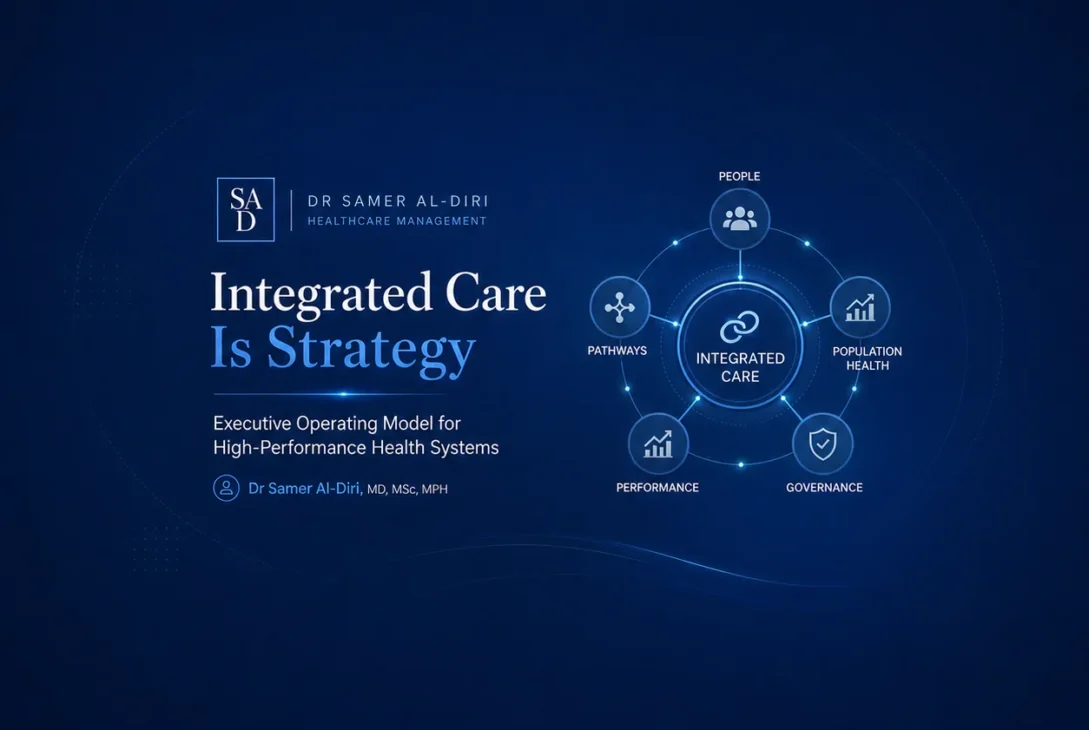
Why the next generation of healthcare leaders must organise strategy around people, pathways and populations
Healthcare rarely fails at the moment of expertise. It fails in the space between moments.
Between the abnormal test and the referral. Between discharge and the first night at home. Between a population-risk signal and an executive decision. These gaps appear in corporate reports as readmissions, duplication, delayed diagnosis, avoidable cost and workforce pressure. To patients and families, they feel much simpler: nobody appears to own the whole journey.
Three figures reveal the scale of the challenge. Noncommunicable diseases caused at least 43 million deaths in 2021. The OECD estimates that up to one-fifth of health spending may be ineffective or wasteful. WHO projects a global shortfall of 11 million health workers by 2030.1,2,3
Boards often discuss these as separate clinical, financial and workforce problems. They are also symptoms of an operating model designed around institutions, specialties and encounters while health is lived across time, settings and professional boundaries.
That is the strategic case for integrated care. It is not a softer alternative to operational discipline, nor a synonym for case management. It is the enterprise architecture that connects prevention, primary care, acute care, behavioural health, social support, rehabilitation and post-acute transition around the needs of people and populations.
The unit of management in modern healthcare can no longer be only the department, facility or episode. It must also be the person and population journey.
Fragmentation is an enterprise risk
A delayed discharge is recorded as a bed-flow problem, although the decisive failure may be an unresolved home-care package. A readmission appears to be an acute-care event, although its origin may lie in medication reconciliation or a missed primary-care review. Poor diabetes control may be labelled “non-adherence” even when the pathway requires multiple appointments, incompatible records and no named coordinator.
The risk sits in the seams. Those seams generate clinical harm, waste professional time, shift cost between organisations and weaken trust. They also conceal accountability: every department can meet its target while the patient experiences failure across the system.
Demography makes this model increasingly untenable. By 2030, one in six people worldwide will be aged 60 or over, and that population will reach approximately 1.4 billion. More people will live longer with multimorbidity, frailty and overlapping physical, behavioural and social needs.5
The human and economic consequences of weak delivery are already substantial. WHO attributes between 5.7 and 8.4 million deaths each year in low- and middle-income countries to poor-quality care and estimates annual productivity losses of US$1.4–1.6 trillion.4
Management matters, but intellectual honesty matters too. A 2025 systematic review found a mixture of positive and null associations between hospital-management practices and quality, with important limitations from non-randomised designs.6 The responsible conclusion is not that leadership produces a guaranteed percentage saving or mortality reduction. It is that governance, incentives, workflow and culture determine whether clinical expertise reaches people reliably.
Integrated care is an operating model—not a programme
Integrated care is sometimes reduced to an organisational merger, a coordination team, a shared office or a new electronic record. Any of these may help. None is sufficient.
WHO’s framework brings together five interdependent strategies: empowering people and communities; strengthening governance and accountability; reorienting models of care; coordinating services within and across sectors; and creating an enabling environment.7 At enterprise level, those principles translate into six executive disciplines.
and risk intelligence
and accountability
and place
and clinical leadership
and continuous learning
and reinvestment
The six disciplines of an integrated health enterprise
1. Define the population mandate before designing the service
Integration starts with a denominator. Who is the enterprise accountable for: residents of a catchment area, enrolled members, people with a defined condition, or patients moving through a particular pathway?
Without that clarity, an organisation can report excellent outcomes among those who reached the service while overlooking people who were never diagnosed, unable to attend or lost after referral. Population intelligence should therefore combine clinical risk, utilisation, social vulnerability, geography, access and patient-reported need. Its purpose is not merely to predict who may become expensive. It is to identify where earlier action can prevent deterioration, preserve function and reduce inequity.
This is where public health becomes part of the operating model rather than a parallel function. Prevention, screening, health protection and the wider determinants of health should shape mainstream investment and capacity decisions.
2. Make accountability travel across organisational boundaries
A patient journey may cross several organisations while accountability stops at each front door. High-performance systems correct this through shared governance: a small set of outcomes that no department can achieve alone, named pathway ownership, explicit decision rights, transparent review and a route for resolving conflict between local targets and system value.
This must reach the front line. Multidisciplinary teams need authority to redesign work, not merely instructions to collaborate. Clinicians engage when integration removes friction, improves care and respects professional judgement. They disengage when transformation adds documentation without clarifying responsibility.
The board’s role is to make it impossible for a serious cross-boundary risk to belong to nobody.
3. Engineer pathways and transitions—not isolated encounters
A pathway is not a flowchart. It is an operational agreement about who acts, when, with what information, under which criteria, and what happens when the expected step does not occur.
The decisive design features are often unglamorous: a closed-loop referral; medication reconciliation; one visible care plan; follow-up arranged before discharge; clear safety-netting; and confirmation that the patient understood the next step.
Evidence should be read without slogans. An umbrella review found significant reductions in emergency admissions in 11 of 21 reviews, commonly in the range of 15–50%, but outcomes were heterogeneous and not every model reduced cost or utilisation.8 “Integrated care” is not one intervention. Results depend on population selection, primary-care capacity, implementation fidelity, data and incentives.
4. Redesign work before asking people to work harder
A projected shortage of 11 million health workers makes workforce design inseparable from strategy.3 Integration should remove repeated histories, duplicate entry, information chasing, preventable escalation and professional time spent navigating internal barriers.
Nurses, pharmacists, allied health professionals, public-health teams, care coordinators, physicians and community partners require explicit roles within one model—not parallel tasks connected only by goodwill. The executive question is not simply how many staff are available. It is how work should be designed so that scarce expertise is used where it creates the greatest value.
A system that improves today’s margin by exhausting tomorrow’s workforce is not high performing. It is borrowing performance from the future.
5. Build a learning system—not a display system
Technology can connect a pathway. It can also digitise fragmentation.
An interoperable record matters when it reduces information loss. Predictive analytics matter when they trigger timely, clinically governed action. Artificial intelligence matters when it improves access, safety, quality or productivity without amplifying inequity.
The National Academy of Medicine defines a learning health system as one in which science, informatics, incentives and culture are aligned for continuous improvement, with knowledge generated through care and returned rapidly to practice.9 That feedback loop—not the dashboard—is the strategic asset.
Every major digital investment should answer four questions: What decision will change? Who will act? How quickly can action occur? How will improved outcomes be demonstrated?
6. Align economics with the outcomes the organisation values
Many enterprises ask teams to coordinate care while budgeting, paying and evaluating them in ways that reward activity inside silos. Integration needs an economic architecture that can see total cost across the journey and allow value created in one setting to be recognised across the system.
For a focused ophthalmology perspective on how patient benefit, financing, affordability and equitable access should be balanced in investment decisions, see Healthcare Management in Ophthalmology: The Economics of Better Care by Dr. Samer Al-Diri.
Depending on context, this may involve pathway budgets, bundled payments, capitation, shared savings, quality-linked incentives or internal gain-sharing. The mechanism matters less than the principle: a service should not be financially penalised for preventing avoidable activity that benefits the wider enterprise.
The opportunity is considerable, but spectacular promises are rarely credible. The OECD’s estimate that up to one-fifth of spending may be ineffective or wasteful describes the scale of potential value—not a guaranteed saving from integration.2 Germany’s Gesundes Kinzigtal model reported more than €18.2 million in cumulative net savings from 2007 to 2018 while reducing avoidable hospitalisation.10 It is a valuable case, not a universal forecast. Its deeper lesson is that value emerged from a defined population, aligned incentives, trusted relationships, credible data and time.
The executive scoreboard must follow the journey
Caseload, documentation, length of stay, occupancy and appointment volume remain necessary. They show whether activity occurred. They do not reveal whether the system improved health.
| Strategic domain | Traditional operational view | Board-level integrated-care measures | Executive question |
|---|---|---|---|
| Population health | Activity and caseload | Risk-adjusted disease control; screening coverage; preventable complications; equity gaps | Are health needs improving across the whole population? |
| Continuity | Discharge-summary completion | Closed-loop referrals; timely follow-up; medication reconciliation; care-plan continuity | Does care survive the handoff? |
| Utilisation | Length of stay and occupancy | Avoidable emergency use, admissions and readmissions; days at home; right-site-of-care rate | Is care occurring in the right setting? |
| Experience | Complaints and satisfaction | Patient-reported outcomes and experience; activation; trust; understanding of next steps | Are people partners in their care? |
| Workforce | Headcount and vacancies | Team stability; engagement; turnover; psychological safety; time released to care | Is the model executable and sustainable? |
| Economics and learning | Budget variance and system go-live | Total cost per person or episode; unwarranted variation; data latency; closed-loop action; improvement-cycle time | Are we creating value and learning faster? |
Table 1. Author’s synthesis. Measures should be adapted to the population, payment model and regulatory environment. The approach builds on IHI’s whole-system measurement and Quintuple Aim thinking: health outcomes, experience, cost, workforce wellbeing and equity.11,12
Ophthalmology offers a revealing stress test
Eye care may appear highly specialised, yet it exposes the integrated-care challenge with unusual clarity.
WHO estimates that at least 2.2 billion people live with near or distance vision impairment and that at least 1 billion cases could have been prevented or remain unaddressed. Annual productivity losses associated with unaddressed vision impairment are estimated at US$410.7 billion, compared with an estimated US$24.8 billion required to address unmet need.13
Consider diabetic retinopathy. A high-performing pathway requires far more than an ophthalmology clinic or retinal camera. It needs a reliable diabetes register, systematic invitation, accessible imaging, quality-assured grading, risk-based recall, closed-loop referral, timely treatment, metabolic control, patient education and active follow-up of non-attendance. The NHS screening model reflects the same principle: identify disease early enough for treatment to prevent or reduce sight loss.14
This is integrated care in miniature. The decisive intervention may occur in the eye clinic, but the outcome depends on primary care, public health, digital systems, patient engagement and pathway governance. A fuller analysis is available in my article, Diabetic Retinopathy: Preventable Blindness, Health-System Impact and the Future of Vision Care.
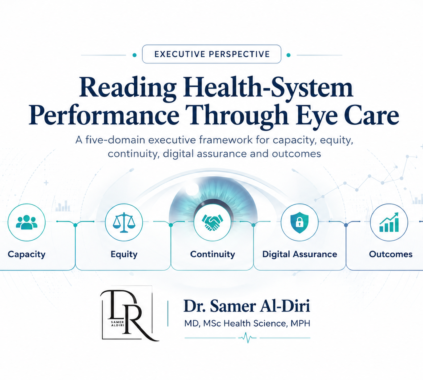
A complementary executive perspective, Reading Health-System Performance Through Eye Care, extends this systems lens by using eye-care measures across capacity, equity, continuity, digital assurance and outcomes as structured prompts for health-system inquiry.
The GCC: six national pathways, one executive imperative
The six GCC states differ in scale, governance and financing. They nevertheless share a strategic direction: stronger population accountability, prevention, primary care, digital integration and value. Each is advancing through a distinctive national lever.
Saudi Arabia — accountable care at scale
Saudi Arabia is reorganising care around geographically defined populations. By the completion of the first transformation phase in 2023, Health Holding reported 20 health clusters, more than 20 million beneficiaries registered in primary care, and eight Model of Care pathways spanning major acute, chronic and preventive priorities.15 The strategic significance lies not in scale alone, but in moving from scattered facilities towards accountable care organisations responsible for the health of a catchment population.
United Arab Emirates — national interoperability
The UAE’s opportunity is to create continuity across a federated health landscape and diverse provider market. We the UAE 2031 aims to place the country among the world’s top ten for healthcare quality.16 Riayati, the National Unified Medical Record platform, reported 4 billion connected medical records and 14 million unique patients in July 2026.17 This gives the nation a powerful foundation for portable histories, safer transitions and population-level intelligence—provided data are converted into coordinated action.
Oman — governance and digital continuity
Oman’s Eleventh Five-Year Plan for Health Development 2026–2030 links quality, equitable access, workforce capability, prevention, modern technology and sustainable development.18 At operating level, the Al-Shifa system connects more than 85% of healthcare institutions across the country.19 Oman illustrates how digital continuity can be positioned within national governance and service redesign rather than treated as an isolated technology project.
Qatar — outcome-led system design
Qatar’s National Health Strategy 2024–2030 defines 15 outcomes across population health, service delivery and system resilience. Announced targets include life expectancy of 82.6 years and a 36% reduction in noncommunicable-disease mortality.20 These are targets, not achieved results; their strategic value is the explicit connection between national ambition, measurable population outcomes, integrated delivery and long-term resilience.
Bahrain — financing, information and precision prevention
Bahrain is aligning complementary national capabilities. SEHATI is intended to advance a comprehensive and sustainable insurance architecture; HIKMA is designed to integrate medical and financial information; and the National Genome Program aspires to analyse 100,000 DNA samples over ten years.21,22,23 Together, these initiatives create a platform for more proactive, data-informed and increasingly personalised population-health management.
Kuwait — capacity connected to continuity
Kuwait operates 28 government hospitals and more than 100 polyclinics, while planning a 40% increase in bed capacity—from 8,757 to 12,230 beds.24 In parallel, WHO has supported integration of its ICOPE approach into primary care and social services for older people.25 The executive opportunity is to ensure that major capacity growth strengthens longitudinal care, healthy ageing and system continuity—not simply the number of available assets.
These are complementary pathways, not interchangeable blueprints and not a ranking. Together, they form a regional portfolio of transformation: Saudi population accountability; UAE interoperability; Omani governance and digital continuity; Qatari outcome-led planning; Bahraini financing, information and precision prevention; and Kuwaiti capacity linked to integrated ageing care.
Leadership behaviours that convert intent into performance
The difference between a transformation programme and a transformed operating model is visible in executive behaviour.
Leaders serious about integration define the population for which the enterprise is accountable and review health outcomes beside financial results—not in a separate quality appendix. They establish joint clinical-operational governance with real authority. They fund the infrastructure of continuity: coordination, pharmacy, analytics, community interfaces and transition management.
They also protect truth. Early results may be uneven. Executives must distinguish implementation milestones from outcomes; savings from cost shifting; prevention from deferred diagnosis; predictive accuracy from clinical usefulness; and promising association from demonstrated causation. They should be prepared to stop initiatives that add complexity without improving care.
Culture is not the soft counterpart to strategy. It determines whether people surface risk, share information, challenge unsafe variation and accept responsibility beyond departmental boundaries. In integrated care, trust is infrastructure.
The new executive test
The old question was: Do we have a care-management programme?
- Is population need visible in our capital, workforce and digital decisions?
- Who owns the outcome when a patient crosses an organisational boundary?
- Can our data close the loop—or only record that it was broken?
- Are incentives aligned with prevention, continuity and total value?
- Would a patient experience one system or a sequence of disconnected services?
The next generation of high-performance health systems will not be defined only by facility sophistication, network size or technology acquisition. They will be defined by the ability to connect prevention, clinical care, public health, workforce, data and finance around the needs of people.
Integrated care is therefore not a downstream function. It is an executive capability—and increasingly, the operating system of the modern health enterprise.
References
- World Health Organization. Noncommunicable diseases. Updated 25 September 2025.
- OECD. Fiscal Sustainability of Health Systems: Improving the Efficiency of Health Systems. OECD Publishing, 2024.
- World Health Organization. Health workforce. Accessed August 2026.
- World Health Organization. Quality health services. Updated 19 May 2025.
- World Health Organization. Ageing and health. Updated 1 October 2025.
- Ward C, et al. What is the relationship between hospital management practices and quality of care? A systematic review of the global evidence. Health Policy and Planning. 2025;40(3):409–421.
- World Health Organization. Integrated people-centred care. Accessed August 2026.
- Damery S, Flanagan S, Combes G. Does integrated care reduce hospital activity for patients with chronic diseases? An umbrella review of systematic reviews. BMJ Open. 2016;6:e011952.
- National Academy of Medicine. Learning Health System. Accessed August 2026.
- Marill MC. From Rural Germany, Integrated Care Grows Into a Global Model. Health Affairs. 2020;39(11).
- Institute for Healthcare Improvement. Whole System Measures 2.0: A Compass for Health System Leaders. Accessed August 2026.
- Institute for Healthcare Improvement. Quintuple Aim. Accessed August 2026.
- World Health Organization. Increasing eye care interventions to address vision impairment. 8 March 2023.
- NHS. Diabetic eye screening. Accessed August 2026.
- Health Holding Company, Saudi Arabia. Health Holding: transformation journey and health clusters. Accessed August 2026.
- United Arab Emirates Government. We the UAE 2031 vision. Updated 19 November 2025.
- UAE Ministry of Health and Prevention. Riayati: National Unified Medical Record. Updated 10 July 2026.
- Ministry of Health, Sultanate of Oman. The Eleventh Five-Year Plan (2026–2030) for Health Development. Accessed August 2026.
- Ministry of Health, Sultanate of Oman. Oman Showcases its Hajj Health Card Experience in Geneva. 18 May 2026.
- Government Communications Office, State of Qatar. National Health Strategy 2024–2030. 13 September 2024.
- Supreme Council of Health, Kingdom of Bahrain. The National Health Insurance Program (SEHATI). Accessed August 2026.
- Supreme Council of Health, Kingdom of Bahrain. The National Health Information Systems (HIKMA). Accessed August 2026.
- Ministry of Health, Kingdom of Bahrain. Bahraini National Genome Program. Accessed August 2026.
- U.S. International Trade Administration. Kuwait—Healthcare. Updated 5 May 2026.
- World Health Organization. Improving the scope of health interventions for older persons in Kuwait. Accessed August 2026.
Publication date: 14 August 2026.
Scholarly manuscript and DOI: The citable open-access preprint / Scholarly Manuscript Version 1.0 was published on ResearchGate on 15 August 2026 and is available at https://doi.org/10.13140/RG.2.2.36314.71362.
Copyright and open access: © 2026 Dr Samer Al-Diri. Except where otherwise noted, this original article is licensed under the Creative Commons Attribution 4.0 International License (CC BY 4.0).
Under CC BY 4.0, the work may be shared and adapted for any purpose, including commercial use, provided appropriate credit is given to the author, a link to the licence is supplied, and any changes are indicated.
Recommended citation: Al-Diri S. Integrated Care Is Strategy: The Executive Operating Model for High-Performance Health Systems. Preprint / Scholarly Manuscript Version 1.0. ResearchGate. Published 15 August 2026. doi: 10.13140/RG.2.2.36314.71362.
Original public-facing publication: DrSamerAlDiri.com, published 14 August 2026.