
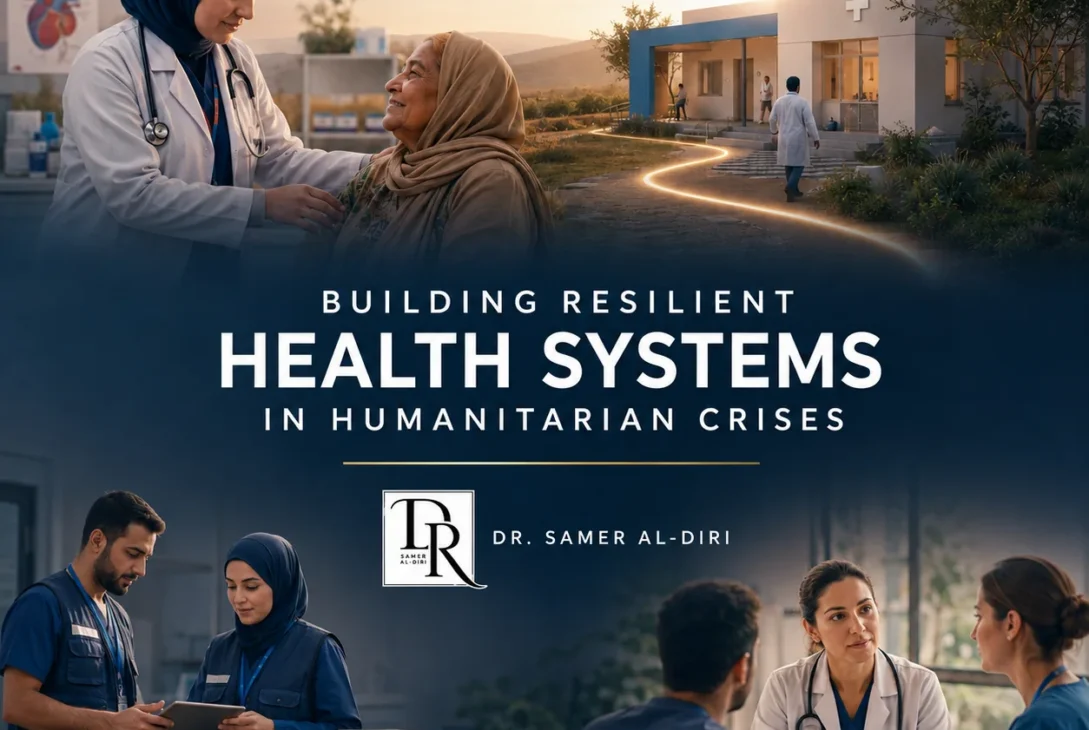
FLAGSHIP CONCEPTUAL AND POLICY ANALYSIS
An Adaptive Stewardship Framework for Continuity and Sustainable Recovery
Healthcare Management | Public Health | Humanitarian Health | Health-System Strengthening
ORCID: 0009-0004-1908-0714 | drsameraldiri.com
DOI: 10.13140/RG.2.2.30378.79045
| “Evidence is not accountability until it changes a decision; adaptation is not stewardship until its effects are verified; and delivery is not continuity until people can rely on it.” |
|---|
Grounded in WHO normative guidance, humanitarian standards and peer-reviewed health-systems research.
Executive abstract
Humanitarian crises do more than damage facilities or interrupt supplies. They fracture the relationships that make care dependable: between communities and services, evidence and decisions, referral and follow-up, emergency action and longer-term recovery. A facility may remain ‘operational’ on a dashboard while medicines, staff, transport, trust or clinical quality have already failed in practice.
This article proposes adaptive stewardship as a way of leading health systems through that uncertainty. It is defined as the continuous, legitimate and sometimes distributed responsibility through which health-system actors observe changing needs, verify operational reality, interpret evidence with those affected, take proportionate action and embed effective adaptations into resilient, locally supportable systems of care.
Its practical core is an Evidence-to-Continuity Framework: Observe, Verify, Interpret, Act and Embed. The framework addresses the Evidence-to-Continuity Gap—the distance between recording that a humanitarian health activity occurred and demonstrating that the associated pathway of care remains accessible, safe, equitable, reliable and capable of continuing under renewed pressure.
The argument is not that humanitarian organisations need another reporting cycle. It is that evidence must travel further: into accountable decisions, resource allocation, changed practice, re-verification and institutional capability. For ministers, policymakers and health-system leaders, the central test is whether governance can convert incomplete but decision-relevant evidence into timely action without sacrificing rights, quality or local legitimacy. Recovery begins during response whenever an urgent adaptation is designed not only to work today, but also to strengthen locally supportable capability for tomorrow. The framework is offered as a conceptual synthesis and practical leadership tool, not as a validated measurement instrument.
Keywords: humanitarian health; health-system strengthening; resilience; adaptive stewardship; continuity of care; recovery; primary health care; quality; governance; complex adaptive systems
1. Health systems under humanitarian pressure
A clinic can be open and still be absent from a patient’s life. The door may be unlocked, the sign visible and the monthly report complete; yet the midwife may have left, insulin may have run out, the referral road may be unsafe, or families may no longer trust that seeking care will help. In humanitarian health, formal availability and lived availability are often very different realities.
Humanitarian crises do more than reduce capacity. They alter the relationship between need, access, authority, information and trust. Populations move. Disease patterns change. Staff are displaced or exhausted. Supply routes become unreliable. New organisations enter, while established lines of accountability weaken or fragment. Acute injuries and outbreaks compete with pregnancy care, immunisation, mental health, disability support and the uninterrupted treatment of chronic disease. The system is asked to make consequential decisions while the evidence is incomplete and the conditions that produced yesterday’s plan are already changing.
WHO’s current global strategy places equity, primary health care, health-system resilience and protection from emergencies at the centre of its agenda for 2025–2028.[1] Its implementation guidance is equally clear that resilience is not an automatic by-product of investment; it must be intentionally developed and adapted to context.[2] In fragile and conflict-affected settings, WHO now frames response, recovery and resilience as overlapping responsibilities rather than neat consecutive phases.[3] The 2026 Johns Hopkins Center for Humanitarian Health–Lancet Commission likewise calls for rights-based, accountable approaches that protect quality and continuity while strengthening local leadership and health systems.[4]
For this article, a health system is under humanitarian pressure when population needs, operational risks or resource constraints change faster than the system can detect, interpret and respond without compromising equity, quality or continuity. This definition shifts attention away from the event alone. The decisive issue is whether the system can still recognise what is happening, report its own performance honestly, act at the speed of risk and preserve the care pathways on which people depend.
2. Beyond delivery: the Evidence-to-Continuity Gap
Humanitarian programmes must count what they do. Consultations, vaccinations, deliveries, referrals, mobile-clinic visits and medicines distributed are indispensable measures of reach. The problem begins when activity is allowed to stand in for dependable care.
An activity tells us that something was done. An output shows how much was delivered or to whom. An outcome asks whether health or performance changed. Continuity asks whether a person could rely on the whole pathway of care. Capability asks whether the system can reproduce and protect that pathway when conditions change again.
A consultation is not continuity if the prescribed medicine will be unavailable next week. A referral is not continuity if transport or receiving capacity is absent. A facility is not meaningfully functional because a form calls it open. Community engagement is not accountability if people can speak but their evidence cannot alter a decision.
WHO and the Global Health Cluster treat quality as integral to humanitarian response, not an improvement to postpone until stability returns.[5, 6] The Lancet Global Health Commission on high-quality health systems likewise showed that access without competent, respectful and trustworthy care is insufficient.[7] WHO’s primary-health-care and people-centred-service frameworks locate continuity across prevention, diagnosis, treatment, referral and follow-up, rather than within one facility or project.[8, 9]
This article defines the Evidence-to-Continuity Gap as:
| The operational distance between documenting that a humanitarian health need, activity or failure exists and demonstrating that the associated pathway of care is accessible, safe, effective, equitable, trusted, reliable and progressively embedded in locally supportable capability. |
|---|
Continuity is a property of a pathway, not merely a building, team or organisation. It does not require preserving every service in its previous form. In crisis, continuity may depend on redesign: task-sharing, simplified schedules, mobile support, new referral routes or temporary service consolidation. Four conditions remain inseparable: reach and relevance; quality and safety; equity and trust; and supportability and learning.
The relevant unit of performance is therefore not the humanitarian activity alone, but the care pathway experienced by the person.
3. Adaptive stewardship: responsibility when governance fragments
Stewardship is an established health-system function. WHO has long associated it with strategic direction, regulation, intelligence, coalition-building, system design and accountability for the public interest.[10, 11, 12] Yet crises expose a practical difficulty: the actor with the legal mandate may not control all territory, financing, data, workforce or delivery. Stewardship functions may be shared among ministries, local authorities, United Nations agencies, NGOs, facilities, professional networks, private providers and community structures. They may also be contested.
This does not make public authority irrelevant, nor should humanitarian action casually replace national and local institutions with parallel governance. It means that stewardship in crisis must be understood as a distributed function whose responsibilities are explicit, rather than as a title presumed to sit in one office. Distributed must never mean diffuse. Where several actors influence the same pathway, decision rights, duties, escalation routes and public accountability must become clearer. Contemporary scholarship similarly moves stewardship from aspiration towards everyday institutional practice and shows why formal structures alone cannot explain how health-system decisions are made and enforced.[13, 14]
Adaptive stewardship is proposed here as:
| The continuous, legitimate and sometimes distributed responsibility through which health-system actors observe changing needs, verify operational reality, interpret evidence with those affected, take proportionate action, and embed effective adaptations into resilient and locally supportable systems of care. |
|---|
It is not a new building block. It is a way of making stewardship operational when volatility is high and authority dispersed. Three features matter. It is closed-loop: evidence must reach a decision, implementation and re-examination. It is normative: adaptation is judged against rights, equity, quality, trust, workforce protection and supportability. And it creates institutional memory: an improvement dependent on one heroic coordinator, exceptional concession or undocumented workaround remains fragile.
Health systems are complex adaptive systems: their outcomes emerge from interactions among people, organisations, incentives, information and power.[15] Resilience scholarship has consequently moved beyond simple ‘bouncing back’ towards capacities to absorb, adapt and transform, while recognising context, power and trade-offs.[16, 17] Cross-country evidence in Nature Medicine likewise found that governance, financing, workforce, public-health functions, service delivery and community engagement operated together during COVID-19; no single resilience intervention was sufficient.[18]
Adaptive stewardship draws from these traditions but asks a more operational leadership question: how does verified intelligence become a legitimate, timely and sustainable change in care—and who is answerable if it does not?
How adaptive stewardship differs from established concepts
The distinctions below are deliberately modest. Adaptive stewardship does not claim territory already occupied by governance, resilience, adaptive management, learning health systems or implementation science. It connects their strengths around a practical leadership problem: closing the distance between evidence and dependable care.
| Established tradition | Primary contribution | Connecting role of adaptive stewardship |
|---|---|---|
| WHO stewardship and health-system governance | Strategic direction, oversight, regulation, intelligence, coalition-building and accountability for the public interest.[10, 11, 12, 13, 14] | Connects those responsibilities to a continuous operating loop of verified evidence, timely decision, implementation and re-verification. |
| Adaptive management | Iterative adjustment of programmes as assumptions, risks and results evolve. | Extends adaptation beyond a project to interdependent care pathways and makes decision rights, equity and public accountability explicit. |
| Health-system resilience | The capacities to absorb, adapt and transform through shocks and long-term stress.[2, 16, 17, 18] | Describes the stewardship practice through which those capacities are mobilised, judged and strengthened. |
| Learning health systems | Continuous use of routine health data and experience to improve care.[21] | Broadens learning to community knowledge, workforce experience, operational risk and political context, including where digital systems are fragmented. |
| Implementation science | Understanding context, implementation strategies, fidelity, adaptation and sustainment.[19, 20] | Places those methods inside a whole-system responsibility to prioritise, allocate resources and protect continuity across organisations. |
| Humanitarian coordination and standards | Collective action, minimum standards, quality, accountability and principled response.[6, 23, 32] | Asks whether coordination and standards are translating into reliable care pathways and lasting local capability. |
Table 1. Adaptive stewardship is an integrative operating discipline; it does not replace the established traditions shown here.
4. The Evidence-to-Continuity Framework
The framework has five functions: Observe, Verify, Interpret, Act and Embed. The arrows should not be mistaken for a queue. In a fast-moving emergency, teams may act on partial but sufficient verification while continuing to observe and interpret. The discipline is to make uncertainty, authority, safeguards and the date of re-verification explicit—not to delay proportionate action while waiting for perfect information.
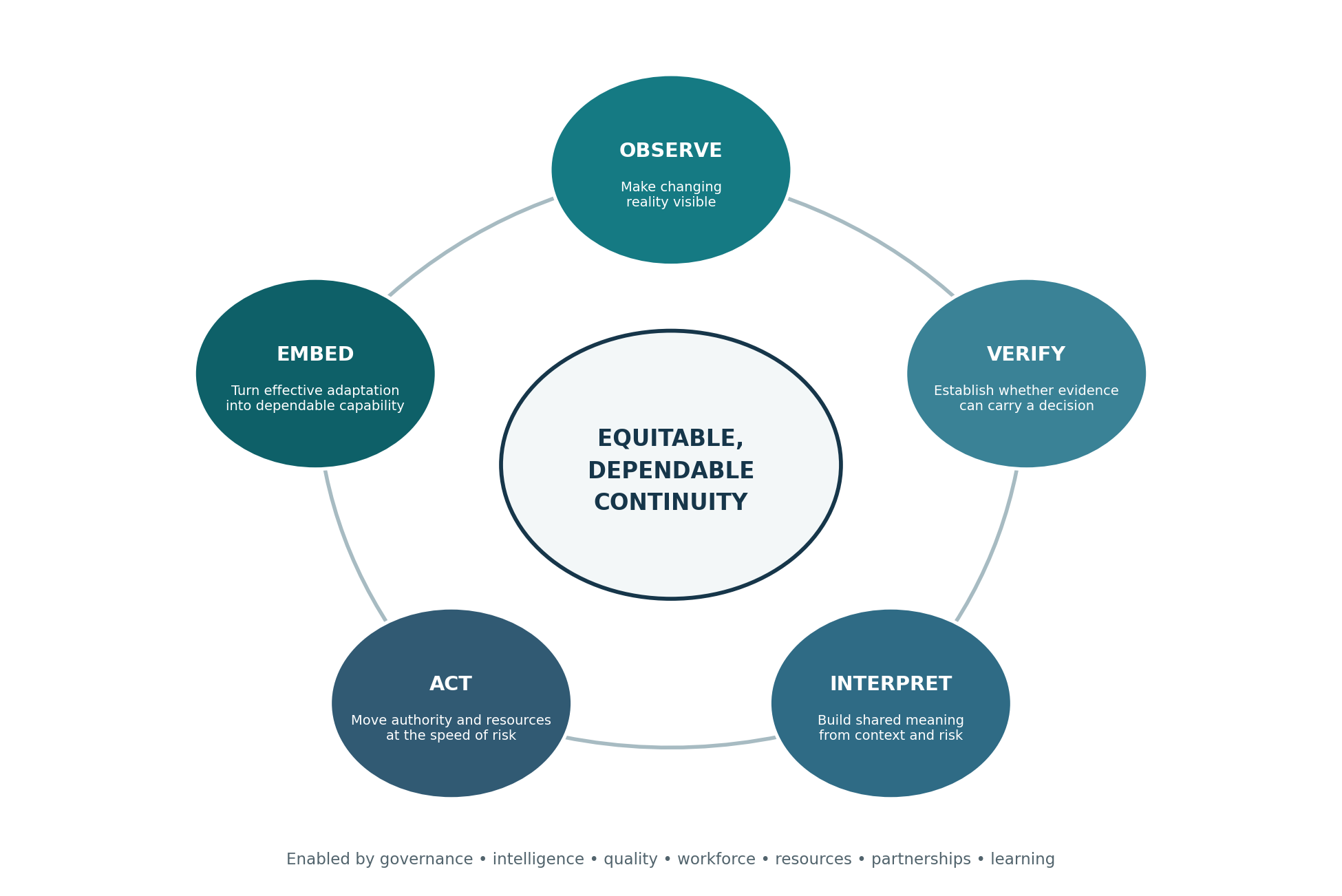
Figure 1. The Evidence-to-Continuity Framework (author’s proposed conceptual synthesis). The functions are iterative and may operate concurrently; the central test is equitable, dependable continuity.
| Function | Decisive question | Evidence that the function is complete enough to move |
|---|---|---|
| Observe | What is changing, for whom, where and how quickly? | Priority risks, pathways and excluded groups are visible early enough to matter. |
| Verify | Is the evidence reliable, relevant and safe enough for this decision? | Confidence, uncertainty and the consequences of error are explicit. |
| Interpret | Why is this happening, who carries the risk and what trade-offs follow? | Causes, power, alternatives and unintended effects are understood collectively. |
| Act | What will change, who can authorise it and how will its effects be tested? | An owned, resourced and safeguarded decision has a re-verification date. |
| Embed | What must become routine so the improvement survives the next change? | Effective adaptation is institutionalised and can withstand renewed pressure. |
Table 2. The five functions are iterative and may overlap; they are not a rigid linear protocol.
The executive decision test
Before endorsing a major adaptation, leaders should be able to answer five questions: Is the risk sufficiently verified? Who has authority to act? What resources and safeguards move with that authority? How will effects on quality, equity and the workforce be detected? What must be embedded—or deliberately stopped—if the adaptation works? If these answers are absent, activity may increase while continuity remains unprotected.
Observe — make changing reality visible
Observation asks what is changing, for whom, where and how quickly. It combines epidemiological and service data with workforce intelligence, medicine and supply signals, referral performance, security risks, community experience and evidence of exclusion. It should detect trajectories, not only events: missed follow-up accumulating, staff absence becoming normal, repeated cold-chain failures or changing care-seeking before a formal crisis is declared.
Observation should follow priority pathways, not organisational reporting alone. Maternal continuity may depend on antenatal access, transport, blood and emergency obstetric capacity. For a displaced population, it may include immunisation, surveillance, mental health, disability access and uninterrupted treatment for chronic disease. Leaders must decide which functions cannot safely fail, which groups are most likely to vanish from averages and which weak signals merit escalation. Frontline staff and communities often detect the gap between reported service and lived reality first.
Verify — establish whether the evidence can carry a decision
Verification asks what is known with enough confidence to act responsibly. It tests integrity and decision-readiness; interpretation asks what the evidence means.
Critical claims may be triangulated through registers, direct observation, service-readiness assessments, stock and staffing records, referral outcomes and community accounts. Data should be timely, sufficiently complete and disaggregated where inequity may be hidden. Verification also tests plausibility: an apparent improvement during insecurity may reflect genuine adaptation, but also denominator error, changed access or reporting pressure.
This is not a demand for certainty. In crisis, certainty may arrive after the moment for prevention has passed. Verification should state what is established, what remains uncertain, the consequences of error and what further evidence is proportionate. It must also ask whether collecting or sharing the information is ethically justified. The question is not simply, “Is the number correct?” but “Is this evidence reliable, relevant and safe enough for this decision?”
Interpret — turn information into shared meaning
Interpretation asks why the situation is occurring, what it implies, who carries the risk and what trade-offs follow. Falling attendance may reflect improved health, insecurity, transport costs, medicine shortages, changed referral practice or lost trust. A technically precise response to the wrong explanation can deepen harm.
Interpretation is collective sensemaking. It brings clinical, public-health, operational, financial, protection and community perspectives together; tests alternatives; and considers unintended effects. Practical knowledge held by managers, frontline staff and communities is part of the evidence required for wise action.[22]
It helps to distinguish technical failure, where a known standard is not delivered; implementation failure, where an intervention is poorly fitted or supported; coordination failure, where the pathway breaks between actors; and strategic failure, where the system is preserving the wrong objective. More training will not repair an impossible workload. More reporting will not resolve unclear authority. Interpretation must also ask whose account is believed and whose absence from the data is mistaken for absence of need.
Act — move authority and resources at the speed of risk
Action asks what will change, who can authorise it, what it requires and how its effects will be tested. The response may be preventive, protective, corrective or transformative: redesigning a service, reallocating resources, stopping harm, preserving a functioning pathway, escalating a constraint, negotiating access or scaling a local solution.
Technical acts alter services or resources. Managerial acts change priorities, roles or budgets. Relational acts negotiate safe passage, resolve duplication, share information or rebuild trust. In humanitarian health, relational action often makes technical action possible.
A material decision should state the problem and risk, accountable owner, action and resources, timeframe, safeguards for quality and equity, and date for re-verification. Action should occur at the lowest level that has the competence, authority and resources to manage the risk, with rapid escalation for constraints that local teams cannot resolve. This principle of subsidiarity is safe only when authority, information, financing and protection travel with responsibility. Implementation science supports making adaptations explicit, reasoned and evaluable rather than treating them as invisible departures from protocol.[19, 20]
Embed — leave capability, not dependency
Embedding asks what must become routine so that the improvement survives the next change. A workaround becomes health-system strengthening only when it can outlast the person who invented it.
Embedding may place an effective adaptation into policy, financing, workforce roles, supervision, procurement, information systems, referral agreements, quality processes, community mechanisms or preparedness plans. It may also remove temporary forms, duplicate reporting or parallel arrangements that no longer add value.
The test is recurrence: does the pathway remain reliable when a leader leaves, a grant changes, demand rises or insecurity returns? WHO recovery guidance emphasises that recovery is non-linear, should begin early and must be revised through national and local leadership.[25, 26] Evidence from the ReBUILD consortium warns against mistaking staff sacrifice and improvised coping for institutional resilience.[28, 29] If continuity depends on chronic exhaustion or permanent external substitution, it has not been embedded.
The cycle returns to observation and re-verification. A system has not learned because it collected data. It has learned when verified knowledge changes care and what works becomes a defensible part of the system.
5. Seven capabilities that make the cycle turn
The five functions describe the work. Seven interconnected capabilities determine whether it can be done.
Legitimate governance and clear decision rights. Shared purpose, transparent priorities, defined authority and routes for challenge are essential. A coordination forum may discuss risk while no participant can authorise change; adaptive stewardship makes that decision architecture visible.
Integrated intelligence. Decisions need a usable picture of need, readiness, quality, workforce, finance, supplies, surveillance, protection and community experience. Integration does not require one enormous database. It requires relevant information to cross organisational boundaries without losing context or creating unsafe exposure.
Quality and patient safety. Continuity must protect effectiveness, safety, timeliness, integration, efficiency, equity and people-centredness.[5, 6, 7] A service that remains open but becomes clinically unsafe is not continuous.
A capable and protected workforce. Adaptation needs competence, teamwork, supportive supervision, psychological safety and permission to surface bad news. No system is resilient because staff repeatedly compensate for structural failure. Heroism can save lives; it is not a staffing strategy or resilience measure.[29, 30]
Flexible resources and reliable supply. Leaders need enough discretion to move funds, people, medicines, diagnostics and transport as evidence changes, within transparent rules.
Community and partnership capability. Communities, civil society, public institutions, private providers and humanitarian organisations often co-produce the same outcome. Accountability to affected people is part of evidence quality, legitimacy and feasibility—not a courtesy after technical planning.[23, 31]
Institutional learning and memory. After-action review, implementation records, succession planning and preserved local knowledge prevent each shock being treated as unprecedented. Learning must include staff and community knowledge, not only data generated inside clinical encounters.[21]
These capabilities are not a second framework. They are the conditions that allow evidence to move into continuity.
6. Adaptive stewardship in practice
The framework becomes useful only when it changes how a real problem is seen. These scenarios are illustrative and do not describe any particular organisation.
Primary health care for a displaced population
A district reports stable consultation numbers after a large influx, yet clinicians notice late antenatal presentation, interrupted chronic-disease treatment and incomplete childhood immunisation.
Observe looks beyond attendance to new settlements, missed appointments, refill gaps, maternal referrals, disability access, transport cost and community concerns. Verify compares registers with stock records, referral outcomes, outreach observation and accounts from women’s groups, community health workers and people with disabilities. The clinic is open, but opening hours, documentation fears and repeated journeys make it inaccessible for some.
Interpret identifies unstable residence, lost income, fragmented records, gendered mobility constraints and a model requiring several visits. Act therefore coordinates appointments, strengthens medicine continuity where appropriate, links outreach with fixed services, clarifies referral feedback and works with communities on safe access—while monitoring effects on host populations. Embed revises medicine forecasts, rosters, records, referral agreements and district plans. Success is not the number of outreach sessions; it is whether people remain connected to safe care.
A conflict-affected district hospital
A hospital is labelled functional, but surgical capacity changes with oxygen, blood, sterilisation, electricity, security and specialist staffing; ambulance routes are repeatedly disrupted.
Observe shifts from “facility open” to the minimum safe service package and the referral network. Verify checks actual emergency, obstetric and surgical readiness, including postoperative nursing and receiving facilities. Staff need a safe route to report deterioration without honesty being treated as failure.
Interpret shows that insecurity, exhaustion, supply fragmentation and unclear partner roles are interacting; the pathway, not simply the building, is failing. Act defines a realistic service package, triage, supply buffers and dynamic referral routes; protects shifts; clarifies partner responsibilities; negotiates access; and states openly when a service cannot be delivered safely. Embed incorporates protocols, maintenance, cross-training, referral agreements, incident learning and contingencies into local coordination and recovery plans rather than an indefinite parallel command system.
A communicable-disease outbreak during wider disruption
An unusual surveillance signal appears while flooding or conflict is already reducing access to maternity, immunisation and chronic care.
Observe combines laboratory, syndromic, environmental, mobility and community signals while tracking essential-service deterioration and rumours. Verify checks specimens, case definitions, completeness, denominators and whether apparent low incidence reflects low transmission or low access, using no more data exposure than operationally necessary.[24]
Interpret weighs transmission, uncertainty, trust, protection and the secondary harm of diverting all capacity. Act proceeds with outbreak control, risk communication and resource mobilisation while explicitly protecting priority routine pathways. Relational work with community leaders addresses fear; technical action strengthens surveillance and infection prevention; managerial action preserves staff and supplies for essential care. Embed leaves stronger laboratory links, community surveillance, infection-control practice, supply arrangements, training and after-action learning. WHO’s Health Emergency and Disaster Risk Management framework supports this whole-cycle approach.[27]
Across all three settings, tempo and authority differ. The question is the same: did evidence travel far enough to protect a person’s pathway of care, and did the response leave the system better able to protect it next time?
7. From humanitarian response to sustainable recovery
Recovery does not begin on the day an emergency is declared over. It begins with choices made during response about what will be protected, rebuilt and left behind when exceptional support recedes.
Returning to the pre-crisis state may be neither possible nor desirable. WHO guidance treats recovery as an opportunity to address pre-existing weaknesses and inequities rather than restore a fragile baseline.[26] Its Eastern Mediterranean work emphasises integrated recovery, local leadership and bridging humanitarian and development workstreams.[3, 25] The humanitarian–development–peace nexus carries a similar ambition: immediate relief should not be disconnected from the institutions and relationships required for longer-term health and stability.[33, 34]
This does not burden emergency teams with an unrealistic reform agenda. It gives temporary measures a transition logic. A parallel supply chain may save lives today; stewardship asks when it should connect with, strengthen or hand over to a sustainable system. An externally supported platform may improve visibility; the question is whether local teams can govern, finance and use it afterwards.
Four tests help. Ownership: do local actors hold real authority? Interoperability: can the adaptation connect with public systems and referral networks? Supportability: can recurrent costs, workforce and maintenance be sustained? Survivability: can the pathway function through leadership turnover, funding change or renewed shock? These are governance tests, not merely technical design criteria.
Transferring responsibility without authority, financing, information or protection is not localisation; it is risk transfer. Retaining control indefinitely can equally suppress local capability. The aim is neither premature handover nor permanent substitution, but a deliberate movement from externally enabled delivery towards locally governed and resilient care.
An activity is not an outcome. An outcome is not a capability. A capability becomes part of a health system when people can rely on it under pressure.
8. Ethical safeguards, limitations and a research agenda
Adaptive stewardship could be misused. Faster feedback can become intrusive surveillance. Verification can burden staff and communities repeatedly asked for the same information. Local discretion can reproduce discrimination. Digital systems can make connected populations visible while those at greatest risk remain unseen. Resilience language can conceal whose labour absorbs the shock.
The framework therefore requires restraint. Data collection should be proportionate to a defined decision, with confidentiality, conflict sensitivity, participation and safe sharing built in.[23, 24, 32] Community engagement must include the ability to influence priorities and receive an account of what happened next. Workforce burden should be monitored alongside service outputs, and uncertainty stated honestly.
The framework cannot overcome attacks on health care, denial of access, political fragmentation, severe financing constraints or deliberate obstruction. Nor should it transfer responsibility for structural or political failures to frontline teams. It is a conceptual synthesis, not a validated causal model, accreditation standard or universal protocol; its value will depend on contextual adaptation and empirical testing.
Research should test feasibility, acceptability and decision usefulness; effects on decision latency, continuity, quality and equity; implementation and workforce burden; the distribution of decision rights; and whether adaptations are sustained or merely shift harm across groups, services or time. Comparative case studies and prospective implementation research should identify where the framework adds value, where it duplicates existing practice and where it fails. The framework should earn authority through empirical challenge, not repetition.
9. Conclusion
Humanitarian crises test more than health-system capacity. They test the integrity of the relationship between a system and the people who must depend on it.
Resilient health systems are not built simply by counting more activity, reopening damaged facilities or asking staff to endure more. They are built when institutions can see deterioration early, verify what is real, interpret evidence with humility, move authority and resources in time, and turn effective adaptation into capability that survives the next shock.
Adaptive stewardship offers a disciplined way to connect those responsibilities. Its Evidence-to-Continuity Framework does not replace WHO guidance, humanitarian standards, implementation science or established resilience work. It gives them an operating logic centred on the care pathway experienced by people.
The decisive question is no longer only, “What did we deliver?” It is, “Can people still depend on care—and is the system now better able to protect that dependence when pressure returns?”
Evidence is not accountability until it changes a decision. Adaptation is not stewardship until its effects are verified. Delivery is not continuity until people can rely on it.
| “Evidence is not accountability until it changes a decision; adaptation is not stewardship until its effects are verified; and delivery is not continuity until people can rely on it.” |
|---|
PRACTICE BOX 1
Adaptive Stewardship Self-Assessment
Use this for structured team reflection—not accreditation, external audit or ranking. Rate each statement: 1 Not in place; 2 Partially in place; 3 Largely in place; 4 Fully embedded. Do not rely on a total score; discuss where the Evidence-to-Continuity chain is most likely to break.
| Function | Behaviourally specific reflection statement | 1–4 |
|---|---|---|
| Observe | 1. We have defined the priority care pathways and populations whose continuity must be protected. | □ |
| 2. We combine service, workforce, supply, epidemiological, protection and community signals rather than activity totals alone. | □ | |
| 3. We can detect deterioration early enough to act before a pathway fails. | □ | |
| Verify | 4. Critical claims about access, readiness, quality and referral completion are triangulated against field reality. | □ |
| 5. Data are timely and disaggregated enough to reveal material inequities and missing populations. | □ | |
| 6. For major decisions, we state what is known, what remains uncertain and why the evidence is sufficient. | □ | |
| Interpret | 7. Clinical, operational, financial, protection and community perspectives inform interpretation. | □ |
| 8. We test alternative causes, system interactions and unintended effects. | □ | |
| 9. We ask whose voice is absent, who bears the burden and whether action may shift harm. | □ | |
| Act | 10. Every material finding has an accountable owner, resources, timeframe and escalation route. | □ |
| 11. Decisions include safeguards for quality, equity, workforce protection and responsible data use. | □ | |
| 12. Technical, managerial and relational actions are matched to the problem and scheduled for re-verification. | □ | |
| Embed | 13. Effective adaptations enter routine roles, financing, workflows, supply, information, referral and preparedness arrangements. | □ |
| 14. Temporary or parallel processes have a transition, integration or responsible exit plan. | □ | |
| 15. Continuity can survive turnover, funding change and renewed pressure without chronic staff sacrifice or external substitution. | □ |
Interpretation: focus on the weakest link and the discussion it generates. A numerical total should not be used to compare organisations or programmes.
Evidence selection note
This article is a critical interpretive synthesis rather than a systematic review. Sources were selected for their direct conceptual or operational relevance, with priority given to WHO normative guidance, Global Health Cluster and IASC materials, and peer-reviewed health-systems and humanitarian research available to 3 August 2026. The proposed definitions and framework are the author’s conceptual synthesis. They are not an official WHO framework and have not yet been validated as a measurement instrument.
Open access and licence
© 2026 Dr Samer Al-Diri. This article is licensed under the Creative Commons Attribution 4.0 International Licence (CC BY 4.0). It may be shared and adapted for any purpose, provided appropriate credit is given and any changes are indicated.
References
Suggested citation: Al-Diri S. Building Resilient Health Systems in Humanitarian Crises: An Adaptive Stewardship Framework for Continuity and Sustainable Recovery. 2026.