
Author ORCID iD: 0009-0004-1908-0714 | https://orcid.org/0009-0004-1908-0714
Healthcare Management in Modern Healthcare Systems
Strategic Leadership, Artificial Intelligence, and Value-Based Healthcare
Table of Contents
- Executive Summary
- Why Healthcare Management Matters More Than Ever
- The Shift Toward Value-Based Healthcare
- Traditional vs Modern Healthcare Management
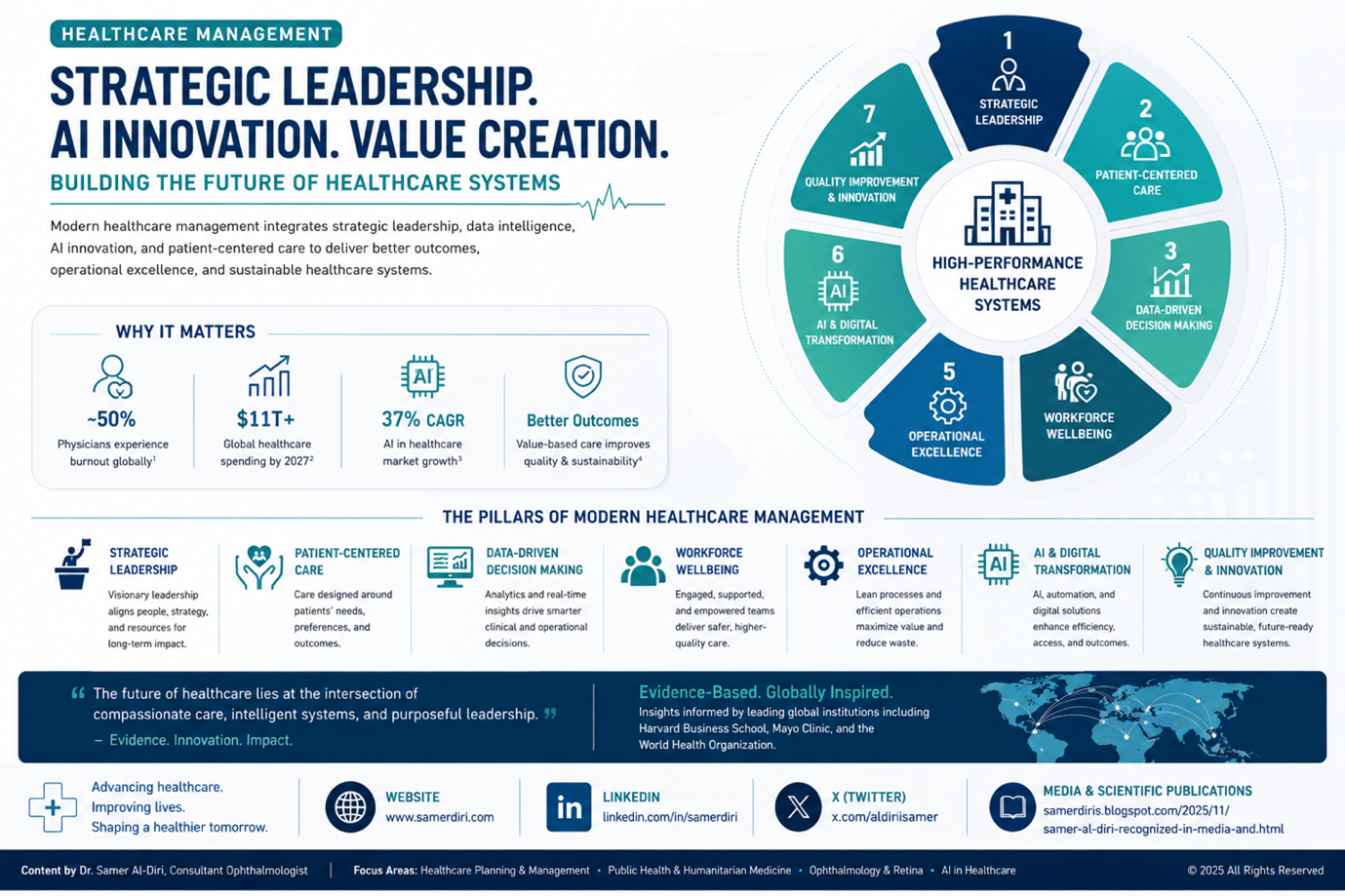
- The 7 Pillars of High-Performance Healthcare Management
- Strategic Leadership Principles
- Healthcare Management in Ophthalmology
- Strategic Case Study
- Future Skills for Healthcare Leaders
- Future Outlook
- Strategic Lessons
- Common Healthcare Management Failures
- Key Takeaways
- Questions & Answers
- Academic References
- Conclusion
Executive Summary
Healthcare management is undergoing one of the most significant transformations in modern medical history. The convergence of Artificial Intelligence (AI), digital health systems, value-based healthcare, healthcare analytics, workforce resilience, and operational intelligence is fundamentally reshaping how healthcare organizations function globally.
Modern healthcare institutions are no longer evaluated solely by service volume or financial performance. Increasingly, healthcare systems are assessed based on patient outcomes, healthcare quality, operational efficiency, workforce sustainability, digital innovation, healthcare equity, and long-term value creation.
This article explores the strategic foundations of modern healthcare leadership, including healthcare systems engineering, AI-powered healthcare administration, healthcare analytics, workforce wellbeing, and patient-centered healthcare delivery.
“The future of healthcare operation strategy will depend not only on technological advancement, but on how effectively healthcare systems integrate human-centered leadership with operational intelligence and ethical innovation.”
Healthcare leaders today must simultaneously manage increasing patient expectations, workforce shortages, rising healthcare costs, digital disruption, cybersecurity risks, regulatory complexity, and accelerating technological innovation.
Why Healthcare Management Matters More Than Ever
Healthcare systems worldwide are currently facing unprecedented operational and strategic pressures.
- Aging populations
- Rising chronic disease burden
- Workforce shortages and burnout
- Escalating healthcare expenditures
- Complex regulatory environments
- Healthcare inequities
- Digital transformation demands
- Increasing patient expectations
According to recent healthcare workforce analyses, physician burnout has affected nearly 40–50% of healthcare professionals in some healthcare environments.
Modern healthcare leadership increasingly requires expertise in organizational strategy, healthcare economics, leadership psychology, clinical systems management, healthcare analytics, digital transformation, crisis management, healthcare governance, and operational efficiency.
The Shift Toward Value-Based Healthcare
One of the most transformative developments in modern healthcare systems is the transition from volume-based healthcare toward value-based healthcare models.
| Traditional Healthcare Management | Modern Healthcare Management |
|---|---|
| Volume-focused healthcare delivery | Value-based healthcare |
| Reactive care models | Preventive and predictive care |
| Fragmented departments | Integrated multidisciplinary systems |
| Limited use of analytics | Data-driven operational intelligence |
| Administrative leadership | Strategic transformational leadership |
| Manual operational systems | AI-powered healthcare administration |
| Short-term operational focus | Long-term sustainability planning |
| Institution-centered systems | Patient-centered healthcare models |
Modern healthcare systems increasingly prioritize better patient outcomes, preventive healthcare, reduced complications, long-term population health improvement, patient satisfaction, and sustainable operational performance.
Traditional vs Modern Healthcare Management
Healthcare transformation has evolved into a highly sophisticated discipline that combines clinical operations, strategic planning, healthcare economics, operational intelligence, healthcare analytics, population health strategy, and digital transformation.
Healthcare organizations capable of integrating these dimensions effectively are increasingly becoming global benchmarks for healthcare excellence, institutional resilience, operational agility, and sustainable healthcare delivery.
The 7 Pillars of High-Performance Healthcare Management
1. Strategic Leadership and Organizational Vision
The world’s highest-performing healthcare institutions operate with clear long-term strategic direction.
- Anticipating healthcare trends
- Building resilient healthcare systems
- Aligning organizational goals with population health needs
- Encouraging innovation
- Creating adaptive institutional cultures
- Supporting workforce resilience
During the COVID-19 pandemic, healthcare organizations with strong leadership structures adapted rapidly by expanding telemedicine services, accelerating digital transformation, dynamically reallocating clinical resources, and improving crisis communication systems.
2. Patient-Centered Care Models
Modern healthcare systems increasingly prioritize patient-centered healthcare delivery.
- Designing care pathways around patient needs
- Reducing waiting times
- Enhancing communication
- Improving continuity of care
- Coordinating multidisciplinary services
- Improving patient experience
Healthcare systems organized around patient needs consistently demonstrate higher patient satisfaction, improved healthcare outcomes, and reduced long-term healthcare costs.
3. Healthcare Equity and Sustainable Care Delivery
Modern healthcare leadership must also address healthcare equity and disparities in access to care.
- Geography
- Socioeconomic status
- Preventive healthcare access
- Healthcare literacy
- Digital accessibility
Organizations integrating equity-focused healthcare planning are more likely to achieve stronger population health outcomes, greater institutional trust, and improved healthcare sustainability.
4. Data-Driven Decision Making and Healthcare Analytics
Modern healthcare organizations increasingly rely on healthcare analytics and operational intelligence for clinical and organizational decision-making.
- Electronic Health Records (EHRs)
- Predictive analytics
- AI-assisted forecasting
- Population health dashboards
- Real-time operational metrics
- Outcome measurement systems
Common healthcare performance indicators include hospital readmission rates, surgical complication rates, emergency department waiting times, patient satisfaction scores, workforce retention, and healthcare outcomes.
5. Workforce Leadership and Burnout Prevention
Healthcare professionals remain the foundation of every healthcare system.
- Psychological safety
- Leadership transparency
- Staff engagement strategies
- Professional development opportunities
- Workload optimization
- Efficient digital workflows
- Workforce wellbeing programs
Healthcare transformation cannot succeed without workforce resilience.
6. Financial Sustainability and Operational Efficiency
Financial sustainability remains essential for modern healthcare organizations.
- Lean healthcare methodologies
- Waste reduction
- Process redesign
- Operational efficiency
- Strategic investments
- Outcome-based resource allocation
- Healthcare systems engineering
Operational efficiency and clinical excellence are deeply interconnected.
7. Digital Transformation and Artificial Intelligence in Healthcare Management
Artificial Intelligence is rapidly reshaping digital healthcare ecosystems globally.
- Predictive patient flow analysis
- Bed capacity forecasting
- Staffing optimization
- Revenue cycle management
- Clinical decision support
- Population health analytics
- Operational intelligence systems
- AI-powered healthcare administration
Responsible AI implementation in healthcare requires transparency, ethical governance, patient privacy protection, cybersecurity resilience, and careful human oversight.
Strategic Leadership Principles for Modern Healthcare Organizations
- Long-term strategic planning
- Data-driven operational decision-making
- Workforce-centered leadership
- Ethical digital transformation
- Continuous quality improvement
- Interdisciplinary collaboration
- Patient-centered organizational culture
- Operational adaptability
- Sustainable healthcare planning
- Innovation-oriented governance
Healthcare Management in Ophthalmology and Specialized Care
Clinical systems innovation is increasingly influencing specialized medical disciplines including ophthalmology and retinal care.
- AI-assisted diagnostics
- Integrated imaging systems
- Digital workflow optimization
- Predictive patient monitoring
- Multidisciplinary coordination
- Data-driven healthcare planning
Strategic Case Study: Operational Transformation in Modern Healthcare
A major healthcare institution facing increasing emergency department overcrowding implemented an integrated operational transformation strategy combining predictive analytics, AI-assisted patient flow forecasting, multidisciplinary coordination, and workflow redesign.
The institution demonstrated improved emergency department throughput, reduced waiting times, enhanced patient satisfaction, lower operational bottlenecks, and improved workforce efficiency.
Future Skills for Healthcare Leaders
- Artificial Intelligence literacy
- Digital health systems
- Healthcare analytics
- Change management
- Strategic communication
- Population health planning
- Operational intelligence
- Ethical healthcare innovation
- Healthcare economics
- Workforce leadership
- Cybersecurity awareness
- Systems thinking
Future Outlook: Healthcare Management in the AI Era
The future of healthcare leadership is expected to be increasingly shaped by AI-assisted operational leadership, predictive healthcare ecosystems, intelligent hospital command centers, precision healthcare planning, and advanced healthcare analytics.
- AI-assisted operational leadership
- Predictive healthcare ecosystems
- Intelligent hospital command centers
- Precision healthcare planning
- Workforce augmentation through AI
- Advanced healthcare analytics
- Real-time population health monitoring
- Digitally integrated care pathways
Strategic Lessons from Leading Global Healthcare Institutions
Mayo Clinic
Mayo Clinic developed a Value Creation System focused on organizational alignment, systems engineering, operational efficiency, and healthcare innovation.
Harvard Business School
Harvard’s healthcare management frameworks emphasize value-based healthcare, integrated multidisciplinary care, patient-centered healthcare systems, and strategic organizational alignment.
World Health Organization
The World Health Organization emphasizes universal health coverage, healthcare system resilience, sustainable workforce planning, healthcare equity, and population health integration.
Common Healthcare Management Failures
- Poor communication systems
- Fragmented care pathways
- Weak organizational culture
- Resistance to innovation
- Inadequate data utilization
- Staff disengagement
- Short-term financial thinking
- Lack of strategic planning
Key Takeaways
- Modern healthcare management increasingly depends on strategic leadership and operational intelligence.
- Artificial Intelligence is reshaping healthcare administration and operational workflows globally.
- Workforce wellbeing and organizational resilience are essential for sustainable healthcare systems.
- Value-based healthcare models are progressively replacing traditional systems.
- Healthcare analytics significantly improve organizational performance and patient outcomes.
- Healthcare equity and patient-centered systems are becoming central pillars of healthcare governance.
Questions & Answers
What is the most important principle in modern healthcare management?
The most important principle is creating measurable value for patients through high-quality outcomes, operational efficiency, patient-centered care, and sustainable healthcare delivery.
Why is leadership essential in healthcare organizations?
Healthcare systems are highly complex environments requiring coordinated decision-making, strategic planning, workforce leadership, operational resilience, and adaptive organizational governance.
How does Artificial Intelligence improve healthcare management?
AI improves operational forecasting, workflow optimization, predictive analytics, staffing efficiency, resource allocation, and population health management.
What are the major causes of healthcare organizational failure?
Common causes include weak leadership, workforce burnout, poor communication, resistance to innovation, lack of strategic planning, and inadequate quality measurement systems.
What is value-based healthcare?
Value-based healthcare focuses on improving patient outcomes relative to healthcare costs rather than simply increasing service volume.
Selected Academic References
- Porter ME. Value-Based Healthcare Frameworks — Harvard Business School.
- Teisberg E, Wallace S, O’Hara S. Defining and Implementing Value-Based Healthcare.
- Swensen SJ et al. The Mayo Clinic Value Creation System.
- World Health Organization Health Systems Governance and Financing.
- World Health Organization – Ethics and Governance of Artificial Intelligence for Health.
Conclusion
Healthcare management is rapidly evolving into one of the most strategically important disciplines in modern healthcare systems.
The future of healthcare leadership increasingly depends on integrating operational intelligence, workforce resilience, digital transformation, healthcare analytics, value-based healthcare, and patient-centered innovation into unified healthcare ecosystems.
Healthcare organizations that successfully combine strategic leadership, Artificial Intelligence, healthcare analytics, operational excellence, ethical governance, and compassionate patient care are likely to become the defining healthcare institutions of the next decade.
Transforming Healthcare Through Innovation & Leadership
Discover the future of healthcare systems through strategic leadership, digital transformation, and AI-powered healthcare innovation.
Contact Dr. Samer Al-Diri