


Dr Samer Al-Diri, MD, MSc, MPH
ResearchGate DOI: 10.13140/RG.2.2.26372.08323
Healthcare partnership governance is the system of decision rights, responsibilities, oversight, information flows, performance expectations and escalation mechanisms through which organisations collaborate while preserving accountability for healthcare outcomes.
Modern healthcare organisations increasingly depend on external relationships. Hospitals work with specialist providers, diagnostic companies, laboratories, technology organisations, outsourced service providers, insurers, community organisations and other health systems. These arrangements can expand expertise, increase capacity and improve access. But they also create a management problem that is easily underestimated: when service delivery crosses organisational boundaries, accountability can become less clear precisely when it needs to become stronger.
The central governance question is therefore not simply whether a partnership has been contractually established. It is whether leaders can still answer, without ambiguity: Who is responsible for the patient, the outcome, the risk, the data, the decision and the corrective action when performance fails?
A healthcare organisation may outsource an activity or obtain capability from another provider. It cannot outsource its responsibility to understand whether the resulting care remains safe, effective, accessible and aligned with its strategic purpose.
What is healthcare partnership governance?
Healthcare partnership governance extends beyond contract management.
A contract can define scope, price, deliverables, service standards and legal responsibilities. Governance must additionally determine how organisations make decisions together, how clinical risk is handled, what information leaders receive, how responsibility transfers across organisational boundaries, how disagreements are resolved and what happens when contractual performance appears satisfactory but patient or system outcomes are not.
The World Health Organization increasingly describes modern healthcare delivery through the reality of mixed health systems, in which public, private and other actors contribute to service delivery. WHO’s governance work emphasises strategic intelligence, alignment of structures and incentives, clarity of roles, stewardship, trust and accountability when different organisations participate in healthcare.
A signed agreement establishes a formal relationship. It does not automatically create effective governance.
Partnership does not remove accountability
Responsibility for performing a task and accountability for the consequences of that task are not necessarily the same thing.
A hospital may contract another organisation to provide imaging, laboratory testing, specialist clinical activity, digital infrastructure or other services. Operational responsibility for performing that activity may sit with the partner.
But consider a patient whose externally performed diagnostic test identifies a serious abnormality. Producing the report may be the provider’s responsibility. Who ensures that the result reaches the correct clinician? Who confirms that an abnormal result is acted upon? Who ensures that the patient is not lost between organisations? Who investigates if the result is delayed or overlooked?
The diagnostic transaction may have been completed successfully while the patient pathway has failed.
NHS England’s current Standard Contract framework recognises this complexity through dedicated arrangements for subcontracting clinical services, including formal provisions covering the relationship between providers and associated data-processing responsibilities.
The broader governance lesson applies well beyond one health system: services can be delegated. Accountability must remain visible.
This whole-pathway principle is developed further in Integrated Care Is Strategy: The Executive Operating Model for High-Performance Health Systems, where cross-boundary accountability is treated as part of the operating model rather than a downstream coordination task.
The Five-Interface Partnership Governance Model
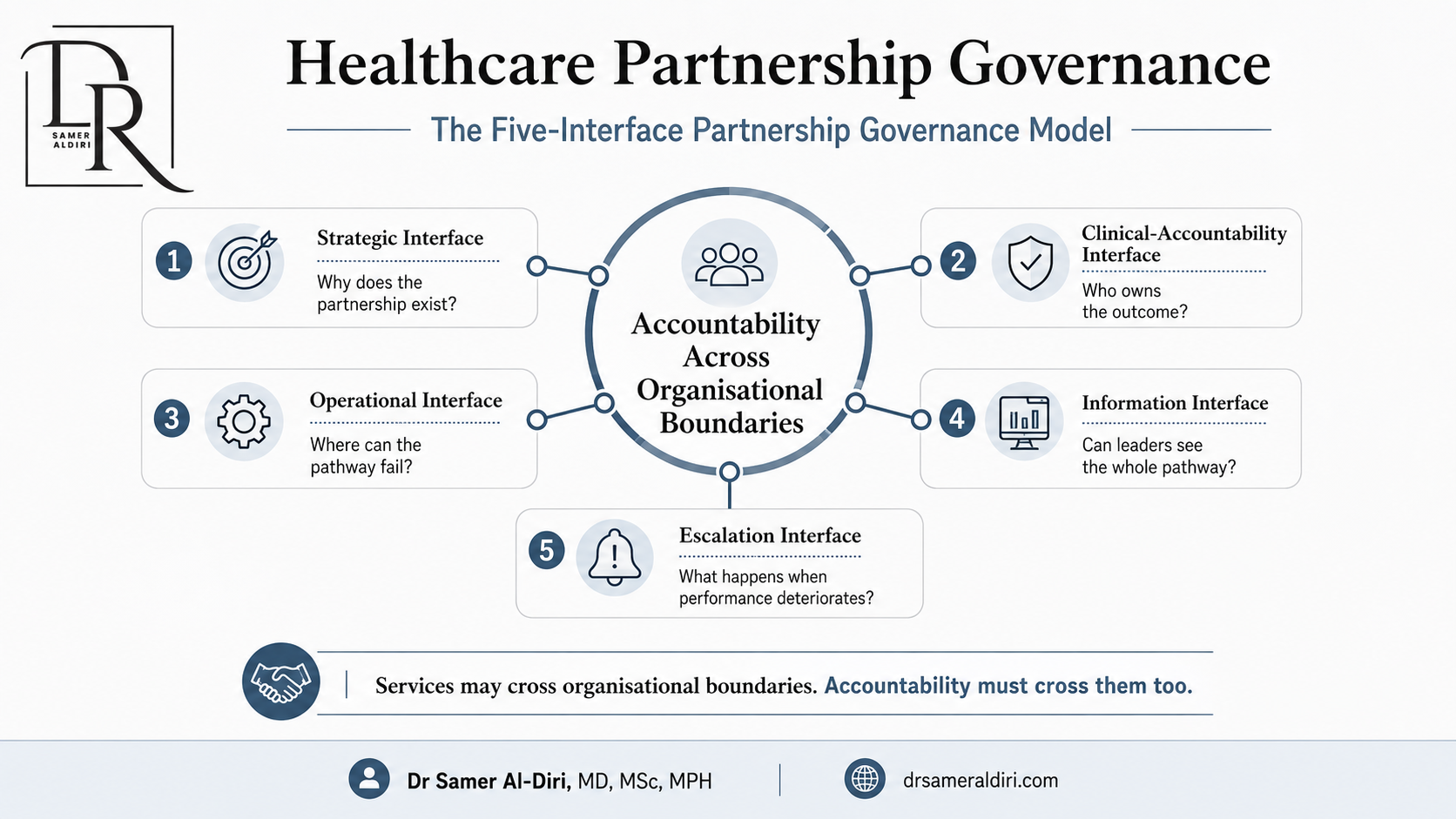
A practical way for healthcare executives and boards to assess a significant partnership is to examine five interfaces at which accountability can become fragmented.
The Five-Interface Partnership Governance Model introduced here considers:
- Strategic interface
- Clinical-accountability interface
- Operational interface
- Information interface
- Escalation interface
The purpose is not to create another contractual checklist. It is to identify the points at which organisational boundaries can become patient-safety, performance or accountability boundaries.
1. The strategic interface: Why does the partnership exist?
Every significant partnership should begin with a strategic problem rather than an available supplier, technology or commercial opportunity.
Is the organisation trying to increase capacity? Improve access? Obtain specialist expertise? Introduce technology? Reduce waiting time? Extend geographic coverage? Improve resilience?
A partnership that has no clearly articulated strategic purpose can become an organisational fixture whose activity continues even after its original rationale has weakened.
Leaders should therefore define the outcome the partnership exists to achieve, not merely the service it has been contracted to deliver.
This distinction matters because activity is not the same as strategic value. A provider may deliver the agreed volume while the underlying access problem remains unresolved. A technology partnership may install a functioning system without improving workflow. An outsourced service may reduce internal workload while creating new downstream delays.
Partnership governance begins by connecting the relationship to a measurable health-system purpose.
2. The clinical-accountability interface: Who owns the outcome?
Clinical accountability becomes especially vulnerable when patient responsibility moves between organisations.
A contract may describe individual components of a service, but patients experience a pathway.
Governance should therefore make explicit who is responsible for referral acceptance, clinical information transfer, result communication, escalation of abnormal findings, treatment activation, follow-up and pathway completion.
The appropriate executive question is not only: Did each provider perform its contracted task? It is: Did the combined partnership reliably deliver the intended patient outcome?
This whole-pathway principle is closely connected to integrated-care governance. Fragmentation often becomes clinically important not inside one organisation, but at the point where responsibility passes from one organisation to another.
3. The operational interface: Where can the pathway fail between organisations?
Many partnership failures occur in the space between organisations.
Common vulnerabilities include unclear referral criteria, incompatible operating procedures, duplicated administrative work, delayed information exchange, different escalation thresholds, uncertainty over appointment ownership, gaps in follow-up and conflicting performance priorities.
Research on healthcare collaboration repeatedly identifies clear decision-making, accountability, trust, shared commitment and the ability to act jointly as important conditions for effective inter-organisational working.
Interface design should therefore be treated as a management responsibility.
Every important transfer point should have an identifiable owner, an expected response, a defined time threshold where appropriate, an escalation route and a mechanism for learning when the interface fails.
This is also a resilience issue. Systems become more vulnerable when leaders understand individual services but cannot see the dependencies connecting them.
4. The information interface: Can leaders see the whole pathway?
A partnership cannot be effectively governed if every organisation sees only its own portion of performance.
A laboratory may report excellent turnaround times while follow-up delays remain invisible. A digital provider may report high platform availability while clinicians struggle to incorporate the technology into routine workflow. An outsourced service may achieve contractual volumes while repeat work, complaints or downstream delays increase somewhere else.
Boards and executive teams therefore need information that crosses organisational boundaries.
- patient outcomes and safety signals;
- access and waiting times;
- pathway completion;
- repeat work and rework;
- complaints and service-recovery patterns;
- continuity failures;
- equity of access;
- data quality; and
- agreed operational and financial measures.
Where artificial intelligence, shared digital infrastructure or automated decision support are involved, the information interface becomes even more important. Data quality, accountability, human oversight and escalation cannot stop at the boundary between the healthcare organisation and its technology partner. These principles are examined in greater depth in Healthcare AI Governance.
The purpose of a partnership dashboard is therefore not merely to demonstrate contractual compliance. It should show whether the combined system is working.
5. The escalation interface: What happens when performance deteriorates?
Governance becomes most visible when normal performance breaks down.
Healthcare leaders should know before a serious failure occurs: Who can intervene? Who investigates? Who has authority to require corrective action? Who communicates with patients or regulators where required? Who can redesign the pathway? At what threshold does a provider-performance problem become an executive issue? And when should the partnership itself be reconsidered?
An arrangement that functions through goodwill during normal conditions but has no clear architecture for challenge, escalation and corrective action remains structurally fragile.
Strong escalation architecture is also central to resilient healthcare systems: organisations need predefined authority, continuity mechanisms and decision routes before disruption occurs rather than trying to create them during failure.
Summary: the five governance interfaces
| Interface | Key executive question | Typical failure signal | Governance response |
|---|---|---|---|
| Strategic | Why does this partnership exist? | Activity continues without measurable strategic value | Reconfirm purpose, outcomes and continuing justification |
| Clinical accountability | Who owns the patient outcome? | Patient lost between organisational responsibilities | Define pathway ownership and clinical escalation |
| Operational | Where can the pathway fail? | Delays, duplication, handover failures or unclear responsibility | Map interfaces and assign ownership |
| Information | Can leaders see the whole pathway? | Each party reports success while overall performance deteriorates | Create shared outcome and pathway visibility |
| Escalation | What happens when performance fails? | Problems circulate without clear authority to act | Define thresholds, decision rights and corrective-action routes |
Contracts are necessary — but relationships still matter
Strong governance does not mean replacing trust with bureaucracy.
Healthcare partnerships operate in complex environments in which every possible future circumstance cannot be anticipated contractually. Professional credibility, transparent communication, mutual understanding and working relationships therefore remain important.
The strongest governance model is neither purely contractual nor purely relational. It combines formal accountability with functional trust.
Contracts define obligations. Relationships allow organisations to solve problems that the contract did not predict.
Trust without accountability can allow problems to remain unchallenged. Control without trust can make collaboration slow, defensive and transactional. Mature partnership governance requires both.
Boards should govern value, not partnership activity
Boards can easily receive reports describing numbers of contracts, partnerships, projects, outsourced services or collaborative initiatives. These measures describe activity. They do not necessarily demonstrate value.
Board oversight should instead ask whether the partnership produces outcomes the organisation could not achieve as effectively alone and whether those outcomes justify the financial, operational and governance complexity created by the relationship.
Value assessment is not always straightforward. Healthcare partnerships may generate benefits across access, quality, workforce capability, resilience, patient experience and financial performance, and those benefits may emerge at different times.
The methodological difficulty of measuring value, however, is not a reason to avoid measuring it.
WHO’s work on public-private and mixed-system governance also highlights that partnerships can introduce both benefits and additional transaction, financing and oversight requirements.
The executive question should therefore move from Do we have a successful partnership? to: What evidence shows that this partnership is creating sufficient health-system value to justify its complexity, cost and risk?
The Seven-Question Executive Partnership Test
Before approving, renewing or materially expanding a healthcare partnership, leaders should be able to answer seven questions clearly.
- Purpose: What strategic problem does this partnership solve?
- Accountability: Who ultimately remains accountable for the patient and the intended outcome?
- Interfaces: Where does responsibility transfer between organisations, and who owns those transfer points?
- Information: Can both parties see the performance of the complete pathway rather than only their own activity?
- Escalation: Who has authority to intervene when performance deteriorates?
- Value: What measurable benefit is being realised beyond contracted activity?
- Exit: What happens to patients, data, workforce, clinical continuity and unfinished pathways if the relationship changes or ends?
If several of these questions cannot be answered clearly, the weakness is unlikely to be merely contractual. It is a governance weakness.
Partnership governance is ultimately patient governance
Healthcare partnerships will continue to expand because modern health systems increasingly depend on expertise, infrastructure and capabilities distributed across multiple organisations.
That evolution can improve access, innovation, specialist capability and resilience.
The risk begins when organisational boundaries become accountability boundaries.
Patients experience healthcare as a journey, not as a collection of contracts. They should not need to understand which company, department or organisation owns each component of their care for that journey to remain safe and coordinated.
Services may cross organisational boundaries. Accountability must cross them too.
The most mature partnerships are not necessarily those with the longest contracts or the greatest number of controls. They are those in which strategic purpose, clinical responsibility, operational interfaces, information and escalation are sufficiently clear that every participating organisation understands both what it must deliver and what the wider system is trying to achieve.
Partnership governance is not an administrative layer added to collaboration. It is the mechanism that turns collaboration into reliable healthcare.
Frequently asked governance questions
What is healthcare partnership governance?
Healthcare partnership governance is the system of decision rights, responsibilities, oversight, information flows and escalation mechanisms through which healthcare organisations collaborate while maintaining accountability for outcomes. It goes beyond contract management by governing how organisations make decisions, manage risk, share information and respond when performance fails.
How is partnership governance different from contract management?
Contract management focuses primarily on agreed obligations such as scope, price, deliverables and service levels. Partnership governance addresses the wider relationship: clinical accountability, shared decisions, pathway interfaces, performance visibility, escalation and whether the partnership is producing the intended patient and health-system outcomes.
Who remains accountable when healthcare services are outsourced?
Operational responsibility for a service may be transferred to another provider, but accountability for understanding whether patients continue to receive safe, effective and coordinated care does not disappear. Healthcare leaders must ensure that responsibility for referral, communication, escalation and follow-up remains explicit across organisational boundaries.
What are the five interfaces healthcare leaders should govern?
The five interfaces are strategic purpose, clinical accountability, operational handovers, information visibility and escalation. Together they identify where partnership arrangements are most vulnerable to fragmented responsibility and help leaders assess whether collaboration is producing reliable patient and organisational outcomes.
Why can healthcare partnerships fail despite strong contracts?
Contracts cannot predict every operational circumstance. Partnerships often fail at organisational interfaces because of unclear responsibility, delayed information, incompatible processes, different priorities or weak escalation mechanisms. Effective governance therefore combines formal accountability with functional trust and clearly designed ways of solving problems together.
References
- World Health Organization. Progression Pathway for Governance of Mixed Health Systems. Geneva: WHO; 2025.
- World Health Organization. Governance of the Private Healthcare Sector in Low- and Middle-Income Countries: A Scoping Review of Approaches, Effectiveness and Enablers. Geneva: WHO; 2024.
- World Health Organization. Engaging the Private Health Service Delivery Sector Through Governance in Mixed Health Systems. Geneva: WHO; 2020.
- World Health Organization Regional Office for Europe. Public-Private Partnerships for Health Care Infrastructure and Services: Policy Considerations for Middle-Income Countries in Europe. Copenhagen: WHO Regional Office for Europe; 2023.
- NHS England. 2025/26 NHS Standard Contract: Sub-contracts. NHS England; 2025.
- Governance of Public-Private Partnerships for Primary Healthcare in Low- and Lower-Middle-Income Countries, 2000–2023: A Systematic Review.
- Hospital Governance Accountability Structure: A Scoping Review. BMC Health Services Research.
- Unravelling Collaborative Governance Dynamics Within Healthcare Networks: A Scoping Review.
- The Impacts of Collaboration Between Local Health Care and Non-Health Care Organisations and Factors Shaping How They Work: A Systematic Review of Reviews.