
Evidence-Informed Strategic Perspective
Designing the Clinical Architecture for Retinal AI, Genomic Medicine and Real-World Learning
By Dr. Samer Al-Diri, MD, MSc Health Science, MPH
UK-trained Ophthalmologist | Public Health Professional | Strategic Healthcare Consultant
Ophthalmology & Retina | Healthcare Management | Public Health | Responsible Digital Health | Health-System Transformation
Published: 14 September 2026 | Author ORCID: 0009-0004-1908-0714 | Professional profile: LinkedIn
Executive Abstract
Precision ophthalmology is entering a period in which artificial intelligence, genomic medicine and large-scale clinical data are beginning to influence not only how disease is recognised, but how risk is interpreted, patients are stratified and services are organised.
Yet technological capability should not be confused with clinical transformation.
Artificial intelligence can perform remarkably well on defined imaging tasks, but performance can change across populations, devices and clinical environments. Molecular diagnosis has become increasingly important in inherited retinal disease, but genomic information is not equally actionable across common ophthalmic conditions. Real-world data can reveal patterns that conventional trials cannot easily capture, while also introducing challenges involving missingness, interoperability, confounding and representation.
The strategic challenge is therefore larger than adopting new technologies.
This perspective argues that precision ophthalmology should be understood as a clinical operating system: one that connects reliable biological and imaging signals to validated interpretation, accountable clinical decisions, functioning patient pathways, responsible governance and continuous learning.
For healthcare leaders, the central question is no longer simply whether an innovation performs well. It is whether the surrounding health system can translate that performance into safer, more timely, equitable and sustainable vision care.
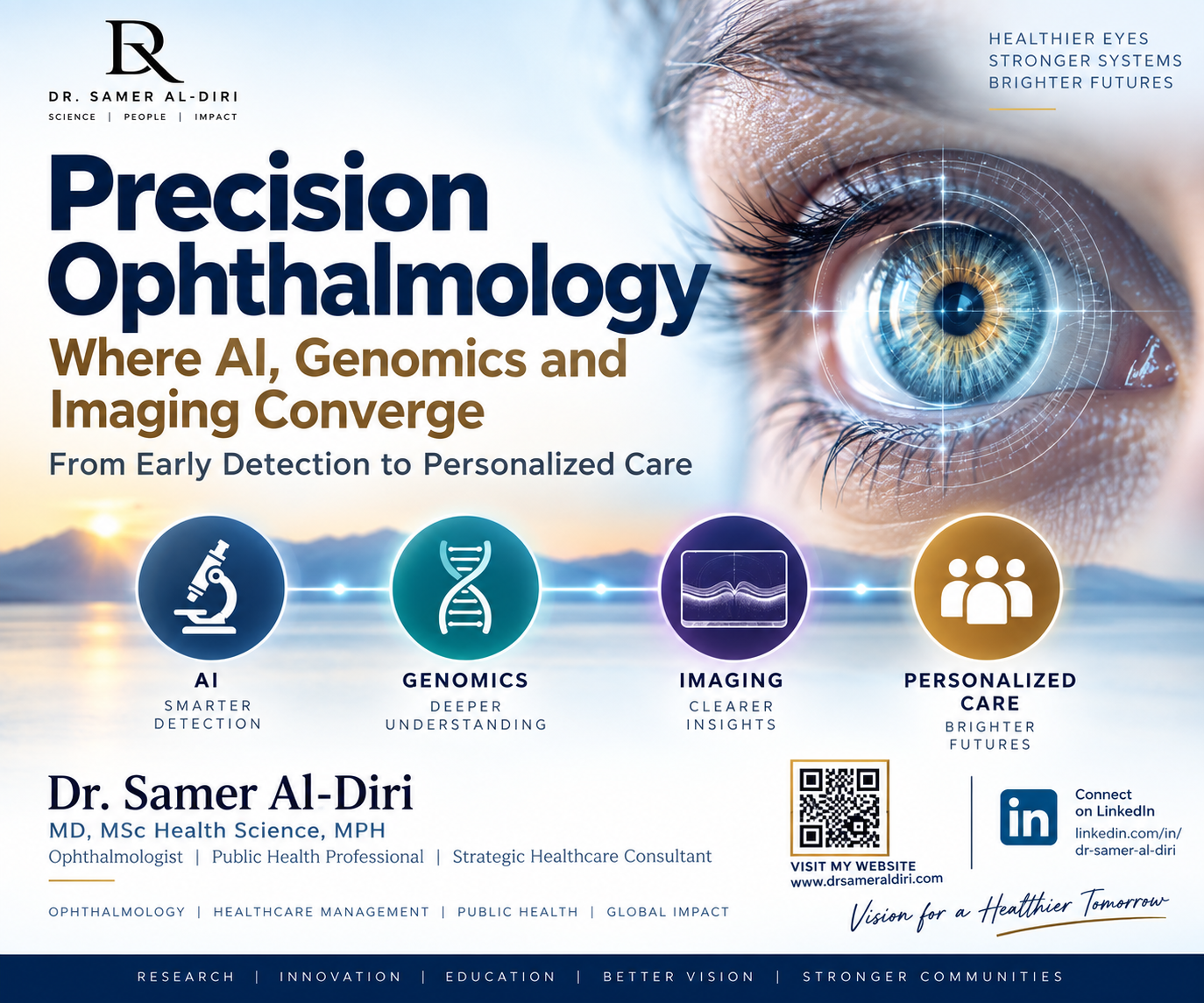
Precision Ophthalmology: The Question Has Changed
Ophthalmology has always been shaped by technology.
The slit lamp altered examination. Microsurgery transformed cataract care. Optical coherence tomography changed retinal assessment by allowing clinicians to visualise structures that previously could only be inferred indirectly.
Artificial intelligence, genomics and large-scale clinical data represent another important transition, but they differ from earlier technologies in one crucial respect.
They do not merely produce better images or measurements. Increasingly, they help interpret information, estimate risk and influence decisions.
That changes the leadership question.
The relevant question is no longer simply: What can the technology do?
It is: What must the clinical system be able to do before that technology creates reliable value for patients?
That distinction is becoming increasingly important as ophthalmology moves from isolated digital tools toward multimodal and potentially learning systems of care.
Artificial Intelligence: From Image Recognition to Clinical Assistance
The strongest evidence for ophthalmic artificial intelligence has historically come from relatively well-defined image-analysis problems.
De Fauw and colleagues demonstrated that a deep-learning system analysing three-dimensional OCT scans could generate referral recommendations for retinal disease at a level comparable with experts in the study environment. Importantly, that work was based on 14,884 OCT scans, rather than the much broader claims sometimes associated with early ophthalmic AI literature.1
Autonomous diabetic-retinopathy systems subsequently demonstrated that carefully validated algorithms could move beyond specialist eye clinics and into primary-care screening pathways.2 Reviews of the field have also documented the rapid development of deep learning across retinal imaging and other ophthalmic applications.3
These achievements matter. But they should not be interpreted as evidence that ophthalmic AI is uniformly superior to clinicians or ready for unrestricted autonomous practice.
Performance is conditional.
It depends on the population being examined, disease prevalence, image quality, equipment, thresholds, workflow and what happens when the algorithm is uncertain. Real-world implementation research has demonstrated that apparently routine operational factors—including image acquisition and workflow constraints—can materially affect the usefulness of an otherwise capable system.5
Algorithmic accuracy is not the same as clinical effectiveness.
From narrow algorithms to foundation models
The scientific frontier is now moving further.
Rather than developing a separate model for every disease or imaging task, researchers are developing foundation models trained on large quantities of ophthalmic data and subsequently adapted to multiple downstream applications.
RETFound, for example, was pretrained using approximately 1.6 million unlabelled retinal images and subsequently adapted to diagnostic and prognostic tasks.6
More recently, EyeFM extended this concept into multimodal clinical assistance. In a 2025 randomized controlled study, ophthalmologists assisted by EyeFM demonstrated improved diagnostic and referral performance within the study setting.7
These results are important, but the boundaries of the evidence matter just as much as the headline.
The randomized component was conducted in a defined population and clinical environment. It does not establish universal effectiveness across all eye diseases, healthcare systems or populations. A 2026 review of ophthalmic foundation models similarly emphasised continuing challenges involving generalisability, multimodal integration, interpretability and clinical translation.8
The mature conclusion is therefore neither that AI will replace ophthalmologists nor that it is merely technological hype.
It is that ophthalmologists are increasingly likely to work with computational systems whose clinical value will depend on how carefully they are validated, governed and integrated.
Prediction Is Not Yet Prevention
One of the most compelling applications of retinal AI is disease prediction.
Yim and colleagues demonstrated that deep learning applied to OCT could identify patients at increased risk of conversion to exudative age-related macular degeneration in the fellow eye within a six-month period.4
That is scientifically important.
It does not, however, mean that predictive AI has already become routine preventive ophthalmology.
A prediction becomes clinically valuable only when several additional questions can be answered:
- Is the prediction sufficiently accurate in the population where it will be used?
- Is the model appropriately calibrated?
- Does knowing the risk alter management?
- Does intervention at that point improve patient outcomes?
- What are the consequences of false reassurance or excessive referral?
- Can the clinical service accommodate the additional surveillance generated?
This distinction between prediction and actionability is fundamental.
Medicine does not create value by identifying risk alone. Value arises when risk information can be converted into an intervention or pathway that improves an outcome important to the patient.
Genomic Medicine: Precision Where the Biology Is Actionable
Genomic medicine presents a similar need for precision in our language.
There is strong evidence that molecular diagnosis has transformed the management of inherited retinal diseases. Gene panels, exome sequencing and increasingly broader sequencing approaches can help establish molecular diagnoses, refine counselling, identify eligibility for clinical trials and, for selected disorders, determine eligibility for gene-directed treatment.9
Voretigene neparvovec-rzyl established an important precedent by translating molecular diagnosis into an approved gene-replacement treatment for patients with confirmed biallelic RPE65 mutation-associated retinal dystrophy who meet the relevant clinical criteria.1012
The scientific trajectory continues.
In a phase 1–2 study published in the New England Journal of Medicine, in vivo CRISPR-Cas9 editing with EDIT-101 was evaluated in 14 participants with a specific CEP290-associated inherited retinal degeneration.11
The study supported further investigation. It did not establish routine gene-editing treatment.
Precision medicine should remain clinically precise
The growing prominence of genomics creates a temptation to describe all ophthalmology as genomically personalised.
The evidence does not justify that.
For age-related macular degeneration, the 2025 American Academy of Ophthalmology Preferred Practice Pattern states that routine genetic testing is not supported by the existing literature and is not currently recommended.13
Similarly, the 2026 Primary Open-Angle Glaucoma Preferred Practice Pattern states that, apart from specific inherited contexts such as children of patients with juvenile open-angle glaucoma, routine genetic testing for POAG risk alleles is not recommended.14
The correct strategic lesson is therefore not that every ophthalmic patient requires genomic profiling.
Genomic information creates its greatest clinical value when molecular diagnosis meaningfully changes diagnosis, counselling, surveillance, trial eligibility or treatment.
That is a more clinically defensible definition of precision medicine.
Real-World Data: From Records to Learning
Clinical trials remain indispensable because they are designed to answer defined questions while controlling important sources of bias.
They cannot answer every question.
Rare outcomes, long-term treatment patterns, geographic variation, heterogeneous populations and routine clinical behaviour may become clearer only after treatments and technologies move into wider practice.
This is where real-world data can add substantial value.
The American Academy of Ophthalmology’s IRIS Registry has supported analyses of patient populations, disease patterns, treatment outcomes, complications, risk factors, practice variation and trends at a scale difficult to reproduce through conventional single-centre studies.15
But a large database is not automatically a learning health system.
Clinical records are created primarily to care for patients, not to satisfy research protocols. They may contain missing information, inconsistent coding, varying measurement techniques and systematic differences between institutions.
Ophthalmology has an additional challenge: its clinical information is unusually dependent on laterality, structured measurements, imaging modalities and device-specific outputs.
Research mapping ophthalmic examination data into the Observational Medical Outcomes Partnership common data model has demonstrated significant gaps in the ability of existing health-data vocabularies to represent eye-care information with full precision.16
Data volume cannot substitute for data meaning.
The strategic priority is therefore not merely to collect more information. It is to develop data environments in which information is sufficiently standardised, interoperable, traceable and clinically meaningful to support responsible analysis.
A Clinical Translation Architecture for Precision Ophthalmology
The convergence of retinal AI, genomic medicine and real-world data suggests a useful management principle:
Precision ophthalmology should be designed as a system rather than purchased as a collection of technologies.
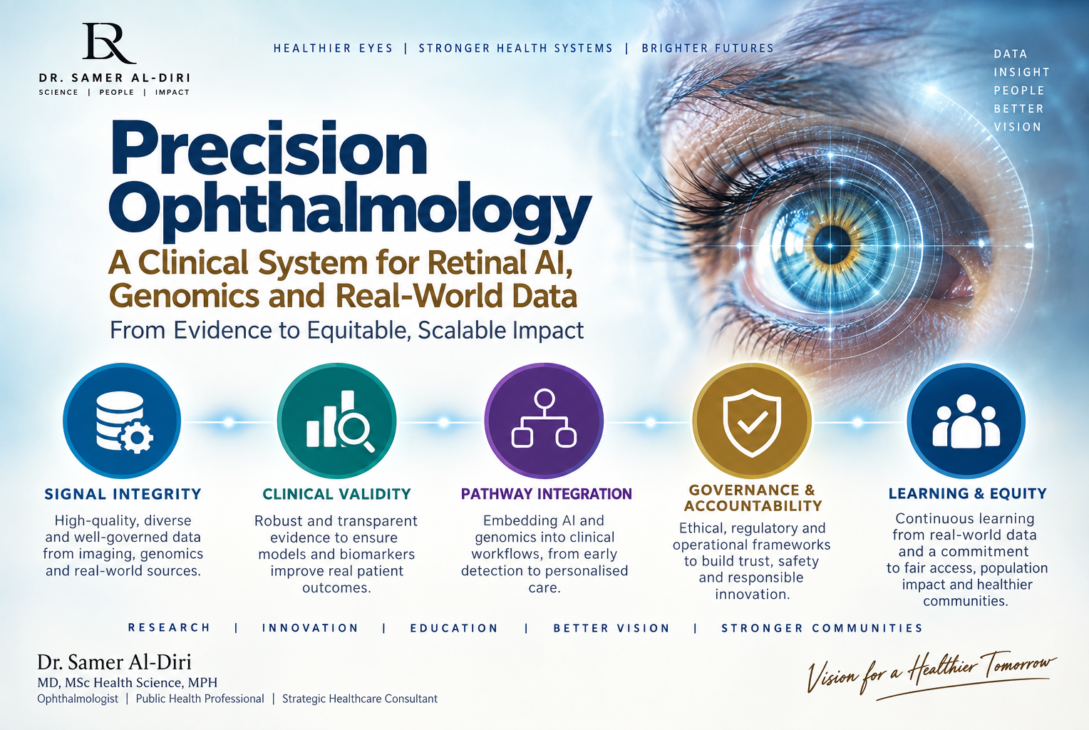
I propose five connected layers through which new ophthalmic technologies can be evaluated. This is a strategic translation framework rather than a validated clinical standard.
1. Signal Integrity
Everything begins with the quality of the underlying signal.
That signal may include:
- optical coherence tomography;
- fundus photography;
- visual-field testing;
- electrophysiology;
- genomic sequencing;
- laboratory information;
- clinical examination; and
- patient-reported outcomes.
Before asking what an algorithm or genomic platform can infer, organisations must ask whether the source information is reliable, standardised and sufficiently representative.
Poor signals produce sophisticated errors.
2. Clinical Validity
The next question is whether interpretation of that signal performs reliably.
For AI, this means more than reporting a single performance statistic. External validation, calibration, sensitivity, specificity, subgroup performance, failure modes and clinically appropriate thresholds matter.
For genomic medicine, it means distinguishing pathogenic findings from uncertain variants and understanding whether molecular information meaningfully changes clinical management.
The essential question is:
Can we trust the inference sufficiently for the decision being considered?
3. Pathway Integration
Even a clinically valid technology can fail if it does not fit the patient pathway.
A diabetic-retinopathy screening algorithm is useful only if actionable results lead to reliable referral. A molecular diagnosis is useful only if appropriate counselling, specialist review and treatment or trial pathways exist. A predictive model is useful only if clinicians know what action follows a high-risk result.
Every implementation should therefore define:
- the entry point;
- the responsible clinician or team;
- the escalation pathway;
- the confirmation process;
- the follow-up mechanism; and
- the exception pathway.
Technology without pathway ownership creates information without accountability.
4. Governance and Human Accountability
The more sophisticated a system becomes, the more important its governance becomes.
Healthcare organisations need clarity around:
- clinical responsibility;
- patient consent and communication;
- privacy and cybersecurity;
- algorithmic or genomic uncertainty;
- bias and subgroup performance;
- human oversight;
- adverse-event reporting;
- model and software updates;
- vendor accountability; and
- auditability.
Governance should not be treated as a barrier to innovation. Proper governance creates the conditions in which innovation can be trusted.
This principle aligns with my wider work on healthcare AI governance, institutional leadership and patient-centred accountability .
5. Learning and Equity
The final layer is continuous evaluation after implementation.
Organisations should monitor not only whether a technology performs as expected, but whether it produces the outcome it was introduced to improve.
Relevant measures may include:
- time to diagnosis;
- referral completion;
- treatment initiation;
- visual outcomes;
- false-positive and false-negative pathways;
- ungradable examinations;
- clinician workload;
- patient experience;
- cost and resource use; and
- access across demographic and geographic groups.
This final dimension is particularly important.
A technology that improves outcomes for patients already well connected to specialist services while widening access gaps elsewhere should not automatically be described as transformational.
Precision medicine that is accessible only to selected populations can inadvertently produce precision inequality.
The Metric That Matters Is Not Accuracy Alone
Healthcare executives will increasingly encounter impressive technical performance statistics.
Accuracy matters, but it is only one component of healthcare value.
A system with marginally lower technical performance but high accessibility, reliable referral completion and strong patient acceptance may create more population benefit than a technically superior system that cannot be integrated into routine care.
Leaders should therefore evaluate ophthalmic innovation across several dimensions simultaneously:
- Clinical performance: Does it identify what matters?
- Operational performance: Does it work in the real clinical pathway?
- Patient value: Does it improve outcomes or experience?
- Equity: Who benefits, and who remains excluded?
- Economic sustainability: Can the service continue to support it?
- Governance: Can failures be detected, explained and corrected?
This is where healthcare management becomes inseparable from technological innovation.
Four Distinctions Ophthalmology Must Preserve
Innovation is not evidence
A technically impressive system may still lack prospective clinical validation.
Prediction is not actionability
Knowing who is at risk does not automatically mean that changing management improves outcomes.
Association is not causation
Real-world datasets can reveal patterns at enormous scale, but observational associations remain vulnerable to confounding, selection effects and bias.
Genetic detectability is not genetic treatability
Identifying a molecular abnormality does not mean that a clinically effective targeted therapy exists.
These distinctions are not arguments against innovation. They are the disciplines that allow innovation to mature.
The Human Value of Precision
The term “precision medicine” can sound technological.
Its real purpose should be human.
A patient with progressive retinal disease is not seeking a foundation model, genomic panel or registry.
The patient wants to preserve vision.
Technology becomes meaningful only when it reduces uncertainty, shortens the path to appropriate care, improves a treatment decision, prevents avoidable deterioration or helps someone live more independently.
The objective is therefore not to build an ophthalmology service in which machines know more.
It is to build one in which patients benefit from what the combined clinical system knows.
Human judgement remains central because medicine does not consist only of classification.
It involves communicating uncertainty, balancing alternatives, understanding individual priorities and accepting responsibility for decisions.
The strongest future model is therefore unlikely to be clinician versus machine.
It is more likely to be clinician, patient and technology working within a better-designed system.
Conclusion: The Real Transformation Is Organisational
Artificial intelligence, genomic medicine and real-world data are each reshaping parts of ophthalmology.
Their convergence could be considerably more important.
But convergence will not occur merely because technologies become more powerful.
Health systems must build the architecture that connects them.
That requires reliable data, clinically valid interpretation, accountable pathways, multidisciplinary capability, responsible governance and continuous measurement of outcomes and equity.
This is why precision ophthalmology should be understood not as a technology portfolio, but as an operating model for better care.
The institutions that lead this transition will not necessarily be those that acquire the newest algorithms first.
They will be those that become best at distinguishing evidence from enthusiasm, prediction from actionability, information from knowledge and technological performance from genuine patient value.
The ultimate measure of progress will therefore not be how sophisticated ophthalmic technology becomes.
It will be whether health systems can translate that sophistication into earlier diagnosis, more appropriate treatment, preserved vision and more equitable access to sight-saving care.
This health-system perspective also complements my analysis Reading Health-System Performance Through Eye Care , which examines how ophthalmic services can reveal wider questions of capacity, equity, continuity, digital assurance and outcomes.
Evidence and Scope Note
This article is an evidence-informed strategic perspective, not a systematic review, scoping review or clinical practice guideline.
It synthesises selected peer-reviewed clinical studies, contemporary reviews, professional guidelines, regulatory information and health-system evidence relevant to artificial intelligence, genomic medicine, real-world data and ophthalmic service design.
The field is evolving rapidly. Regulatory status, algorithm performance, genomic interpretation and clinical recommendations may change as new evidence emerges. Technologies discussed as investigational should not be interpreted as established standards of clinical care.
This article is intended for professional education, healthcare leadership discussion and strategic analysis. It does not constitute individual clinical guidance.
Related Work by Dr. Samer Al-Diri
- Healthcare AI Governance: Institutional Leadership, Workforce Readiness and Patient-Centred Accountability
- Reading Health-System Performance Through Eye Care
- Age-Related Macular Degeneration: Population Ageing, Health-System Impact, Artificial Intelligence and Sustainable Vision Care
- Artificial Intelligence in Ophthalmology: Transforming Retina Care, OCT Imaging and Precision Eye Health
References
- De Fauw J, Ledsam JR, Romera-Paredes B, et al. Clinically applicable deep learning for diagnosis and referral in retinal disease. Nature Medicine. 2018;24:1342–1350. doi:10.1038/s41591-018-0107-6.
- Abràmoff MD, Lavin PT, Birch M, Shah N, Folk JC. Pivotal trial of an autonomous AI-based diagnostic system for detection of diabetic retinopathy in primary care offices. npj Digital Medicine. 2018;1:39. doi:10.1038/s41746-018-0040-6.
- Ting DSW, Pasquale LR, Peng L, et al. Artificial intelligence and deep learning in ophthalmology. British Journal of Ophthalmology. 2019;103:167–175. doi:10.1136/bjophthalmol-2018-313173.
- Yim J, Chopra R, Spitz T, et al. Predicting conversion to wet age-related macular degeneration using deep learning. Nature Medicine. 2020;26:892–899. doi:10.1038/s41591-020-0867-7.
- Beede E, Baylor E, Hersch F, et al. A human-centered evaluation of a deep learning system deployed in clinics for the detection of diabetic retinopathy. Proceedings of the 2020 CHI Conference on Human Factors in Computing Systems. 2020:1–12. doi:10.1145/3313831.3376718.
- Zhou Y, Chia MA, Wagner SK, et al. A foundation model for generalizable disease detection from retinal images. Nature. 2023;622:156–163. doi:10.1038/s41586-023-06555-x.
- Wu Y, Qian B, Li T, et al. An eyecare foundation model for clinical assistance: a randomized controlled trial. Nature Medicine. 2025;31:3404–3413. doi:10.1038/s41591-025-03900-7.
- Gharbi K, van Wijngaarden P, Hadoux X. Foundation models for ophthalmic imaging. Survey of Ophthalmology. 2026;71:1129–1147. doi:10.1016/j.survophthal.2026.01.004.
- Kang S, Lam BL, Lee W, et al. Genetic Testing in Inherited Retinal Disease: Current Strategies and Future Directions. Journal of Personalized Medicine. 2026;16:288. doi:10.3390/jpm16060288.
- Russell S, Bennett J, Wellman JA, et al. Efficacy and safety of voretigene neparvovec in patients with RPE65-mediated inherited retinal dystrophy: a randomised, controlled, open-label, phase 3 trial. The Lancet. 2017;390:849–860. doi:10.1016/S0140-6736(17)31868-8.
- Pierce EA, Aleman TS, Jayasundera KT, et al. Gene Editing for CEP290-Associated Retinal Degeneration. New England Journal of Medicine. 2024;390:1972–1984. doi:10.1056/NEJMoa2309915.
- US Food and Drug Administration. LUXTURNA (voretigene neparvovec-rzyl): treatment of patients with confirmed biallelic RPE65 mutation-associated retinal dystrophy. FDA product information.
- Vemulakonda GA, Bailey ST, Kim SJ, et al. Age-Related Macular Degeneration Preferred Practice Pattern®. Ophthalmology. 2025;132:P1–P74. doi:10.1016/j.ophtha.2024.12.018.
- Gedde SJ, Bowden EC, Challa P, et al. Primary Open-Angle Glaucoma Preferred Practice Pattern®. Ophthalmology. 2026;133:P1–P103. doi:10.1016/j.ophtha.2025.12.029.
- Pershing S, Lum F. The American Academy of Ophthalmology IRIS Registry (Intelligent Research In Sight): current and future state of big data analytics. Current Opinion in Ophthalmology. 2022;33:394–398. doi:10.1097/ICU.0000000000000869.
- Cai CX, Halfpenny W, Boland MV, et al. Advancing Toward a Common Data Model in Ophthalmology: Gap Analysis of General Eye Examination Concepts to Standard Observational Medical Outcomes Partnership Concepts. Ophthalmology Science. 2023;3:100391. doi:10.1016/j.xops.2023.100391.
- World Health Organization. Eye Care in Health Systems: Guide for Action. Geneva: World Health Organization; 2022. WHO publication.
About the Author
Dr. Samer Al-Diri, MD, MSc Health Science, MPH, is a UK-trained ophthalmologist, public-health professional and strategic healthcare consultant. His work connects ophthalmology and retinal care with healthcare management, health-system transformation, clinical governance, prevention and responsible digital innovation.
His evidence-informed professional analyses examine how clinical evidence, technology, governance and service design can be translated into safer patient pathways, stronger organisational accountability and more sustainable healthcare delivery.
Professional profiles: Author profile | ORCID | LinkedIn | Publications
Suggested Citation
Al-Diri S. Precision Ophthalmology: Building the Clinical System for Retinal AI, Genomics and Real-World Data: Designing the Clinical Architecture for Retinal AI, Genomic Medicine and Real-World Learning. DrSamerAlDiri.com. Published 14 September 2026. Available at: https://drsameraldiri.com/precision-ophthalmology-ai-genomics-data/ .
Author ORCID: 0009-0004-1908-0714
Original publication: DrSamerAlDiri.com | Author: Dr. Samer Al-Diri | Publication date: 14 September 2026
© 2026 Dr. Samer Al-Diri.