
By Dr. Samer Al-Diri, MD, MSc Ophthalmology: Retina (UCL), MPH
MD | Master of Science in Ophthalmology: Retina, University College London (UCL) | MPH (Merit), City, University of London
Evidence-Informed Public Health Perspective | Ophthalmology · Population Health · Health Systems
Publication date: 6 October 2026
Author ORCID: 0009-0004-1908-0714 | Official website: drsameraldiri.com
Repository version: Zenodo author preprint
Full-text author PDF: Download the full author PDF
Open Access | CC BY-NC-ND 4.0
Key Points
- Screening coverage, amblyopia prevalence, diagnostic yield and treatment outcomes answer different questions and require different denominators.
- A failed vision screen or amblyogenic risk factor is not the same as clinically confirmed amblyopia; diagnosis is not the same as outcome.
- Children who were never screened, never completed diagnostic assessment or have unknown outcomes should not silently disappear from population measurement.
- Population intelligence requires appropriate use of screening data, clinical records, linked information systems and representative population evidence.
- This article proposes a six-stage conceptual hierarchy: define the population, measure ascertainment, confirm cases, characterise burden, ascertain outcomes and examine population trends.
Contents
- When a treatable condition becomes difficult to see at population level
- There is no single “amblyopia denominator”
- The denominator problem within screening programmes
- Risk, diagnosis and outcome are different states
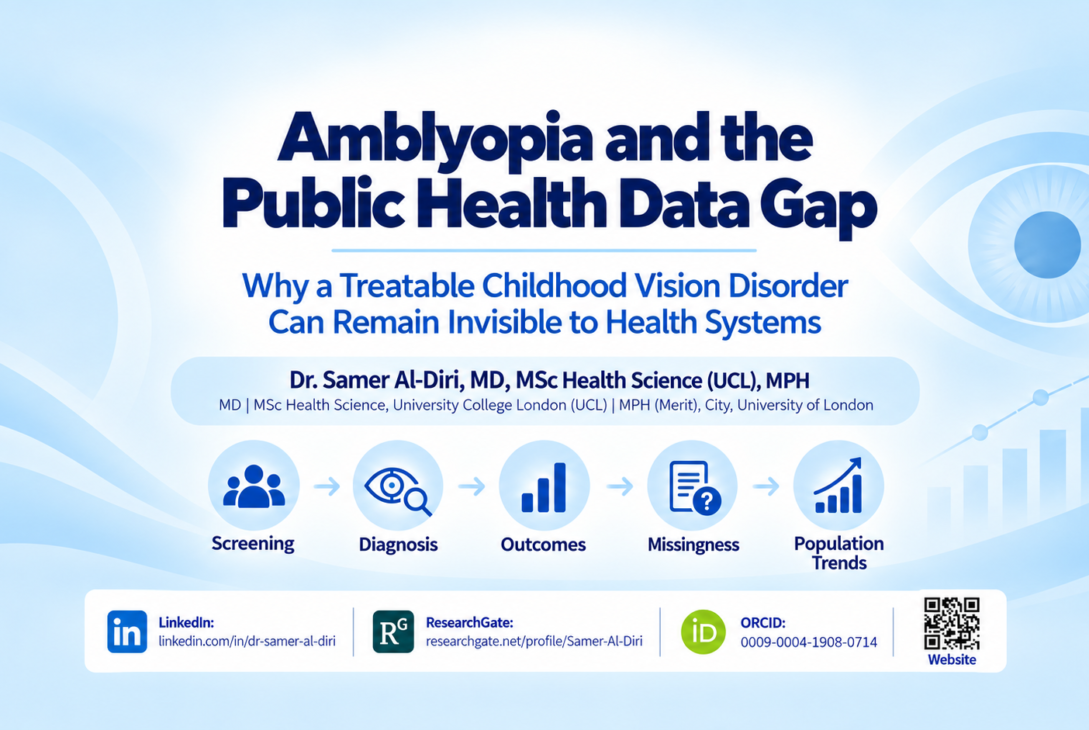
- A proposed hierarchy for amblyopia population measurement
- Missingness is not an empty cell
- Are we measuring what amblyopia actually does?
- Different questions require different data sources
- From data collection to population intelligence
- The health-information architecture behind the eye clinic
- Global eye-care policy already recognises the information problem
- What happens when childhood data ends but amblyopia does not?
- What should an amblyopia population report be able to tell us?
- Scope and limitations of this argument
- From counting services to understanding population benefit
- Conclusion: making the invisible measurable
A country may know how many children received a vision test last year and still not know how many children are living with amblyopia.
That is not necessarily a failure of clinical medicine. It may reveal something different: a failure of population intelligence.
A health system may operate school vision screening, primary-care assessment, optometry services, orthoptic clinics and paediatric ophthalmology departments. It may record thousands—or millions—of encounters. Yet it may still be unable to answer basic public-health questions with confidence.
How many children in the eligible population were actually assessed? How many had amblyogenic risk factors? How many ultimately met defined diagnostic criteria for amblyopia? At what age were they diagnosed? Which groups were incompletely ascertained? How many had documented visual outcomes? And, across comparable cohorts, is the prevalence or severity of persistent amblyopia changing?
These questions are related, but they are not interchangeable.
They concern different populations, require different denominators and may depend on different sources of data.
Amblyopia is a unilateral or, less often, bilateral reduction in best-corrected visual acuity resulting from abnormal visual experience during early visual development, without an ocular structural abnormality sufficient to explain the deficit. Common mechanisms include anisometropic or high bilateral refractive error, strabismus, visual deprivation, and combinations of these.[1]
Clinically, amblyopia is familiar. It is routinely recognised and treated by ophthalmologists, orthoptists and optometrists.
But clinical familiarity is not the same as epidemiological visibility.
A child can be visible to one clinician while remaining poorly represented in the information available to the health system as a whole.
My earlier article, Amblyopia as a Preventable Public Health Failure, examined the architecture of care: how a child moves from identification towards diagnosis, treatment and protected vision. The present article deliberately moves upstream and outward—from the individual care pathway to the epidemiological architecture surrounding it. Its concern is not how care should proceed once a child becomes visible, but whether the health system can determine who is visible, who is missing, what outcomes are known and whether population patterns are changing.
This article is therefore concerned not primarily with how care moves, but with how knowledge moves.
Can a health system determine who is affected, who remains unseen, what happens after diagnosis and whether the population burden is changing?
That distinction—between clinical visibility and population visibility—is the starting point for a different way of thinking about amblyopia.
Core Concept
In this article, the amblyopia public health data gap refers to the difference between the information health systems routinely collect about childhood vision services and the population-level information needed to determine who is affected, who remains unseen, what outcomes are known and whether the burden is changing.
When a treatable condition becomes difficult to see at population level
Amblyopia creates a particular epidemiological challenge.
It may develop without symptoms obvious to the child or family. Diagnosis depends on age-appropriate visual-acuity testing, adequate refractive assessment, ocular alignment, exclusion or interpretation of structural pathology, and identification of a plausible amblyogenic mechanism. The information necessary to understand one child's visual status may therefore be distributed across screening records, community services, optometry, orthoptics and ophthalmology.
At population level, these difficulties multiply.
A 2022 systematic review and meta-analysis included 97 studies involving 4,645,274 children and estimated a pooled worldwide amblyopia prevalence of 1.36%.[2] But the apparent precision of that figure should not obscure the underlying heterogeneity: the reported I² was approximately 98.8%, and the authors also identified evidence of publication bias.
The correct lesson is therefore not that 1.36% should be treated as a universal prevalence that can be transferred uncritically from one population to another.
It is that the word prevalence carries methodological obligations.
Differences in population selection, age, visual-acuity thresholds, diagnostic definitions, examination methods and case ascertainment can materially affect the number reported.
Knowing how many children failed a vision screen is not the same as knowing how many have amblyopia.
Knowing the prevalence of anisometropia, high refractive error or strabismus is not the same as knowing the prevalence of amblyopia.
And knowing how many children attended an eye-care service is not the same as knowing how many affected children exist in the population.
This creates several forms of invisibility.
There is diagnostic invisibility, when screening abnormalities or amblyogenic risk factors are confused with confirmed disease.
There is administrative invisibility, when the same child generates disconnected records across several services and the system cannot reconstruct a coherent episode of care.
There is outcome invisibility, when diagnosis and treatment are recorded but the later visual result is unknown.
And there is population invisibility, when children who never reach screening or clinical services are absent from the routine dataset altogether.
A health system can therefore accumulate large volumes of eye-care data without necessarily acquiring population intelligence.
There is no single “amblyopia denominator”
Public-health interpretation depends on denominators, but one methodological distinction is essential:
different amblyopia questions require different denominators.
Estimating population prevalence requires a representative population denominator and valid case ascertainment.
Measuring screening coverage requires a clearly defined population eligible for that screening programme.
Calculating diagnostic yield requires the population actually screened, referred or examined, depending on the question being asked.
Estimating treatment outcomes requires a defined cohort with confirmed disease and evaluable follow-up.
Assessing population trends requires comparable populations, stable or explicitly harmonised definitions, and sufficient consistency in ascertainment across time.
These measures should inform one another, but they should not be collapsed into a single denominator.
Nor should they be assumed to arise from one information system.
Routine clinical records, screening databases, administrative data, disease-specific registries where appropriate, and periodic representative population studies can answer different questions. They are potentially complementary; they are not interchangeable.
This distinction matters when interpreting apparently impressive activity statistics.
“100,000 children screened” may represent a major operational achievement.
But it does not, by itself, establish screening coverage unless the eligible population is known. It does not establish amblyopia prevalence unless valid diagnostic ascertainment follows. And it does not establish population benefit unless outcomes and population trends are subsequently measured.
Activity demonstrates that services were delivered.
It does not by itself demonstrate that the population burden improved.
The denominator problem within screening programmes
Even when the question is narrowed specifically to screening coverage, the denominator is not trivial.
Who should have been reached?
How many children were offered screening? How many completed it? How many were absent? How many were outside the programme's institutional reach? How many had already received assessment elsewhere? How many moved between jurisdictions? How many failed screening but never completed diagnostic assessment?
These distinctions describe different states of knowledge.
Scotland provides a useful illustrative example because it operates a comprehensive orthoptist-led preschool vision-screening programme. The programme has participation of approximately 85%, involving around 45,000 children annually.[3]
A recent analysis used data from Health Boards covering approximately 87% of Scotland's population. Across the study years, the prevalence of at least one predefined amblyopia risk factor ranged from 4.41% to 5.15%.[3]
Those figures illustrate two methodological disciplines.
First, approximately 85% participation does not make the remaining population irrelevant.
Second, a prevalence of approximately 5% for predefined amblyopia risk factors does not mean that approximately 5% of Scottish children have confirmed amblyopia.
The denominator determines what a statistic can say.
The case definition determines what the numerator means.
Risk, diagnosis and outcome are different states
Amblyopia surveillance therefore requires definitional discipline.
A failed screen is not a diagnosis.
An amblyogenic risk factor is not a diagnosis.
A diagnosis is not an outcome.
And the absence of a later clinical record is not evidence of recovery.
A child with anisometropia may or may not meet criteria for amblyopia.
A child who fails a vision screen may ultimately have refractive error without amblyopia, another ocular disorder, an inconclusive examination, or no clinically significant abnormality.
A child treated for amblyopia may achieve a satisfactory visual result, retain a residual deficit, require further management or become lost to available follow-up.
An information system that collapses these states into a single category loses clinical meaning.
At minimum, measurement should preserve distinctions between:
- screening status;
- screening result;
- amblyogenic risk factor;
- clinically confirmed amblyopia;
- disease characteristics and severity;
- treatment status;
- measured outcome;
- and unknown outcome.
Even the term residual amblyopia requires specification.
It should not be treated as a universal binary endpoint detached from age, visual-acuity criterion, refractive correction, treatment status or timing of assessment. Comparative reporting should therefore define the outcome measure, the relevant threshold, the child's age or developmental stage, and the time point at which the outcome was determined.
Without such definitions, differences between regions or periods may reflect differences in measurement rather than differences in disease.
A rise in recorded amblyopia does not necessarily mean that amblyopia has become more common.
It may mean that the health system has become better at detecting or recording it.
Conversely, a low recorded prevalence is not necessarily reassuring.
It may mean the system is seeing less.
A proposed hierarchy for amblyopia population measurement
The measurement problem can be organised as a six-stage conceptual hierarchy.
This is not a validated international standard, nor is it proposed as a replacement for established eye-health indicator frameworks. It is a way of applying familiar public-health measurement principles specifically to amblyopia.
Stage 1 — Define the population
Who should be represented?
The answer depends on the question. For a screening programme, this may be children within a defined age range and jurisdiction. For a prevalence study, it requires a population capable of supporting valid epidemiological inference.
Stage 2 — Measure ascertainment
Who was actually observed?
This requires more than counting completed examinations. Where feasible, it should distinguish children assessed, children not assessed, and known reasons for non-assessment.
Stage 3 — Confirm cases
Among those requiring diagnostic assessment, who met a prespecified clinical definition of amblyopia?
This stage prevents screening abnormalities and amblyogenic risk factors from being mistaken for disease prevalence.
Stage 4 — Characterise burden
What was found?
Age at diagnosis, laterality, visual acuity, amblyopia mechanism, refractive status, ocular alignment and relevant associated findings describe the burden more meaningfully than a case count alone.
Stage 5 — Ascertain outcomes
What happened after management?
Was an outcome measured? At what time point? Using what criterion? What visual deficit remained?
The important distinction is not simply between “successful” and “unsuccessful” treatment, but between measured outcome and unknown outcome.
Stage 6 — Examine population outcome and trend
Across comparable cohorts, and using sufficiently stable definitions, are the prevalence and severity of persistent amblyopia changing?
Are children being diagnosed at different ages?
Are disparities in ascertainment or documented outcomes changing?
These observations must be interpreted cautiously. A temporal trend can reflect changes in screening, case definition, treatment, population composition, data completeness or health-service access as well as genuine changes in disease burden.
A trend is not automatically evidence of causation.
This is why “we screened 100,000 children” and “the population burden of amblyopia is falling” are fundamentally different claims.
The first concerns activity.
The second requires population-level inference.
Missingness is not an empty cell
One of the most important principles in health-system measurement is that missing information may itself contain information about the system.
A child who was never screened is different from a child who passed screening.
A child who failed screening but never underwent diagnostic assessment is different from a child in whom amblyopia was excluded.
A child with diagnosed amblyopia whose later visual status is unknown is different from a child whose visual acuity improved.
If an information system collapses all of these situations into blank fields, it becomes impossible to distinguish clinical absence from administrative absence.
This becomes especially important when considering equity.
In the 2026 Scottish analysis, children in the most deprived quintile had 39% to 60% higher odds of referral following screening failure than children in the middle deprivation quintile across the study years. Yet the prevalence of the predefined amblyopia risk factors was not significantly associated with deprivation.[3]
The mechanism behind this difference in referral was not established by the study.
That distinction is important.
It would be inappropriate to infer that socioeconomic deprivation biologically causes amblyopia or treatment resistance from these data.
A separate Scottish retrospective cohort of 430 children who failed preschool vision screening found that children from more deprived areas or adverse home circumstances were more likely to attend poorly or become lost to follow-up. Worse home circumstances were also associated with greater odds of residual amblyopia at discharge.[4]
A small single-centre US retrospective study provides another useful, but limited, illustration. Insurance status was used as a proxy for socioeconomic position. Among children who remained in follow-up, visual-acuity improvement was similar in those with Medicaid and private insurance, whereas immediate loss to follow-up was more frequent among children with Medicaid—28.4% versus 10.3% in the study's loss-to-follow-up analysis.[5]
These studies come from particular high-income health systems and should not be treated as universally representative.
But together they support a more careful proposition:
socioeconomic circumstances may influence who is reached, who progresses through assessment, who remains engaged and whose outcome remains visible.
That makes equity partly a question of ascertainment and data completeness.
The absence of a record is not the same as the absence of disease.
Are we measuring what amblyopia actually does?
Visual acuity remains central to the diagnosis and management of amblyopia.
Any population framework that obscures this would become less clinically meaningful, not more sophisticated.
But visual acuity may not describe every aspect of functional experience.
A 2025 review summarised evidence relating amblyopia to contrast sensitivity, attention, reading, eye–hand coordination, physical activity and health-related quality of life.[6]
These findings broaden the research agenda, but they should not be converted into an assumption that every individual with amblyopia experiences clinically important impairment in all these domains.
Longer-term evidence is also nuanced.
An analysis of 126,400 UK Biobank participants identified 3,395 participants classified as having confirmed amblyopia, of whom 77% had persistent amblyopia in adulthood. The study found no evidence that persisting amblyopia produced vision-mediated effects on educational attainment, employment or economic outcomes, although associations with some health and well-being outcomes were reported.[7]
UK Biobank is itself a selected research cohort, and these findings should not be treated as universal.
Nevertheless, the study is valuable because it demonstrates why public-health arguments should not depend on exaggerating the downstream consequences of amblyopia.
Amblyopia matters without needing to be made responsible for every later disadvantage.
The practical measurement question is therefore not whether routine surveillance should capture every conceivable functional outcome.
It should not.
The better question is whether selected programmes or research studies should supplement visual acuity with a small number of validated measures when those measures answer a defined clinical or policy question.
Better measurement is not synonymous with more measurement.
An overloaded dataset can become as uninformative as an inadequate one.
Different questions require different data sources
A further safeguard is necessary.
No single database should be expected to answer every amblyopia question.
Routine health-information systems are valuable for measuring service utilisation, diagnostic activity, treatment, follow-up and selected outcomes.
Screening datasets can estimate programme reach and referral patterns when their eligible population is defined adequately.
Linked records can help reconstruct journeys across providers and reduce fragmentation.
But representative population-based studies may still be required to estimate prevalence, identify people outside routine services, validate routine data and examine questions that facility data cannot answer.
This distinction is consistent with WHO's wider approach to eye-care information systems, which recognises routine health-facility information and population-based surveys as complementary data sources.[8]
The aim should therefore not be to build one enormous registry containing every possible amblyopia-related datum.
The aim should be a measurement architecture in which the appropriate data source is matched to the question being asked.
That is a more realistic goal—and a more scientifically defensible one.
From data collection to population intelligence
Data collection and population intelligence are not the same thing.
Data record events.
Population intelligence allows decision-makers to answer defined questions with valid interpretation.
For amblyopia, a proportionate measurement architecture might therefore include several connected domains:
Population context: eligible population, age or birth cohort, geography and other variables relevant to the question.
Ascertainment: whether screening or assessment occurred, where it occurred, how it was performed and whether non-participation is known.
Clinical confirmation: whether amblyopia was confirmed using a defined clinical approach, together with essential disease characteristics.
Outcome: whether subsequent visual status was measured, when it was measured and how residual deficit was defined.
Equity: selected sociodemographic or access variables where their collection is lawful, proportionate, ethically justified and analytically useful.
Longitudinal status: whether records can be linked sufficiently to distinguish continued follow-up, documented discharge, transfer of care and unknown outcome.
The organising principle is more important than any particular list of variables:
data should be capable of describing the population question, not merely documenting the healthcare encounter.
The health-information architecture behind the eye clinic
No single professional group can solve this problem.
Relevant amblyopia information may be generated in schools, community services, primary care, optometry practices, orthoptic departments, ophthalmology clinics, hospital electronic records, private providers and screening databases.
Each setting may collect high-quality data for its own purpose while the population picture remains fragmented.
Interoperability therefore requires more than connecting software.
It requires agreement about terminology, data standards, quality assurance, legitimate purposes for linkage, mechanisms to reduce duplicate records, cybersecurity, retention rules and transparent governance.
Because these data concern children, legal and ethical safeguards deserve particular attention. Depending on jurisdiction and purpose, processing may rely on consent or another lawful basis. The appropriate model cannot be assumed to be identical across countries.
A technically sophisticated platform cannot rescue poorly defined information.
If one service records “screen positive,” another “significant refractive error,” another “amblyopia suspect,” and another only visual acuity, combining those records may create a larger database without creating a clearer epidemiological picture.
A foundational requirement is therefore semantic agreement.
Artificial intelligence may assist with screening, record linkage, quality assurance, pattern recognition or analysis.
But an algorithm cannot establish whether amblyopia prevalence is falling if the population denominator is uncertain, the diagnostic definition changes between settings, and outcomes are systematically missing.
The deepest infrastructure is organisational.
Global eye-care policy already recognises the information problem
The argument for better amblyopia measurement should not be presented as though global eye health has ignored health-information systems.
It has not.
WHO states that health-information systems underpin health-policy, management and clinical decision-making, and specifically notes that even countries with well-developed systems often lack relevant information about eye conditions, vision impairment, their determinants and eye-care services.[8]
The WHO Eye Care Indicator Menu provides Member States with a set of input, output, outcome and impact indicators to support eye-care monitoring and integration into health-information systems.[9]
WHO's 2023 guidance on routine health-information systems for eye and ear care similarly supports the integration and interpretation of standard facility indicators for policy, programme planning, management and service delivery.[10]
In parallel, the 2024 Vision and Eye Screening Implementation Handbook provides practical guidance for screening in community and primary-care settings across populations including newborns, preschool children and school-age children.[11] The 2025 Vision and Hearing Screening for School-Age Children Implementation Handbook provides further guidance for school-age sensory screening.[12]
The unresolved issue is therefore not the absence of a global philosophy of eye-care measurement.
It is how those principles should be operationalised specifically for amblyopia.
Which denominator answers which question?
How should risk be separated from diagnosis?
Which clinical outcomes are sufficiently standardised for comparison?
How should unknown outcomes be reported?
When are routine data adequate, and when is a representative population study required?
How should equity be examined without confusing missingness with absence of disease?
These are amblyopia-specific applications of wider public-health principles.
They do not require ophthalmology to reinvent epidemiology.
They require ophthalmology to apply it more deliberately.
What happens when childhood data ends but amblyopia does not?
Amblyopia is diagnosed in childhood, but its epidemiological relevance does not necessarily end there.
In the UK Biobank study, 77% of participants classified as having confirmed amblyopia had persistent amblyopia in adulthood, with persistence lower in younger than older age cohorts.[7]
These findings came from adults aged 40–70 years participating in a selected UK research cohort. They should not be interpreted as a contemporary population prevalence applicable to all countries.
But they demonstrate an important principle:
childhood amblyopia can remain measurable decades later when a research system is designed to look for it.
Older population-based evidence raises another life-course question.
In the Rotterdam Study, which included adults aged 55 years and older, people with amblyopia had a relative risk of bilateral visual impairment of 2.6 compared with participants without amblyopia. A multistate life-table analysis estimated a lifetime risk of bilateral visual impairment of 18% among participants with amblyopia and 10% among those without it.[13]
These are modelled estimates from the Rotterdam cohort, not universal lifetime risks.
Their importance here is therefore not the headline percentage.
It is the demonstration that a childhood visual-development disorder may remain relevant when later disease affects vision in adulthood.
This creates a legitimate research agenda around life-course linkage.
How much childhood amblyopia persists into adulthood?
Which childhood characteristics predict persistence?
Do population outcomes differ across cohorts exposed to different screening and treatment systems?
How frequently does later bilateral impairment involve an amblyopic eye?
These questions do not require lifelong specialist follow-up of every child.
They require appropriately designed epidemiology.
What should an amblyopia population report be able to tell us?
A useful information system should be judged not by the number of fields it contains but by the quality of the questions it can answer.
Depending on the jurisdiction and available data, an amblyopia population report should aspire to distinguish at least the following:
What is the clearly defined population being measured?
What proportion of the eligible screening population was actually assessed?
How complete was ascertainment across relevant geographical or sociodemographic groups?
How many screening abnormalities or amblyogenic risk factors were identified?
How many children subsequently met a defined diagnostic criterion for amblyopia?
What were the age, laterality, severity and major amblyopia mechanisms among confirmed cases?
Among children with evaluable follow-up, what visual outcomes were documented using a defined endpoint?
What proportion had unknown outcomes, and where in the system did information loss occur?
Were comparisons across place or time based on sufficiently comparable definitions and ascertainment?
Across comparable cohorts, what population trends can be described—and which cannot yet be inferred?
The report should make uncertainty visible.
“Unknown” is sometimes an important result.
If the outcome of a substantial proportion of referred or treated children is unknown, simply removing those children from the denominator can create unjustified confidence.
At the same time, missing data should not automatically be assumed to represent treatment failure.
The correct response is to report missingness transparently and examine its pattern.
The purpose of surveillance is not to manufacture certainty.
It is to make the limits of knowledge visible alongside the knowledge itself.
Scope and limitations of this argument
This article is a conceptual public-health perspective, not a systematic review, formal consensus statement or validated surveillance guideline.
The proposed measurement hierarchy has not been prospectively validated.
Several empirical examples used here come from Scotland, the wider United Kingdom, the United States and the Netherlands. They illustrate particular measurement and equity issues but cannot establish that the same patterns occur with the same magnitude in every health system.
This is especially important for low-resource settings, where screening infrastructure, workforce, electronic records, school attendance, private-sector involvement and data governance may differ substantially.
Implementation must therefore be adapted to local epidemiology, resources, health-system organisation and law.
The article also does not argue that every jurisdiction requires a dedicated national amblyopia registry. In some settings, representative surveys, existing child-health information systems, routine eye-care data or carefully linked datasets may be more appropriate.
Nor does it claim that observed changes in recorded amblyopia can automatically be attributed to screening or treatment programmes.
Causal evaluation requires study designs capable of separating programme effects from secular trends, changes in ascertainment, changing diagnostic criteria and population differences.
These limitations do not weaken the central argument.
They define its proper boundaries.
From counting services to understanding population benefit
The public-health challenge posed by amblyopia can ultimately be reduced to three different questions.
Clinical medicine asks: Did this child's vision improve?
Healthcare delivery asks: Did this child receive appropriate care?
Public health must additionally ask: What is happening to amblyopia across the population, for whom, and how reliably do we know?
A high-performing health system should increasingly be able to answer all three.
The first requires clinical expertise.
The second requires organised services.
The third requires population intelligence.
That third function is easy to underestimate because modern healthcare produces enormous quantities of encounter data.
Every screening examination, referral, clinic visit, refraction and prescription can generate a record.
But information volume is not the same as epidemiological knowledge.
Population intelligence requires that the question determine the denominator; that screening results remain distinct from risk factors and diagnoses; that measured outcomes remain distinct from unknown outcomes; that routine data are complemented by population-based evidence when necessary; and that trends are interpreted without confusing association with causation.
This is where amblyopia becomes more than a paediatric ophthalmic condition.
It becomes a case study in how health systems understand potentially avoidable childhood impairment.
Conclusion: making the invisible measurable
Amblyopia becomes a public-health challenge not only when a child is missed by screening or treatment.
It also becomes a public-health challenge when the system cannot determine who was missed, cannot distinguish risk from disease, cannot connect diagnosis with defined outcomes, cannot identify where information disappears, and cannot say with confidence whether population patterns are changing.
The answer is not simply another database.
Nor is it more screening, more indicators or more technology for their own sake.
The goal is a coherent measurement architecture in which each question has the correct denominator, each indicator has a defined meaning, each data source is used for what it can validly measure, and uncertainty remains visible rather than being concealed.
Such a system would distinguish screening activity from disease prevalence.
It would distinguish confirmed amblyopia from amblyogenic risk.
It would distinguish documented recovery from unknown outcome.
It would examine whether missingness itself is socially patterned.
It would complement routine service data with representative population evidence when the question requires it.
And it would resist claiming population impact when the evidence supports only programme activity or temporal association.
Clinical visibility allows us to diagnose and treat the child in front of us.
Population visibility asks a harder question:
What about the children, outcomes and patterns that the clinical encounter alone cannot see?
That distinction may define the next phase of amblyopia as a public-health challenge.
The next frontier is therefore not simply whether health systems can find amblyopia, but whether they can measure it rigorously enough to know what is changing, what remains unseen and whether population vision is truly improving.
References
1. Cruz OA, Repka MX, Hercinovic A, Cotter SA, Lambert SR, Hutchinson AK, Sprunger DT, Morse CL, Wallace DK; American Academy of Ophthalmology Preferred Practice Pattern Pediatric Ophthalmology/Strabismus Panel. Amblyopia Preferred Practice Pattern. Ophthalmology. 2023;130(3):P136–P178. doi:10.1016/j.ophtha.2022.11.003.
2. Hu B, Liu Z, Zhao J, Zeng L, Hao G, Shui D, Mao K. The Global Prevalence of Amblyopia in Children: A Systematic Review and Meta-Analysis. Front Pediatr. 2022;10:819998. doi:10.3389/fped.2022.819998.
3. Conway ML, Evans BJW, Pentland L, Edgar DF, Shah R, Evans BEW. Trends in Amblyopia Risk Factors and Socioeconomic Disparities in Scottish Children Aged 3.5 to 5.5 Years. Am J Ophthalmol. 2026;287:109–117. doi:10.1016/j.ajo.2026.03.012.
4. O'Colmain U, Neo YN, Gilmour C, MacEwen CJ. Long-term visual and treatment outcomes of whole-population pre-school visual screening (PSVS) in children: a longitudinal, retrospective, population-based cohort study. Eye (Lond). 2020;34(12):2315–2321. doi:10.1038/s41433-020-0821-4.
5. Hawn S, Yuan SM, Lee AR, Culican SM. Visual Acuity Outcomes and Loss to Follow-up in the Treatment of Amblyopia in Children From Lower Socioeconomic Backgrounds. J Pediatr Ophthalmol Strabismus. 2022;59(2):110–117. doi:10.3928/01913913-20210714-01.
6. Kelly KR, Pang Y, Thompson B, Niechwiej-Szwedo E, Drews-Botsch CD, Webber AL. Functional consequences of amblyopia and its impact on health-related quality of life. Vision Res. 2025;231:108612. doi:10.1016/j.visres.2025.108612.
7. Bountziouka V, Cumberland PM, Rahi JS. Impact of Persisting Amblyopia on Socioeconomic, Health, and Well-Being Outcomes in Adult Life: Findings From the UK Biobank. Value Health. 2021;24(11):1603–1611. doi:10.1016/j.jval.2021.05.010.
8. World Health Organization. Ensuring monitoring and surveillance of eye care. WHO. Available at: WHO source.
9. World Health Organization. Eye care indicator menu: a tool for monitoring strategies and actions for eye care provision. Geneva: World Health Organization; 2022. ISBN 978-92-4-004952-9. Available at: WHO source.
10. World Health Organization. Guidance on the analysis and use of routine health information systems: sensory functions—eye and ear care module. Geneva: World Health Organization; 2023. ISBN 978-92-4-007510-8. Available at: WHO source.
11. World Health Organization. Vision and eye screening implementation handbook. Geneva: World Health Organization; 2024. ISBN 978-92-4-008245-8. Available at: WHO source.
12. World Health Organization. Vision and hearing screening for school-age children: implementation handbook. Geneva: World Health Organization; 2025. ISBN 978-92-4-010520-1. Available at: WHO source.
13. van Leeuwen R, Eijkemans MJC, Vingerling JR, Hofman A, de Jong PTVM, Simonsz HJ. Risk of bilateral visual impairment in individuals with amblyopia: the Rotterdam Study. Br J Ophthalmol. 2007;91(11):1450–1451. doi:10.1136/bjo.2006.113670.
Transparency and Author Statement
Article type: Evidence-informed public-health perspective.
Funding: No external funding was received for this article.
Competing interests: The author declares no competing interests.
AI-assisted editorial disclosure: Generative AI tools were used for language and editorial assistance. The author reviewed and approved the final text and takes responsibility for the scientific content, analysis, interpretation, conclusions and references.
Suggested Citation
Al-Diri S. Amblyopia and the Public Health Data Gap: Why a Treatable Childhood Vision Disorder Can Remain Invisible to Health Systems. DrSamerAlDiri.com. Published 6 October 2026. Available at: https://drsameraldiri.com/amblyopia-public-health-data-gap/.
Licence
© 2026 Dr. Samer Al-Diri. This article is licensed under the Creative Commons Attribution-NonCommercial-NoDerivatives 4.0 International Licence (CC BY-NC-ND 4.0).
The article may be shared and redistributed for non-commercial purposes with appropriate attribution to Dr. Samer Al-Diri and a link to the original publication. Modified, adapted or derivative versions are not permitted under this licence.
Licence: CC BY-NC-ND 4.0
About the Author
Dr. Samer Al-Diri, MD, MSc Health Science (UCL), MPH is an ophthalmologist, public-health professional and strategic healthcare consultant. He holds an MSc Health Science from University College London (UCL) and an MPH with Merit from City, University of London. His work connects ophthalmology and population eye health with healthcare management, prevention, health-system measurement, governance and service transformation.
His publications examine how clinical evidence can be translated into accountable pathways, population intelligence and measurable health-system outcomes.
Verified professional profiles: Official website | ORCID | LinkedIn | ResearchGate | Google Scholar | Publications
Related Publications
- Amblyopia as a Preventable Public Health Failure: Childhood Vision Screening, AI-Enabled Pathways, and the Future of Preventive Eye Care
- Reading Health-System Performance Through Eye Care
- Retinopathy of Prematurity: A Global Health-Systems Framework for Preventing Childhood Blindness
- Explore all publications by Dr. Samer Al-Diri