
Why Healthcare Budgets May Miss the Wider Value of Eye Care
Ophthalmology · Public Health · Healthcare Management | ORCID: 0009-0004-1908-0714
Published · Evidence-informed perspective
The central argument in brief
What if a healthcare budget balanced perfectly while still missing part of the benefit it pays to create? Eye care can affect outcomes recorded beyond ophthalmology—in falls services, education, long-term care and the wider economy. Some of these links are supported by trials; others remain observational. The unanswered question is whether a particular eye-care funding decision considered credible benefits falling outside its own budget. I call a potentially verifiable omission fiscal filling-in. This article proposes a way to test it through vision-sensitive events and four stages: Detection, Validation, Valuation and Recognition. It does not claim that eye care always saves money or that such omissions have already been demonstrated.
Keywords: eye-care funding; vision impairment; healthcare budgets; fiscal filling-in; vision-sensitive events; cataract surgery; public health; health economics
Key takeaways
- A benefit to patients or society is not automatically a saving for the budget that funds eye care.
- Fiscal filling-in is a testable question about an identifiable decision—not a claim that every health system undervalues ophthalmology.
- Vision-sensitive events offer a four-stage approach: detect possible consequences, validate intervention effects, value them and audit whether the decision recognised them.
The defect the patient cannot see
A scotoma is an area of impaired or absent vision that may not appear as an obvious hole in what a person sees. In an experiment involving artificially induced scotomas, Ramachandran and Gregory showed how a peripheral patch on a patterned display can be perceptually absorbed into its surroundings while fixation is maintained.[1] The parallel with budgeting is suggestive: every department can report its own costs accurately while overlooking an outcome recorded somewhere else. But the analogy has limits. A clinical scotoma is not the same as experimental filling-in, and an organisation is not a visual cortex. The economic hypothesis must stand or fall on evidence, not metaphor.
An accurate spreadsheet can still leave one question unanswered: was a relevant benefit included in the decision that paid for the care?
Why vision loss matters beyond the eye clinic
The Lancet Global Health Commission estimated that, in 2020, 596 million people had distance vision impairment and another 510 million had uncorrected near-vision impairment from presbyopia. Together these groups account for approximately 1.1 billion people, with more than 90% of vision impairment attributed to causes that could be prevented or treated.[2] Cataract and uncorrected refractive error are leading causes of distance vision impairment; uncorrected presbyopia is separately important for near vision. Cataract surgery and appropriate spectacles are among the highly cost-effective interventions available, but their delivery and effectiveness depend on local circumstances.[2]
WHO and the US National Academies have long made the case for integrated, population-oriented eye care.[3, 4] The global burden should not, however, be attributed to an accounting problem. Absent services, insufficient workforce, unaffordable care and access inequalities may be more immediate barriers. The hypothesis examined here is narrower: it concerns identifiable funding decisions in systems where eye-care delivery and relevant cross-sector evidence are sufficiently developed to allow a meaningful audit.
Beyond ophthalmology: what does the evidence actually show?
The clinical evidence and the economic evidence answer different questions. Randomised trials can estimate effects of specified interventions in defined populations; observational analyses identify associations subject to confounding; burden studies locate economic consequences but do not estimate how much a treatment would avert. Table 1 deliberately samples these distinct forms of evidence. It is illustrative and non-systematic, not a formal evidence-grade or exhaustive review.
Table 1. Selected evidence on candidate consequences of vision loss: study design and limits (illustrative, non-systematic)
| Consequence | Evidence and estimate | Design / inference limit |
|---|---|---|
| Falls | First-eye trial (n=306 women >70): fall rate ratio 0.66 (95% CI 0.45–0.96) with expedited surgery. Second-eye trial (n=239): 0.68 (0.39–1.19; p=0.18).[5, 6] Six quasi-experimental studies in a later review: pooled RR 0.68 (0.48–0.96), I²=74%.[7] | The second-eye estimate was imprecise, not proof of no effect or a direct failed replication. Evidence is age-, setting- and treatment-sequence-specific; the quasi-experimental pool was heterogeneous. |
| School achievement | In rural China, free spectacles improved mathematics score by 0.11 SD (95% CI 0.01–0.21).[8] In Baltimore, a school-based vision programme improved reading score by 0.09 SD (p=0.02) at one year.[9] | Two cluster-randomised studies in different settings. The Baltimore reading effect was not sustained at two years; the China estimate was below its prespecified powered effect. |
| Hip fracture | Medicare cataract cohort (n=1,113,640): adjusted OR 0.84 (95% CI 0.81–0.87), absolute risk difference 0.20 percentage points.[10] The first-eye trial reported all-type fractures in 4 vs 12 participants (3% vs 8%).[5] | The Medicare result is observational, not a surgical causal effect. The trial had only 16 fractures of all types, not a robust hip-fracture-specific endpoint. |
| Dementia | Cataract extraction was associated with lower dementia hazard: adjusted HR 0.71 (95% CI 0.62–0.83), cohort n=3,038.[11] The 2024 Lancet Commission estimated about 2% population-attributable fraction for untreated vision loss.[12] | Observational association and population-level risk modelling; neither number demonstrates that cataract surgery prevents dementia. |
| Long-term care | A US model estimated $134.2 billion total burden from self-reported serious vision loss in 2017 (sensitivity range $76–218 billion); nursing-home care accounted for $41.8 billion.[13] | Vision loss was identified by difficulty seeing even with glasses; this is not representative of simple uncorrected refractive error, nor an avoidable expenditure estimate. |
| Households and economy | Global potential annual productivity loss associated with blindness or moderate-to-severe vision impairment among people aged 15–64: $410.7 billion, based on 2020 prevalence and expressed in 2018 PPP-adjusted US dollars.[14] | Modelled foregone output, not cash released by eye care; falls outside individual eye-service budgets and is not necessarily a discrete event. |
The examples indicate potentially important consequences, but they do not establish a single recoverable pool of savings. In particular, observational odds ratios, attributable fractions, foregone earnings and already-incurred costs cannot be added together or converted into benefits from cataract surgery.
What is fiscal filling-in in eye-care funding?
The underlying economic problem is not new. McCullough describes the public-health “wrong pocket” problem, in which the entity paying for an intervention is not the entity receiving its returns.[15] The Second Panel on Cost-Effectiveness in Health and Medicine recommends an impact inventory of consequences both within and beyond health care; budget-impact guidance separately addresses what an intervention means for an identified payer.[16, 17] WHO and the National Academies have already argued for the wider population value of vision.[3, 4] None of these ideas should be presented as novel.
Fiscal filling-in is a proposed, auditable failure to recognise an available, decision-relevant benefit outside the eye-service budget when making a specified eye-care funding decision. The contribution is not a new principle of valuation; it is a proposed way to test whether existing methods enter real decisions. For one decision to qualify, all three conditions would need to be demonstrated:
- A defined eye-care intervention credibly changes a specified downstream outcome, on evidence sufficient for the proposed decision.
- A consequence of that change accrues beyond the budget bearing the intervention cost.
- Available and decision-relevant evidence about that consequence was not identified or considered in the specified funding decision, after examination of the relevant records.
This is not an accusation that every funder overlooks eye care. Explicit consideration followed by a decision not to invest is not fiscal filling-in. A clinical recommendation also cannot be assumed to prove that a payer incorporated its possible economic consequences into a funding decision. No actual omission is demonstrated by this manuscript; finding one requires examination of contemporaneous records.
Boyd and colleagues modelled earlier cataract surgery as a falls-prevention strategy in New Zealand. Expediting surgery by 12 months was cost-effective (about NZ$10,600 per QALY gained), yet incurred approximately NZ$2.43 million in net health-system costs in that model.[18] This illustrates why recognising an effect is not the same as making a treatment cost-saving, and still less the same as releasing cash. Porter’s patient-centred account of value across a full cycle of care also predates this proposal.[19]
Clinical recognition is not identical to fiscal recognition. NICE guidance includes assessment of visual impairment and recommends ophthalmology referral for cataract-related visual impairment in falls care.[20] That does not establish whether an individual cataract-funding decision has monetised or otherwise considered downstream benefits.
Vision-sensitive events: a four-stage test
Building on the idea that selected downstream admissions may signal gaps in earlier care—without claiming that all such events were avoidable[21]—I propose vision-sensitive events (VSEs) as candidate events recorded outside eye services for which a timely, specified eye intervention might modify risk. Candidate selection should be pre-specified using: (a) a biologically or functionally credible mechanism; (b) an eligible, effective intervention; (c) a reliably defined outcome and denominator; (d) a plausible time horizon; and (e) lawful, feasible data linkage. A candidate label is a reason to investigate, never an assertion of preventability.
Falls can qualify where systematically ascertained, and hip fractures are often more reliably identified in hospital data. Education outcomes require school-level definitions and governance across sectors. Dementia and long-term-care entry require much longer horizons and especially cautious causal evaluation. Aggregate productivity is a separate economic consequence, not itself a discrete VSE. The method may be transferable, but its evidence standards and funding interfaces will differ for older adults and schoolchildren.
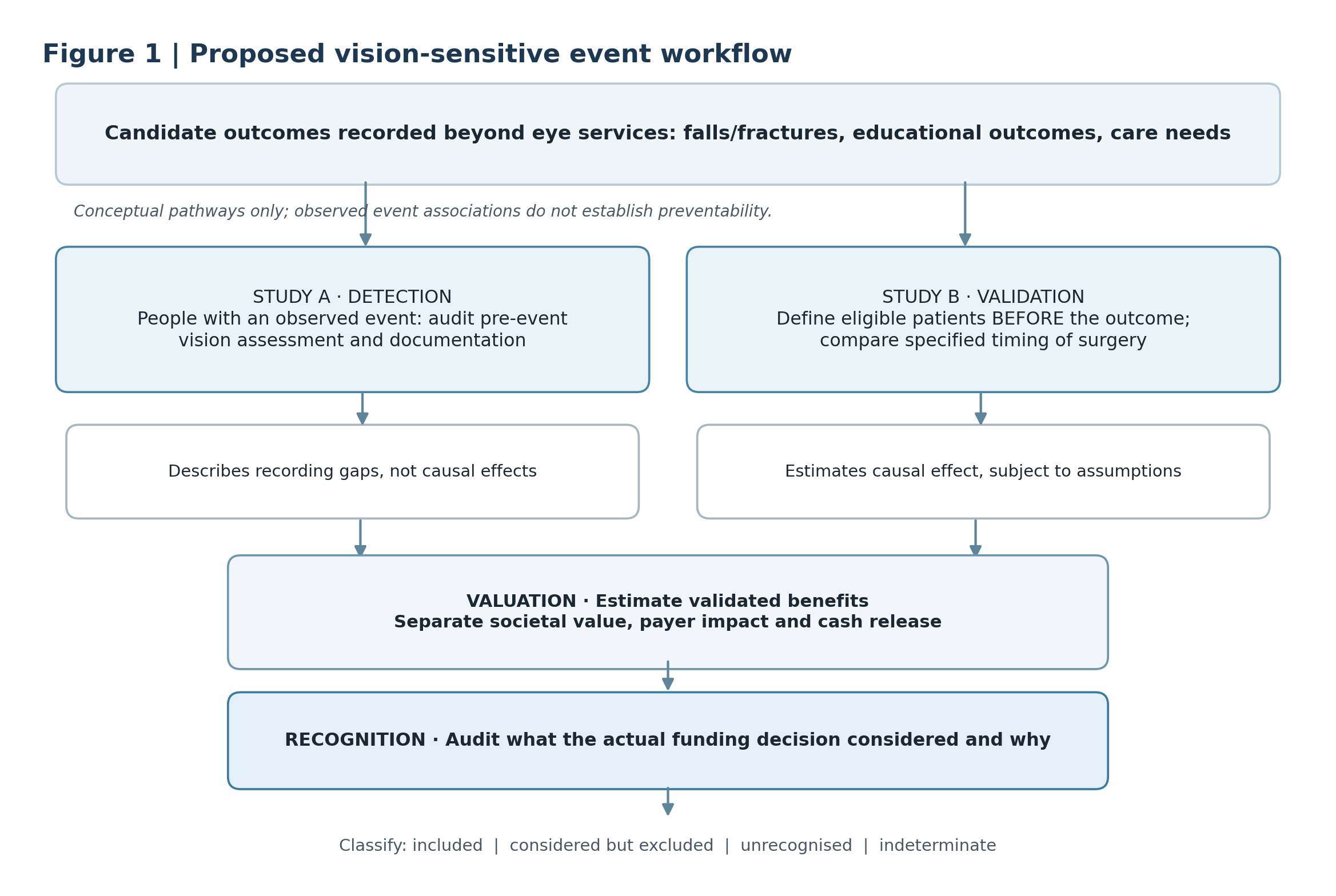
1. Detection. Audit the occurrence and documentation of candidate outcomes and preceding visual status. Missing records are classified as unknown; a look-back study estimates ascertainment gaps, not a treatment effect.
2. Validation. Determine whether a pre-specified intervention and timing actually change the outcome. Prefer relevant randomised evidence; otherwise emulate an explicit target trial using eligible people defined before the outcome, prespecified strategies, follow-up, confounding controls and sensitivity analyses. Association alone is insufficient.[22]
3. Valuation. For supported causal links, report a justified counterfactual and time horizon and distinguish societal benefit, costs avoided, named-payer budget impact, and cash that could genuinely be released. Include intervention costs, uncertainty, double-counting checks and distributional consequences, using existing impact-inventory and budget-impact methods.[16, 17]
4. Recognition. Audit the actual decision: define the decision and date, evidence available at that date, declared decision perspective, and documentary sources (business cases, appraisals, minutes and cross-sector agreements). Classify the benefit as incorporated; considered but excluded with reasons; apparently overlooked despite relevant available evidence; or indeterminate because records are inadequate.
How to test the idea: a proposed hip-fracture pilot
The first implementation could focus on hip fracture because hospital events may be consistently ascertained; this practicality must not be mistaken for strong hip-fracture-specific causal evidence. In the first-eye randomised trial, expedited surgery meant approximately four weeks rather than a roughly 12-month routine wait.[5] These timings motivate, but do not dictate, treatment strategies for a new setting. The pilot below is hypothetical, and its parameters would need local governance approval and prospective protocol registration.
Box 1. Proposed pilot protocol outline (no data collected)
| Element | Pre-specified requirement |
|---|---|
| Setting and scope | One health system for feasibility assessment; linked hospital and eye-care records under appropriate information-governance approvals. Define outcome codes and the record-completeness window in advance. |
| Study A — Detection | Adults aged ≥65 admitted with hip fracture within a defined year. Audit pre-fracture vision documentation, referral and treatment timelines. Report the proportion with qualifying documented visual impairment, documented assessment without qualifying impairment, and unknown status. These are recording categories, not causal exposure groups. |
| Study B — Validation | Separate eligible population with operable cataract identified before falling or fracturing, including people without subsequent events. Compare protocol-defined expedited surgery with usual waiting; specify time zero, eligibility, treatment strategies, follow-up, outcomes, competing mortality, analysis, and adjustment for frailty, cognition, comorbidity and access. |
| Feasibility and precision | The 0.20-percentage-point observational hip-fracture risk difference is not an established causal effect. One system and one year of fracture admissions would ordinarily be insufficient for a reliable causal-effect estimate; feasibility work should assess event rates and completeness. A formal power / precision calculation may support pooling across systems or using a national linked dataset. |
| Valuation | For effects credible enough to value, estimate intervention and downstream costs by perspective; quantify uncertainty, time horizon, fixed versus variable costs, budget displacement and any cashable effect. |
| Decision audit | Select a specified historical cataract-funding decision; examine contemporaneous business cases, analyses and minutes. Record whether relevant evidence existed and was included, explicitly excluded, apparently omitted or impossible to determine. |
| Possible findings | An omitted decision-relevant benefit; an explicitly considered benefit; evidence too weak or economically immaterial to alter the decision; or indeterminate findings due to missing information. No category is assumed in advance. |
What if the audit finds no missed benefit?
The existence and importance of an omission are distinct questions. Failure to establish a causal effect would prevent valuation of that candidate; evidence that a benefit was appropriately assessed would refute non-recognition for that decision. A small but overlooked benefit might still satisfy the descriptive definition while being immaterial to allocation. Missing documents or evidence that was unavailable to the funder at the relevant date should lead to an indeterminate or non-attributable result, not an invented blind spot. A credible research programme should publish null and indeterminate outcomes as readily as positive findings.
What the framework does not claim—and why equity matters
This proposal is untested. No commissioning record has been examined here, and neither the frequency nor the magnitude of any omission has been estimated. The examples are selective and heterogeneous; observational associations may reflect residual confounding, and even well-designed target-trial emulations depend on untestable assumptions. Dementia attributable fractions and burden-of-illness estimates cannot be converted into effects of cataract surgery. In settings without services, timely access may matter far more than the way a budget values distant consequences.
A fiscal-spillover test must not be used to rank patients by income, employment, propensity to fall or predicted institutional costs. Doing so could disadvantage people with substantial visual needs whose downstream costs are not readily monetised. Any use in funding or prioritisation should retain direct patient benefit and equity as independent objectives, assess distributional consequences across age, deprivation and disability, and monitor unintended changes in access. Recognising an external benefit does not settle whether funding it is the best use of scarce resources.
This framework asks a limited and falsifiable question, rather than claiming that budgets always undercount eye care. Its value lies in connecting known economic-evaluation standards to observable records of real allocation decisions.
Three questions for healthcare leaders
- Which potential benefit outside ophthalmology has credible causal evidence for this intervention and population?
- Who receives that benefit, over what time horizon, and how does its value differ from savings a payer could actually realise?
- Where in the relevant funding decision was the evidence included, explicitly ruled out, or left undocumented?
These questions are not a substitute for economic evaluation, nor do they prove that funding has been misallocated. They give executives, payers and policymakers a practical way to distinguish an evidence gap, an accounting omission and a deliberate allocation choice.
Perimetry for the organisation
Perimetry makes a field defect visible by testing what is not obvious from the whole scene. An eye-care funding audit can be equally disciplined: identify the candidate consequence, test whether treatment changes it, value the result and examine the actual decision record. It may uncover an omitted benefit; it may find that the benefit was already considered. Either outcome clarifies the decision. Whether the spreadsheet contains a scotoma remains an empirical question, and it deserves an empirical answer.
Evidence and editorial notes
This is a conceptual analysis and proposed framework, not a report of a completed study. The hip-fracture pilot is hypothetical.
No original participant dataset was collected or analysed for this article. Any future linked-records research would require appropriate ethics and information-governance approvals.
Editorial transparency: AI-assisted language and structural editing contributed to this article. The scientific interpretation and decisions to publish remain the responsibility of the author.
About the author
How to cite this article
Al-Diri S. The Scotoma in the Spreadsheet: Why Healthcare Budgets May Miss the Wider Value of Eye Care. Dr. Samer Al-Diri (website). 2026.
References
- Ramachandran VS, Gregory RL. Perceptual filling in of artificially induced scotomas in human vision. Nature. 1991;350:699–702. doi:10.1038/350699a0.
- Burton MJ, Ramke J, Marques AP, et al. The Lancet Global Health Commission on Global Eye Health: vision beyond 2020. Lancet Glob Health. 2021;9:e489–e551. doi:10.1016/S2214-109X(20)30488-5.
- World Health Organization. World report on vision. Geneva: WHO; 2019. ISBN:9789241516570. WHO report
- National Academies of Sciences, Engineering, and Medicine. Making Eye Health a Population Health Imperative: Vision for Tomorrow. Washington, DC: National Academies Press; 2016. doi:10.17226/23471.
- Harwood RH, Foss AJE, Osborn F, et al. Falls and health status in elderly women following first eye cataract surgery: a randomised controlled trial. Br J Ophthalmol. 2005;89:53–59. doi:10.1136/bjo.2004.049478.
- Foss AJE, Harwood RH, Osborn F, et al. Falls and health status in elderly women following second eye cataract surgery: a randomised controlled trial. Age Ageing. 2006;35:66–71. doi:10.1093/ageing/afj005.
- Gutiérrez-Robledo LM, Villasís-Keever MÁ, Avila-Avila A, et al. Effect of cataract surgery on frequency of falls among older persons: a systematic review and meta-analysis. J Ophthalmol. 2021;2021:2169571. doi:10.1155/2021/2169571.
- Ma X, Zhou Z, Yi H, et al. Effect of providing free glasses on children’s educational outcomes in China: cluster randomized controlled trial. BMJ. 2014;349:g5740. doi:10.1136/bmj.g5740.
- Neitzel AJ, Wolf B, Guo X, et al. Effect of a randomized interventional school-based vision program on academic performance of students in grades 3 to 7: a cluster randomized clinical trial. JAMA Ophthalmol. 2021;139:1104–1114. doi:10.1001/jamaophthalmol.2021.3544.
- Tseng VL, Yu F, Lum F, Coleman AL. Risk of fractures following cataract surgery in Medicare beneficiaries. JAMA. 2012;308:493–501. doi:10.1001/jama.2012.9014.
- Lee CS, Gibbons LE, Lee AY, et al. Association between cataract extraction and development of dementia. JAMA Intern Med. 2022;182:134–141. doi:10.1001/jamainternmed.2021.6990.
- Livingston G, Huntley J, Liu KY, et al. Dementia prevention, intervention, and care: 2024 report of the Lancet standing Commission. Lancet. 2024;404:572–628. doi:10.1016/S0140-6736(24)01296-0.
- Rein DB, Wittenborn JS, Zhang P, et al. The economic burden of vision loss and blindness in the United States. Ophthalmology. 2022;129:369–378. doi:10.1016/j.ophtha.2021.09.010.
- Marques AP, Ramke J, Cairns J, et al. Global economic productivity losses from vision impairment and blindness. EClinicalMedicine. 2021;35:100852. doi:10.1016/j.eclinm.2021.100852.
- McCullough JM. Declines in spending despite positive returns on investment: understanding public health’s wrong pocket problem. Front Public Health. 2019;7:159. doi:10.3389/fpubh.2019.00159.
- Sanders GD, Neumann PJ, Basu A, et al. Recommendations for conduct, methodological practices, and reporting of cost-effectiveness analyses: Second Panel on Cost-Effectiveness in Health and Medicine. JAMA. 2016;316:1093–1103. doi:10.1001/jama.2016.12195.
- Sullivan SD, Mauskopf JA, Augustovski F, et al. Budget impact analysis—principles of good practice: report of the ISPOR 2012 Budget Impact Analysis Good Practice II Task Force. Value Health. 2014;17:5–14. doi:10.1016/j.jval.2013.08.2291.
- Boyd M, Kvizhinadze G, Kho A, Wilson G, Wilson N. Cataract surgery for falls prevention and improving vision: modelling the health gain, health system costs and cost-effectiveness in a high-income country. Inj Prev. 2020;26:302–309. doi:10.1136/injuryprev-2019-043184.
- Porter ME. What is value in health care? N Engl J Med. 2010;363:2477–2481. doi:10.1056/NEJMp1011024.
- National Institute for Health and Care Excellence. Falls: assessment and prevention in older people and in people 50 and over at higher risk. NICE guideline NG249. Published 2025. https://www.nice.org.uk/guidance/ng249.
- Billings J, Zeitel L, Lukomnik J, et al. Impact of socioeconomic status on hospital use in New York City. Health Aff (Millwood). 1993;12:162–173. doi:10.1377/hlthaff.12.1.162.
- Hernán MA, Robins JM. Using big data to emulate a target trial when a randomized trial is not available. Am J Epidemiol. 2016;183:758–764. doi:10.1093/aje/kwv254.