
Turning diagnostic innovation into reliable care through healthcare management, clinical accountability and patient engagement.
By Dr. Samer Al-Diri, MD, MSc Health Science, MPH
A retinal scan can be interpreted promptly and still lead to delayed care. Someone must review the finding, communicate its significance, arrange the next step and confirm that the patient receives it. Technology can accelerate one task while leaving the rest of that journey unchanged.
From my perspective across ophthalmology, public health and healthcare management in ophthalmology, this is the central leadership challenge: connecting clinical capability with dependable delivery.
The eye clinic of the future should not be defined by how much technology it contains. It should be judged by how reliably it converts information into appropriate care. Evidence from artificial intelligence (AI)-assisted assessment, teleophthalmology and patient-support interventions offers practical lessons, provided we distinguish improvements in individual tasks from improvements in patient outcomes.
This is also where the discussion connects with the wider evolution of precision ophthalmology: increasingly sophisticated diagnostics have value only when clinical systems can translate them into timely decisions and dependable care.
Healthcare Management Is Part of Clinical Quality
Managing eye care involves more than scheduling appointments or purchasing equipment. It means deciding which patients need attention first, which professionals can undertake defined tasks, how uncertainty is escalated and who remains responsible when a referral or follow-up fails.
Workforce investment remains essential; redesign is not an excuse for understaffing. Nor can software compensate for unaffordable treatment or inadequate clinical capacity. The management opportunity is to make existing expertise more accessible without transferring unrecognised risk to patients.
This requires three connected functions: triage, referral and engagement. Clinical governance must run through all three.
This principle is closely related to the broader economics of better eye care: operational design, capacity allocation and pathway performance can influence both clinical access and resource use. I explored this relationship further in Healthcare Management in Ophthalmology: The Economics of Better Care.
AI: Measure the Task Before Claiming the Benefit
Chen and colleagues studied AI-assisted age-related macular degeneration assessment involving 24 clinicians from 12 institutions. AI improved overall disease-severity grading performance for 23 clinicians. Among 19 with complete timing data, first-round assessments were approximately ten seconds faster with assistance; smaller advantages persisted in later rounds.1
These were image-assessment results, not evidence of shorter appointments, reduced waiting lists or preserved vision. The study supports careful workflow evaluation, not automatic conversion of seconds saved into additional clinical capacity.
The 2026 PathFinder study illustrates why clinical context matters. Three non-retina specialists assessed optical coherence tomography (OCT) scans from 202 eyes with AI assistance. Sensitivity varied across readers and conditions, and referral agreement was inconsistent. Assisted readers also had clinical information unavailable to the retina specialists providing the reference assessments, limiting like-for-like comparisons.2
The practical implication is to define the task before selecting the technology. Image classification, referral prioritisation and treatment decisions are different responsibilities. Evidence supporting one does not automatically validate the others.
Community Screening: An Ungradable Image Is an Unresolved Decision
A pragmatic study in rural India evaluated non-ophthalmologist-led screening and offline AI-assisted diabetic-retinopathy screening. The AI model reported 93.3% sensitivity for referable disease, but with a wide 95% confidence interval of 68.1–99.8%. Its reported ungradability rate was 38%, largely associated with cataract and poor image quality; diagnostic accuracy calculations excluded ungradable images.3
That exclusion matters. Performance among interpretable images cannot describe what happens to everyone entering a screening programme. Differences in cameras and delivery settings also limit attributing differences between models to AI alone.
For service design, an ungradable image must remain an unresolved assessment, not become a reassuring negative result. Programmes need a defined route to repeat imaging or appropriate clinical assessment, alongside staff training and accessible referral arrangements.
Screening creates an opportunity for care. It does not, by itself, complete it.
Teleophthalmology: Redesign the Referral, Not Just the Interface
The HERMES cluster-randomised trial analysed 294 participants referred through UK community optometry pathways. In the teleophthalmology arm, hospital clinicians remotely reviewed OCT scans. Unnecessary urgent referrals occurred in approximately 18% of the standard-care group versus 1% of the teleophthalmology group, using all analysed participants as the denominator.4
The overall reduction in unnecessary referrals was less conclusive. A separate AI evaluation could process images from only about half its participants and did not outperform hospital specialists. The benefit therefore belongs to the clinician-led teleophthalmology pathway, not to AI alone.4
For leaders, the lesson is to invest in the connections between professionals: usable images, sufficient clinical information, timely review and an explicit destination for the decision. A digital referral is not complete merely because someone has pressed “send”.
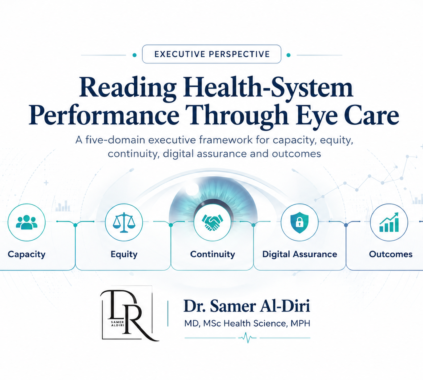
This is one reason eye care can function as a useful indicator of wider health-system performance. Referral reliability, pathway closure and specialist access reveal how effectively a health system converts clinical knowledge into delivered care, a theme explored further in Reading Health-System Performance Through Eye Care.
Follow-Up and Engagement Are Clinical Infrastructure
In a randomised ophthalmology trial involving 362 adults with active patient portals, adding an electronic message after a missed appointment increased attendance within 30 days from 11.6% to 22.2%. Both groups received a standard mailed reminder.5
This was a meaningful improvement in re-engagement, not evidence that most patients returned: nearly four in five intervention recipients still did not attend within that period. Portal messaging should therefore be one component of follow-up, with telephone or other accessible alternatives for people who cannot use it.
The 2026 Support, Educate, Empower trial randomised 235 adults with glaucoma and poor self-reported adherence. A six-month programme combining nonphysician coaching, personalised education and reminders improved electronically monitored medication adherence compared with usual care plus written education.6
The intervention was a package, not a test of reminders alone. Its adherence benefit should not be presented as demonstrated prevention of visual-field loss. Nevertheless, it supports a practical principle: prescribing treatment and helping someone sustain it are different, complementary responsibilities.
An Operating Model for Reliable Eye Care
I propose using triage, referral and engagement as a practical organising approach—not as a validated scoring system.
Triage should match clinical urgency to an appropriate response. Eligibility criteria, image-quality requirements and escalation rules must be explicit. Staff need a route to challenge an automated recommendation when symptoms, examination findings or uncertainty warrant review.
Referral should transfer responsibility as well as information. Each pathway needs an identifiable receiving team, a clinically appropriate response window and confirmation that the next step occurred. Unanswered referrals and overdue reviews should remain visible until resolved.
Engagement should make participation realistically achievable. Communication needs to accommodate visual impairment, language, health literacy, transport difficulties and digital access. A missed appointment should prompt an assessment of risk and barriers, not an assumption of indifference.
Across all three functions, governance should specify who reviews exceptions, how errors are investigated and when a digital tool is paused or withdrawn. These are operational recommendations informed by the evidence, rather than outcomes established by a single trial.
The same principle underlies the broader concept of prevention liability: risk can accumulate when identified clinical need is not converted into completed care, particularly when delays consume a time-sensitive opportunity for prevention.
What Leaders Should Measure Before Scaling
A useful implementation programme should begin with one defined problem, such as incomplete retinal referrals, rather than a broad commitment to “AI transformation”. Establish the baseline, test a bounded change and assess the whole pathway before expanding it.
I would prioritise:
- time from an actionable finding to the required review or treatment;
- the proportion of patients completing that next step;
- unresolved ungradable images;
- missed or delayed urgent cases;
- loss to follow-up; and
- variation in these measures between relevant patient groups.
Results should be examined across relevant populations so that an improving average does not conceal worsening access for others.
Capacity assessment should include staff training, repeat imaging, specialist verification and administrative follow-up. A faster interpretation step may shift work elsewhere rather than remove it. Financial appraisal should therefore consider the cost of completing appropriate care, not merely the price per scan.
Patient experience and condition-appropriate clinical outcomes belong alongside these operational measures. More throughput is not sufficient evidence of better care.
Before wider deployment, leaders should require evaluation in the intended population, clear data-access arrangements, usable record exchange, a downtime pathway and monitoring after software or equipment changes. Expansion should depend on demonstrated performance under those conditions, not on a vendor’s benchmark alone.
Beyond Eye Disease: Keep Oculomics Clinically Grounded
Oculomics—the study of ocular features as indicators of systemic health—extends this management challenge. A 2025 study used multimodal retinal imaging from people with type 1 diabetes to classify cardiovascular-risk categories.7
It examined existing risk classifications, not whether retinal screening prevented future cardiovascular events. Moving towards clinical use requires appropriate external and prospective evaluation, evidence of added value, and clarity about who investigates an abnormal result.
Otherwise, a new signal may create another unresolved referral.
The opportunity is important, but the service must be designed before the technology is treated as routine care.
The Defining Capability of Future Eye Care
The eye clinic of the future will not be run by systems instead of doctors. It will depend on clinicians, managers, allied professionals and patients working within systems that make good decisions easier to act upon.
Its defining capability will be neither automation nor activity alone. It will be the reliable completion of appropriate care: the right assessment, a clear decision, an accountable handover and follow-up that does not lose the patient.
Technology may generate the signal. The health system determines whether that signal becomes useful care.
Scope and Editorial Note
This evidence-informed perspective draws on selected studies published in 2024–2026. The studies differ in design, populations and outcomes; their findings should not be pooled or assumed universally transferable. It is not a systematic review or clinical guideline. The management recommendations are the author’s synthesis and require local evaluation. AI-assisted editorial and source-checking support was used in developing the article.
About the Author
Dr. Samer Al-Diri, MD, MSc Health Science, MPH writes at the intersection of ophthalmology, retinal care, public health, healthcare management, artificial intelligence and health-system transformation.
More professional publications and analysis: DrSamerAlDiri.com
References
- Chen Q, Keenan TDL, Agron E, et al. AI Workflow, External Validation, and Development in Eye Disease Diagnosis. JAMA Network Open. 2025;8(7):e2517204. View source.
- Fong KCS, Wong WJ, Samsudin A, et al. PAIR: Evaluating the Limits of Agreement Among Non-Retinal Specialist Using PathFinder Artificial Intelligence Tool for Retinal Disease Referrals: A Prospective Observational Study. Clinical Ophthalmology. 2026;20:584717. View source.
- Chauhan A, Vale L, Kankaria A, et al. Evaluation of non-ophthalmologist-led and offline AI-assisted models for diabetic retinopathy screening in India: a pragmatic diagnostic accuracy study. BMJ Open. 2026;16(3):e106397. View source.
- Sharma A, Hussain R, Learoyd AE, et al. Teleophthalmology versus standard of care for community optometry referrals of retinal disease (HERMES): a cluster randomised controlled trial with linked prospective diagnostic accuracy assessment of artificial intelligence support. The Lancet Primary Care. 2025;1(4):100041. View source.
- Atta S, Brown RB, Wasser LM, et al. Effect of a Patient Portal Reminder Message After No-Show on Appointment Reattendance in Ophthalmology: A Randomized Clinical Trial. American Journal of Ophthalmology. 2024;263:93–98. View source.
- Newman-Casey PA, Niziol LM, Lu M, et al. Effect of the Support, Educate, Empower Personalized Glaucoma Coaching Program on Medication Adherence: The SEE Program Randomized Clinical Trial. JAMA Ophthalmology. 2026;144(4):299–306. View source.
- Tohà-Dalmau A, Rosinés-Fonoll J, Romero E, et al. Machine Learning Prediction of Cardiovascular Risk in Type 1 Diabetes Mellitus Using Radiomic Features from Multimodal Retinal Images. Ophthalmology Science. 2025;5(6):100874. View source.