
Healthcare Management | Hospital Investment | Clinical Governance
How healthcare boards can trace resource transfers, protect essential services and reconcile growth decisions.
Medical degree: MD, Damascus University (1999)
Postgraduate qualifications: MSc Health Science (Ophthalmology/Retina), UCL Institute of Ophthalmology; Master of Public Health (MPH) in Planning and Management, awarded with Merit, City, University of London.
Healthcare Management, Ophthalmology & Retina, Public Health | Evidence-informed executive perspective
Executive overview: the core question behind hospital investment
Before approving a hospital expansion, leaders should be able to answer a practical question: which existing clinical service, if any, is supplying the staff, sessions or equipment that make the expansion possible? A positive financial business case does not, by itself, establish that the required clinical capacity is genuinely available.
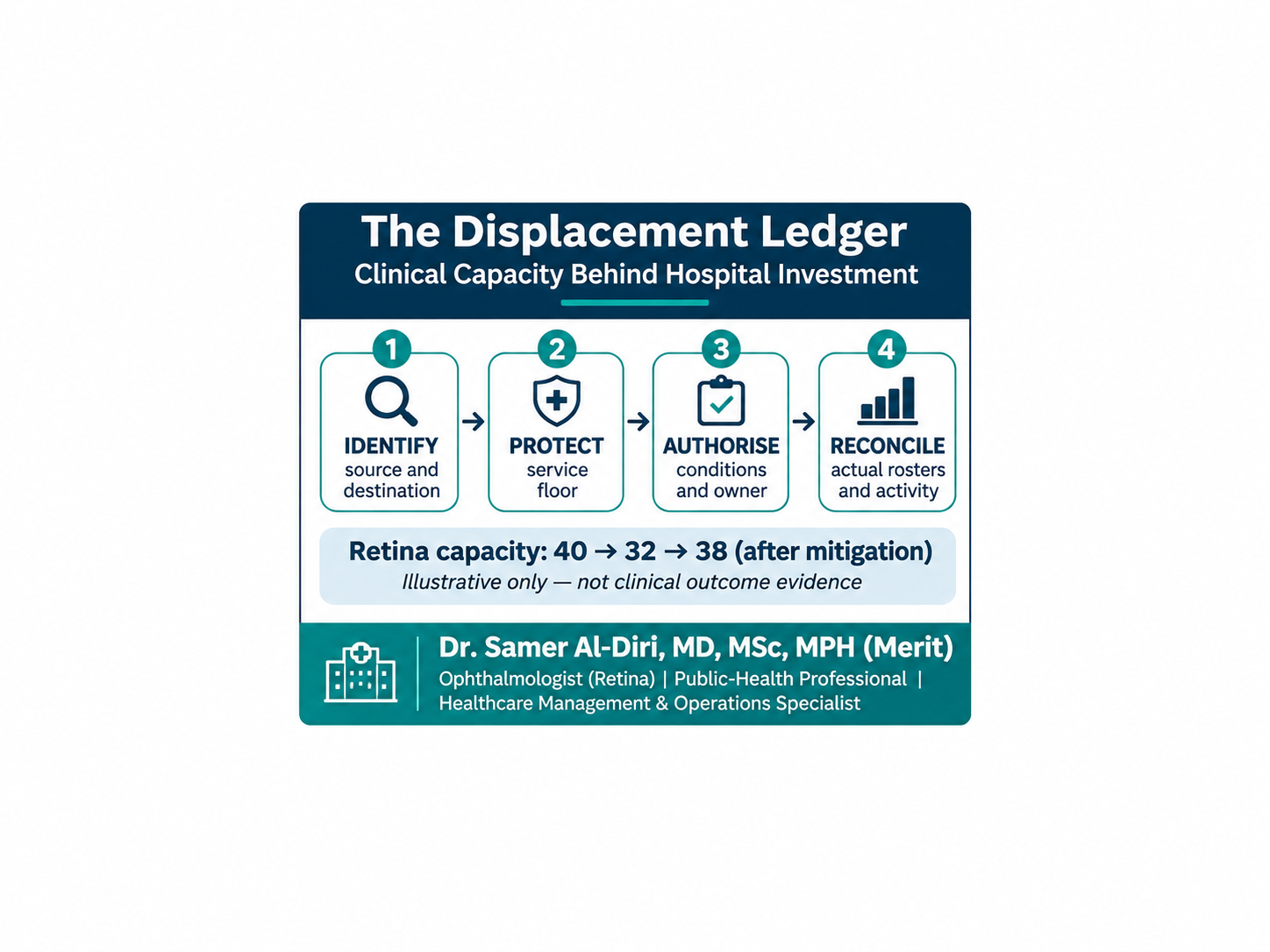
The Displacement Ledger is a proposed board-facing record for hospital investment decisions that move scarce clinical resources between services. It is designed to make those movements traceable: from their source to their destination, through clinical protection requirements and mitigation, and finally to implementation evidence.
The proposal would help decision-makers:
- Identify the source and destination of each material resource transfer.
- Distinguish transferred capacity from genuinely new or recovered capacity.
- Document locally agreed safeguards for services that give up resources.
- Compare approved resource movements with subsequent rosters and service activity.
Important qualification: this is a governance proposal, not a validated intervention or a new mathematical planning method. Whether the additional record improves decisions beyond established, high-quality processes remains to be tested.
Why can hospital investment reduce clinical capacity elsewhere?
Clinical capacity is not one interchangeable stock. An available clinic room cannot replace a suitably trained injection nurse; an additional theatre list may require staff who already support medical-retina follow-up. Feasibility depends on skills, timing, equipment, downstream appointments, clinical demand and the interaction of entire pathways.
Consequently, an expansion may increase activity or projected financial contribution while leaving another question unresolved: what becomes less feasible elsewhere when constrained resources are reassigned?
This is a question of operational feasibility, not a presumption of harm. Some transfers use genuinely spare time and leave essential services unaffected. Others may reduce available treatment slots or change the set of services a hospital can safely deliver. Total hospital activity, on its own, cannot reliably distinguish those situations.
What does the Displacement Ledger add to healthcare governance?
Opportunity cost, resource allocation and priority setting are established disciplines. Programme budgeting and marginal analysis (PBMA) already addresses investments and disinvestments [1], and a published scoping review describes existing approaches to healthcare resource-allocation decisions [4]. NHS England’s quality impact assessment (QIA) framework already asks organisations to assess workforce, quality, equity, mitigation and governance effects of proposed service changes [2].
The ledger therefore does not claim to replace a business case, QIA, clinical assessment or optimisation model. Its narrower proposition is to put a matched source-to-destination resource schedule into routine investment governance, with a documented protection requirement and subsequent reconciliation against operational reality.
If existing governance already captures this information clearly and reliably, there may be little value in adding another form. The case for adoption depends on demonstrating incremental usefulness rather than assuming a gap exists.
How the Displacement Ledger relates to earlier work
The author’s earlier articles, The Prevention Liability [5] and The Care Recovery Clock [6], consider the consequences of delayed care and how to assess recovery after disruption. The Displacement Ledger addresses an earlier governance decision: whether a proposed investment should reassign constrained resources between clinical pathways. The difference is one of decision timing and accountability, not a newly discovered mathematical technique.
What should a clinical-capacity transfer record include?
Each material resource movement should identify the investment decision; originating and receiving pathways; resource type; native operational unit; quantity and period; supporting roster or planning evidence; accountable owner; and review date. Examples of native units include injection-trained nursing hours per week, staffed theatre sessions per month and clinic-room hours, rather than a general monetary proxy.
Entries should separate three categories: new capacity, matched internal transfers and recovered capacity. An internal transfer should have an identifiable entry on both sides of the movement. Disputed or incompletely evidenced transfers should remain unresolved pending clinical and operational review.
A resource entry is not an estimate of patient outcomes. Removing eight nursing hours does not automatically imply eight fewer treatments. Any inference about visits, waiting times, risk or outcomes requires a locally justified pathway model that considers competencies, bottlenecks, demand, protected capacity, timing, equity and quality. Such modelling is separate from the ledger and must remain open to clinical judgement.
Worked example: cataract expansion, clinical capacity and medical-retina protection
All values in this example are hypothetical. They are not taken from a hospital business case, NHS tariff, clinical staffing norm or observed patient dataset. Their purpose is to demonstrate governance arithmetic and the limits of that arithmetic.
Assume that an additional cataract operating list could provide eight procedures per week and generate £4,000 per week in incremental contribution, before mitigation and before accounting for any retina contribution forgone. The list would reassign eight nursing hours from the retina pathway. Solely for illustration, assume each transferred nursing hour supports one retina appointment-equivalent, with all other resources available. Actual conversion factors would have to be established locally.
| Parameter | Illustrative value or consequence |
|---|---|
| Added cataract activity | 8 procedures per week |
| Pre-mitigation contribution | £4,000 per week; excludes any forgone retina contribution unless separately adjusted |
| Nursing hours reassigned | 8 hours per week from retina to cataract |
| Retina appointment capacity before mitigation | 40 to 32 appointment-equivalents per week; the assumed one hour per appointment-equivalent is not a staffing norm |
| Proposed protected retina floor | 38 appointment-equivalents per week; illustrative and not clinically established |
| Mitigation | 6 independently staffed, competency-appropriate retina appointment-equivalents per week, at an assumed fully loaded cost of £900 |
| Contribution after mitigation | £4,000 − £900 = £3,100 per week, before forgone retina contribution and other uncounted costs |
| Overall incremental net benefit | Not estimable from these assumptions; would require all relevant opportunity costs and incremental costs |
Under these assumptions, retina appointment capacity drops from 40 to 32, six below the proposed protected floor of 38. Six genuine, appropriately staffed and timed replacement appointment-equivalents would restore that floor, but capacity would still be two below its original level. The replacement cannot be counted unless it actually meets the retina pathway’s clinical requirements.
The £3,100 figure is only contribution after the assumed £900 mitigation cost. It is not total incremental hospital benefit. The calculation still needs to deduct any forgone retina contribution and other uncounted costs. If the clinically justified protection floor were 40 rather than 38, the hospital would need to replace all eight appointment-equivalents, not six.
A well-prepared business case or QIA might already capture these implications. The illustrative role of the ledger is to keep the transfer quantity, agreed floor, mitigation and subsequent reconciliation in one auditable schedule, and to make approval conditional on the evidence.
How should a hospital board use the Displacement Ledger?
- Identify the resource source. List staff, room, equipment and session requirements in their actual operational units. Funded posts or budgets alone do not prove usable clinical capacity.
- Reconcile the transfer. Match each internal transfer to its receiving-service entry; distinguish truly new and recovered resources. Escalate disputed quantities, availability or skill mix before approval.
- Protect essential services. Agree clinically defensible activity, access and safety thresholds with specialty and governance leads. The ledger does not generate those thresholds.
- Test feasibility and mitigation. Review rosters, competencies, equipment, demand, dependencies, equitable access, mitigation costs and assigned responsibilities.
- Approve conditionally when appropriate. Record conditions, escalation triggers, accountable owners and review dates within existing investment and QIA processes.
- Reconcile forecasts with actual delivery. Review staffing and service measures after implementation. Investigate discrepancies without automatically assigning causation to the investment.
Does the Displacement Ledger have proven benefits and what are its limitations?
Not yet. The Displacement Ledger is an unvalidated proposal for a record format, not a tested hospital intervention. Exploratory synthetic modelling associated with its development examined conventional linear-programming comparisons. It did not establish a new algorithm, validate clinical effects, reproduce actual hospital transfers or demonstrate changed board decisions. A related technical methods manuscript remains a working draft; this article claims neither a public preprint nor a DOI for that manuscript.
A meaningful next step would compare the information already available in business cases and QIAs with an independently reconstructed account of plausibly investment-linked changes in staffing and service activity, under appropriate local governance approvals. The evaluation should ask whether the ledger improves completeness, decision timeliness, accountability or detection of unmet mitigation requirements beyond current practice.
There are important limitations. Rosters may be incomplete; staff may cross-cover services; the same hours may have different clinical value depending on competence and timing; and changing demand can confound before-and-after comparisons. Maintaining a ledger also has an administrative cost. A pilot should assess whether any improvement in governance justifies that burden. If an existing QIA already provides an equivalent, reliable record, the proposed ledger should be simplified or not adopted.
Why does the Displacement Ledger matter for healthcare leadership?
The link between financial incentives and clinical capacity is especially visible in ophthalmology. In England, the 2026/27 NHS Payment Scheme revised prices for selected ophthalmology activities, including reductions in principal cataract prices and adjustments to other ophthalmology prices [7]. The Royal College of Ophthalmologists welcomed the changes and emphasised the importance of supporting more complex, potentially sight-preserving care [3].
Those policy documents do not demonstrate that any named hospital moved nursing staff from retina to cataract services, and payment changes alone do not establish how an individual provider allocates capacity. The applicable payment mechanism, commissioning arrangements and local pathway data must be examined before drawing provider-specific conclusions.
Responsible growth requires financial accountability for the investment, clinical accountability for affected patients and operational accountability for scarce resources. A simple, reconciled record may help connect those responsibilities—provided that it adds value to, rather than duplicates, effective governance.
Before authorising an expansion, an investment committee should ask: Which existing clinical alternatives might this decision constrain? What are the complete financial and operational consequences? And what evidence would show that essential care remains protected?
References and evidence notes
- Mitton C, Dionne F, Donaldson C. Managing Healthcare Budgets in Times of Austerity: The Role of Program Budgeting and Marginal Analysis. Applied Health Economics and Health Policy. 2014;12:95–102. https://doi.org/10.1007/s40258-013-0074-5
- NHS England. Quality impact assessment framework. Published 24 June 2025. NHS England framework.
- Royal College of Ophthalmologists. College welcomes changes to ophthalmology tariffs. 31 March 2026. Royal College statement.
- Seixas BV, Dionne F, Mitton C. Practices of decision making in priority setting and resource allocation: a scoping review and narrative synthesis of existing frameworks. Health Economics Review. 2021;11:2. https://doi.org/10.1186/s13561-020-00300-0
- Al-Diri S. The Prevention Liability: The Hidden Balance Sheet of Delayed Care. DrSamerAlDiri.com. 29 July 2026. Non-peer-reviewed executive article. Read article.
- Al-Diri S. The Care Recovery Clock. DrSamerAlDiri.com. 20 October 2026. Non-peer-reviewed conceptual website article. Read article.
- NHS England. 2026/27 NHS Payment Scheme. First published 26 March 2026; subsequently updated September 2026. Official scheme and updated annexes.
About the author: Dr. Samer Al-Diri
Publication and disclosure information
Article type: evidence-informed executive perspective and proposed governance framework; not peer-reviewed research, a validated intervention or clinical guidance.
Suggested citation: Al-Diri S. The Displacement Ledger: Clinical Capacity Behind Hospital Investment. DrSamerAlDiri.com. 2026. Cite the final published webpage using its permanent URL. No DOI has been assigned to this website article.
Editorial revision: 11 November 2026. The public publication date should be the actual date on which the WordPress post is published.
Competing interests: The author declares no conflicts of interest or financial interests related to this article.
Editorial and AI-assistance disclosure: AI-assisted tools supported drafting and editorial review. The author is responsible for the final content and interpretation. All worked-example figures are hypothetical and are not reported clinical observations or validated hospital productivity estimates.