
An independent educational review of Ozempic, Wegovy, NAION risk, clinical guidance, FDA safety monitoring and patient compensation • Evidence checked 15 October 2026
Professional website • ORCID 0009-0004-1908-0714
Can Ozempic or Wegovy cause vision loss? The short answer
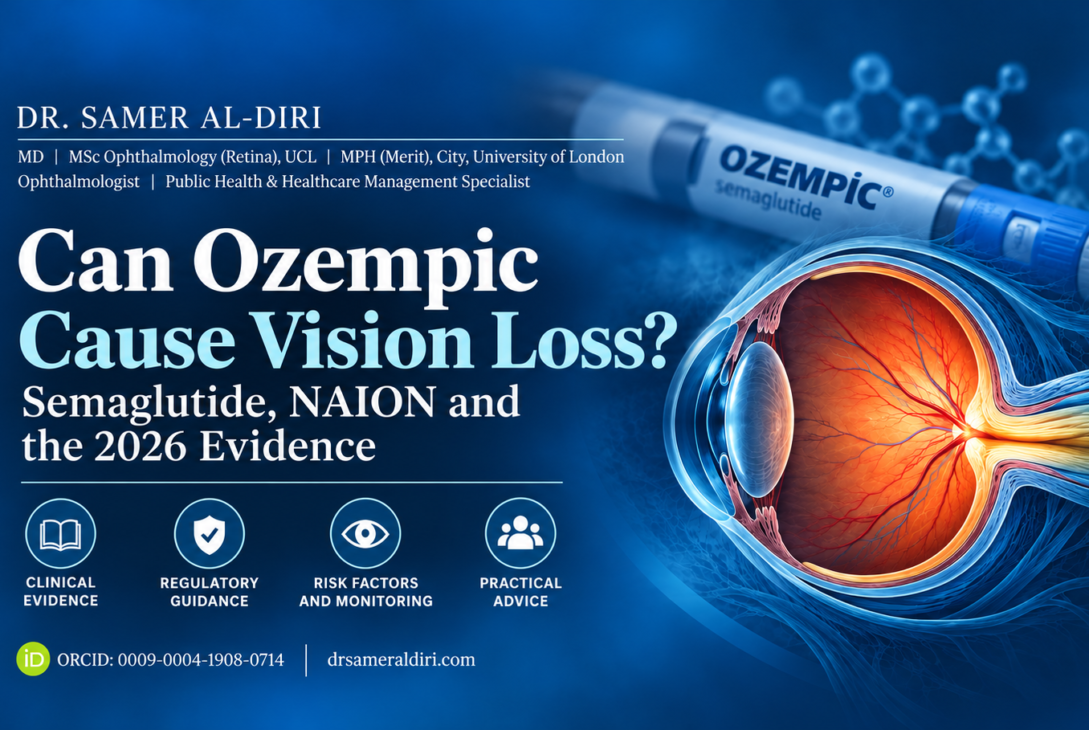
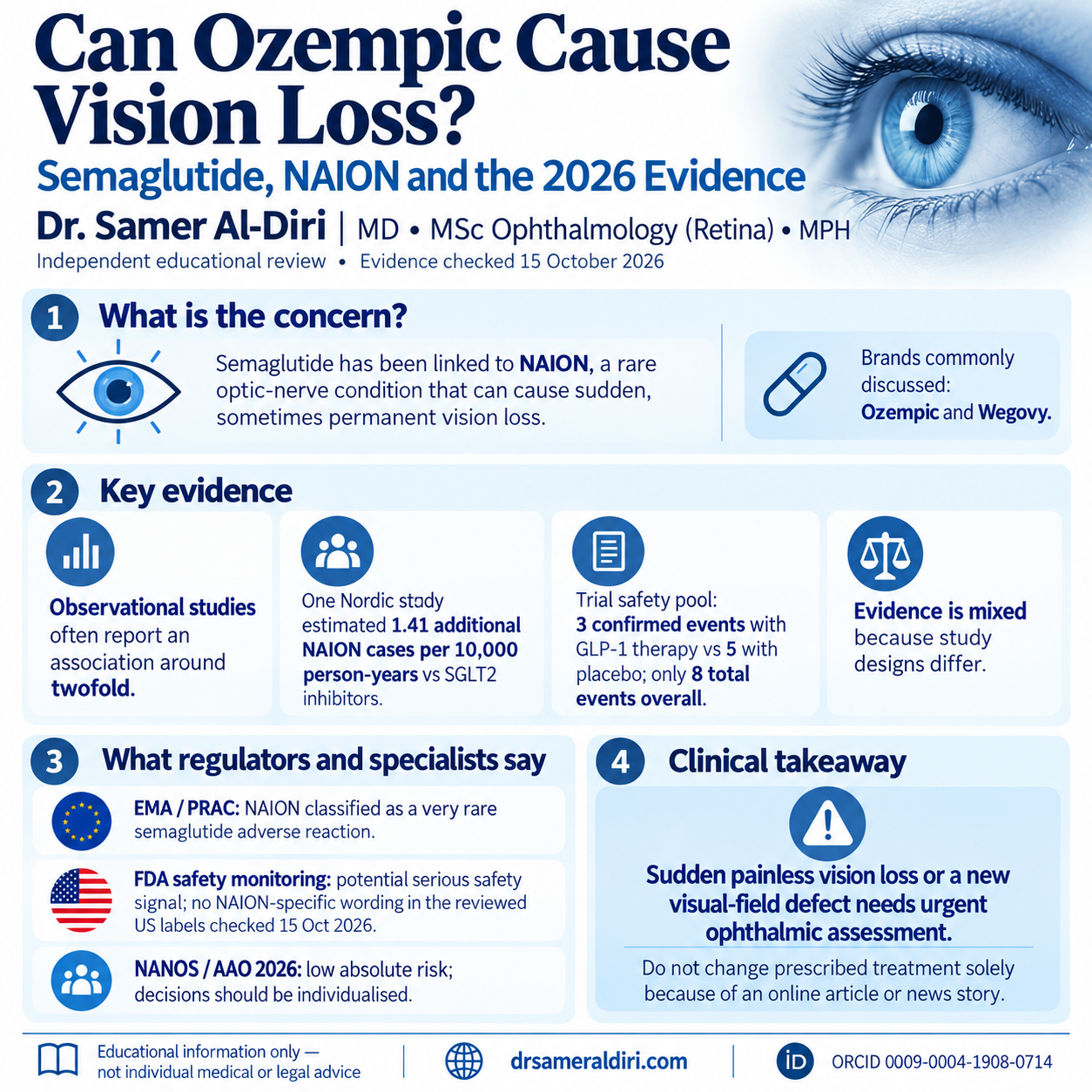
Semaglutide has been linked to non-arteritic anterior ischaemic optic neuropathy (NAION), a rare optic-nerve condition that can cause sudden and sometimes permanent loss of vision. Several observational studies report an increased association, while pooled randomised-trial safety data have not shown more confirmed cases among treated participants; few events occurred. In June 2025, Europe’s medicines safety committee concluded that NAION is a very rare semaglutide adverse reaction. The 2026 NANOS/AAO clinical consensus emphasises limited evidence, low absolute risk and individualised decisions. If vision suddenly deteriorates, seek emergency ophthalmic assessment immediately. [2–10]
At a glance: four evidence-based conclusions
| Question | What the evidence supports |
|---|---|
| How large is the signal? | Observational estimates vary; large cohorts often report an association around twofold, but the design and comparator matter. [2–6] |
| How common is it? | A Danish–Norwegian analysis estimated 1.41 additional NAION cases per 10,000 person-years versus SGLT2 inhibitors. This is population- and comparator-specific. [3] |
| Do trials agree? | A sponsor-linked safety analysis of 112 placebo-controlled trials found 3 confirmed events with GLP-1 therapy and 5 with placebo, but only eight events overall. [7] |
| What should a patient do? | Sudden visual loss requires urgent examination. If NAION is confirmed, follow applicable local labelling and a coordinated eye-specialist/prescriber decision. [9–14] |
Why do European regulators, US eye specialists and the FDA address NAION differently?
European regulators classify NAION as a very rare adverse reaction to semaglutide and instruct discontinuation if NAION is confirmed. The US NANOS/AAO clinical consensus recommends individualized discussion of treatment risks and benefits rather than an automatic rule for every patient. The US FDA publicly identified NAION as a potential serious safety signal for GLP-1 receptor agonists requiring evaluation; that published listing does not, by itself, establish the current wording of individual FDA-approved labels. These are three distinct decisions—medicine labeling, patient management and ongoing safety assessment—not three independent measurements of causation. [8–13,16]
What is NAION—and why does it matter?
NAION is acute ischaemic injury affecting the anterior optic nerve. It commonly presents as sudden, painless loss of vision or a visual-field defect in one eye, sometimes noticed upon waking. Recovery can be limited, and no treatment has consistently restored lost vision. Urgent assessment matters not because NAION has a proven emergency reversal treatment, but because other causes—including giant-cell arteritis and retinal vascular disease—may require immediate diagnosis and treatment. [8,11,12]
Susceptibility is associated with a small or crowded optic disc (“disc at risk”) and with vascular or metabolic conditions such as diabetes, hypertension, dyslipidaemia, obesity and obstructive sleep apnoea. These conditions are also common among people prescribed semaglutide. This overlap complicates interpretation of non-randomised studies: the medicine and the indication may both correlate with baseline NAION risk. [2–5,8,13]
What did the major studies actually find?
The table keeps unlike results separate. Hazard ratios are relative estimates—not percentages of users who lose vision. Counts, incidence rates and estimated excess cases also have different denominators. Meta-analyses may reuse the same cohorts rather than provide entirely independent confirmation.
| Study | Design / comparison | Effect estimate (95% CI) | Absolute result | Principal limitation |
|---|---|---|---|---|
| Hathaway 2024 [1] | Single referral centre; T2D and obesity cohorts | HR 4.28 (1.62–11.29) / HR 7.64 (2.21–26.36) | 17 vs 6 / 20 vs 3 events | Selected clinical population; few outcomes, wide CIs |
| Grauslund 2024 [2] | 424,152 Danes with T2D; exposed vs unexposed | HR 2.19 (1.54–3.12) | 0.228 vs 0.093 per 1,000 person-years | Observational; residual confounding and coded diagnoses |
| Simonsen 2025 [3] | 61,377 initiators in Denmark/Norway; SGLT2 inhibitor comparator | HR 2.81 (1.67–4.75) | +1.41 per 10,000 person-years (95% CI 0.53–2.29) | Only 32 events; self-controlled analysis imprecise |
| Heberer 2026 [5] | US Veterans with T2D; SGLT2 inhibitor comparator | HR 2.33 (1.54–3.54) | 123 vs 67 per 100,000 person-years | Predominantly men; outcome coding and residual bias |
| Chrzanowski 2026 [6] | Meta-analysis of observational T2D cohorts | HR 2.17 (1.73–2.74); vs SGLT2i HR 1.96 (1.28–2.99) | Estimated annual excess ~0.014% | Low/very-low certainty; potentially overlapping cohorts |
| Vilsbøll 2026 [7] | 112 Novo Nordisk placebo-controlled trials; semaglutide and liraglutide | No confirmed-event excess detected | 3 vs 5 cases; ~3 vs ~6 per 100,000 person-years | Only eight confirmed cases; pooled drugs; sponsored analysis |
T2D = type 2 diabetes; HR = hazard ratio; CI = confidence interval; SGLT2i = sodium–glucose cotransporter-2 inhibitor; person-year = one person followed for one year. Study-specific crude rates and adjusted associations must not be compared as if they were the same quantity. [1–7]
Why do observational cohorts and randomised trials differ?
Case ascertainment and diagnostic coding
US ICD-10-CM code H47.011 describes ischaemic optic neuropathy of the right eye, not neuro-ophthalmologist-adjudicated NAION specifically. Claims-based identification can therefore introduce outcome misclassification. Nordic registry designs may use different coding and validation pathways. However, coding alone cannot explain the entire evidence discrepancy. [2,4,5,8]
Treatment selection, comparators and overlapping evidence
Patients initiating semaglutide may differ from people who do not take it in metabolic disease, age, cardiovascular risk and optic-disc characteristics. Active-comparator designs, for example semaglutide versus SGLT2 inhibitors, can improve comparability but cannot remove all confounding. Tertiary referral series also differ sharply from population registries. Multiple reviews reuse some original datasets, so apparent replication should not be overcounted. [1–6]
Why eight confirmed trial events cannot settle the question
In a pooled Novo Nordisk-associated safety analysis of 96,829 participants and 205,777 participant-years, three confirmed NAION events occurred in GLP-1-treated participants and five in placebo recipients. The study did not find an increased rate. Nevertheless, these trials were designed primarily for metabolic and cardiovascular outcomes and were not powered to identify a small change in an exceptionally rare eye outcome. The analysis also pooled liraglutide and semaglutide, not semaglutide alone. [7]
How small is the absolute risk?
Published background NAION incidence estimates vary substantially by age, diabetes status and case definition. The more useful comparison is an absolute excess against a relevant treatment alternative. Simonsen and colleagues estimated 1.41 additional events per 10,000 person-years (95% CI 0.53–2.29) among people with T2D beginning semaglutide rather than SGLT2 inhibitors—approximately one extra event per 7,100 treatment-years in that specific comparison. [3]
That result is not a general probability for every person prescribed Ozempic or Wegovy. The EMA’s “very rare” adverse-reaction frequency classification is a regulatory product-information category, whereas 1.41 per 10,000 person-years is a cohort-based annualised excess; they must not be used interchangeably. Cardiometabolic benefits, other visual risks from inadequately controlled diabetes, and treatment alternatives belong in an individual risk–benefit discussion. [3,9,10]
What did regulators conclude—and why is this different from clinical guidance?
A central distinction is between a pharmacovigilance determination, an epidemiological estimate and a decision about one patient. The European Medicines Agency’s PRAC meeting minutes of 2–5 June 2025 state: “PRAC agreed that there is sufficient evidence to establish a causal relationship between semaglutide and NAION.” (Section 6.4.3, page 34.) This is the committee’s regulatory assessment supporting product-information changes; it does not establish that semaglutide caused an individual patient’s vision loss. EMA’s public communication subsequently classified NAION as a “very rare” semaglutide side effect and advised discontinuing semaglutide if NAION is confirmed. [9,10]
| Jurisdiction / source | Status and practical meaning |
|---|---|
| European Union — EMA [9,10] | 2025 PRAC adverse-reaction determination; NAION added as very rare; discontinue semaglutide if NAION confirmed. |
| United Kingdom — MHRA [11] | February 2026 product-information update; urgent ophthalmology referral for sudden visual loss; discontinue if NAION confirmed. |
| Saudi Arabia — SFDA [12] | 9 September 2026 healthcare-professional letter: local product-information updates; urgent eye assessment and discontinuation if NAION diagnosed. |
| Australia — TGA [13] | July 2026 GLP-1 class-wide warnings; semaglutide-specific precaution includes discontinuation if NAION confirmed. Evidence across agents differs. |
| United States — FDA [16] | In its October–December 2024 safety-signal listing (published 2025), FDA indicated it was evaluating need for regulatory action; this listing is not a current label determination. |
The NANOS/AAO 2026 consensus instead interprets the available studies for clinical decision-making and stresses that changing an effective diabetes or cardiovascular treatment can itself cause harm. It favours individualised discussion rather than a blanket treatment-change rule. Its clinical opinion should be read alongside the product information that applies in the patient’s jurisdiction; it does not automatically override local label requirements. [8]
Do patients need an eye examination before starting a GLP-1 medicine?
A useful professional disagreement concerns the purpose of a baseline examination. The AAO/NANOS consensus does not support routine examinations solely to predict NAION before GLP-1 treatment, and RANZCO does not recommend a universal pretreatment NAION-screening requirement. The American Optometric Association recommends a broader comprehensive, dilated baseline examination within 12 months before initiation or one month afterward, particularly for people with diabetes or age-related macular degeneration. These recommendations have different screening goals and are not interchangeable. [8,14,15]
A crowded optic disc is a recognised risk characteristic that an eye-care professional can identify, but there is no validated strategy showing that screening for disc crowding and withholding semaglutide prevents NAION. Patients with diabetes should follow established diabetic retinal-screening schedules irrespective of semaglutide use. A patient with a prior NAION event or a major visual complaint may require individual specialist assessment. [8,13–15]
What do litigation and compensation developments mean?
Medication safety signals can have legal and health-system consequences even while scientific evidence remains contested. In November 2025 the New Jersey judiciary confirmed separate coordinated litigation tracks for alleged GLP-1 gastrointestinal injuries and alleged NAION-related vision loss. This is a record of legal allegations and case management, not a court finding that a medicine caused a particular patient’s injury. [17]
Denmark’s public patient-compensation authority reported 90 applications concerning NAION after Wegovy or Ozempic as of 14 October 2026: 29 recognised, 25 rejected and 36 undecided. Its official public table is updated every Wednesday; these counts are therefore a dated snapshot, not a continuously current total. Recognition of a claim under Denmark’s statutory compensation framework requires individual assessment, but is neither a pooled epidemiological risk estimate nor a finding of legal liability under other countries’ laws. Consult the linked authority page for the latest figures. [18]
For a patient experiencing sudden visual deterioration, the first priority is emergency clinical assessment, proper documentation of the diagnosis and medicines used, and follow-up with treating specialists. Reporting suspected adverse reactions to the appropriate national system also supports pharmacovigilance. Compensation or legal questions should be handled separately under the relevant jurisdiction; this article is not legal advice. [11–13,17,18]
What should healthcare systems learn from this safety signal?
A health system does not need to settle every causal question before acting on an urgent symptom. The proportionate response is to make the red-flag pathway unambiguous: patients and prescribers should recognise sudden visual loss, emergency services should enable prompt ophthalmological assessment, and suspected drug exposures and final diagnoses should be documented accurately. Referral completion, time to assessment, diagnostic confirmation and reporting completeness are process measures that could be audited locally; none should be advertised as a proven method of preventing NAION. [8,11–13]
Communication also needs denominators. Relative-risk headlines without baseline risk can generate unnecessary treatment abandonment, while reassurance without acknowledging the small potential harm can undermine informed choice. Clinicians, pharmacists and health authorities should therefore explain absolute risk in the relevant population, separate NAION from diabetic retinopathy, and distinguish confirmed adverse-reaction labeling from unresolved individual attribution. This is a practical test of drug-safety governance: maintain trust and continuity of effective care while ensuring that a serious rare event is not missed. [3,7–13]
What should patients and clinicians do?
If you have no visual symptoms
Do not stop semaglutide simply because you have seen alarming headlines. Discuss personal risk factors, the reason for treatment and possible alternatives with your prescriber. Continue any indicated diabetic eye screening and report new symptoms promptly. [8,11,14]
If vision is lost or deteriorates suddenly
Attend emergency eye services or an emergency department immediately, even if the change is partial, one-sided or painless. Acute visual loss has several potentially treatable or time-critical causes. Tell the examining team about semaglutide and all other medicines; do not delay examination while seeking routine prescribing advice. [10–13]
If NAION is diagnosed
Follow the applicable local prescribing information and obtain urgent coordinated advice from the eye specialist and prescribing clinician. European, UK, Saudi and Australian semaglutide product guidance instructs discontinuation when NAION is confirmed; the US NANOS/AAO consensus emphasises individualised assessment of treatment benefits and harms. Neither an online article nor an adverse-event headline can resolve those decisions for a particular patient. [8,10–13]
For healthcare professionals
Record the visual findings, relevant medication history and vascular risk factors, arrange specialist assessment and coordinate with the prescribing team. Report suspected adverse reactions through the relevant national system. Do not estimate incidence by dividing spontaneous safety reports by pharmacy packs: reports are subject to underreporting, incomplete verification and unsuitable exposure denominators. [11–13]
Frequently asked questions
Can Ozempic cause blindness?
It is linked to a very rare condition called NAION that may cause sudden and sometimes permanent vision loss, usually in one eye. European regulators treat NAION as a very rare semaglutide adverse reaction. Epidemiological estimates vary, and it is not possible to conclude from a population study that the drug caused a particular person’s injury. [8–11]
What are the warning signs?
Sudden, often painless loss or blurring of vision, including a new shadow or loss of part of the visual field, requires emergency eye assessment. Do not wait for a routine appointment: NAION is one possibility, but other causes may need immediate treatment. [11–13]
How likely is NAION with semaglutide?
The absolute risk is low, and it differs across patient groups. In one Nordic cohort of people with type 2 diabetes, the estimated excess was 1.41 NAION events per 10,000 person-years versus SGLT2 inhibitors. That is not a universal estimate for every individual or indication. [3]
Should I stop Ozempic or Wegovy?
Do not change prescribed treatment on your own because of a news story. Seek emergency assessment for sudden visual loss. If NAION is confirmed, the applicable medicine label and urgent specialist–prescriber discussion determine the next step; several jurisdictions instruct discontinuation. [8,10–13]
Do I need an eye exam before starting treatment?
A routine examination specifically to predict NAION has not been shown to prevent it. NANOS/AAO and RANZCO do not recommend universal NAION screening, whereas the AOA supports a broader baseline eye examination. If you have diabetes, continue guideline-indicated retinal examinations. [8,14,15]
Does a crowded optic disc increase my risk of NAION?
A small or crowded optic disc (sometimes called a “disc at risk”) is an established anatomical susceptibility factor for NAION, including in people who do not take GLP-1 medicines. An optometrist or ophthalmologist can assess the optic nerve. However, no study has shown that routinely examining everyone for disc crowding before starting semaglutide prevents NAION. Discuss any prior NAION or other concerns with your clinician. [8,13,14]
Does Mounjaro carry the same risk?
The available evidence does not establish that semaglutide, tirzepatide and other GLP-1-related medicines have identical NAION risks. Australia has added warnings across the group, while its safety committee found stronger support for the signal with semaglutide than some other medicines. [13]
Has the US FDA investigated NAION?
Yes. FDA publicly identified NAION as a potential serious safety signal involving GLP-1 receptor agonists and indicated that it was evaluating whether regulatory action was needed. That listing is not proof of individual causation or evidence, by itself, that a specific FDA-approved label has—or has not—changed. Confirm the current US product label before relying on a jurisdiction-specific prescribing statement. [16]
Have patients received compensation after NAION following Ozempic or Wegovy?
Yes. Denmark’s official patient compensation authority recorded 29 recognised NAION-related claims, 25 rejected claims and 36 pending applications as of 14 October 2026, with figures updated weekly. Each case is assessed under Danish law; this does not prove that semaglutide caused every reported case or establish entitlement in another country. Seek urgent medical care first if vision changes, then check the relevant official compensation process. [18]
What if I previously had NAION in one eye?
Tell your ophthalmologist or neuro-ophthalmologist and prescriber before starting or continuing the medicine. Previous NAION changes the individual risk discussion, including the fellow eye. No single online recommendation can substitute for a review of your history, treatment benefits and local prescribing requirements. [8,14]
Update policy: International medicine labels and evidence are reviewed when substantive changes emerge. The Danish compensation table changes weekly; the numbers above describe the official 14 October 2026 snapshot and should be checked again before any future republication or numerical update. The current date of evidence review must not be mistaken for a website publication date.
Methods, transparency and limitations
This is a clinician-authored narrative evidence review—not a systematic review, independent meta-analysis, original patient study, treatment guideline or legal opinion. Sources were selected for direct relevance to semaglutide–NAION epidemiology, randomized-trial safety, specialist guidance, medicine labeling and the public consequences of the safety signal. Evidence was reviewed through 15 October 2026. No uniform formal evidence-certainty grade is assigned across designs. Interpret epidemiological associations, trial counts, pharmacovigilance decisions, compensation determinations and litigation as distinct categories; overlapping original cohorts do not count as independent replication.
Funding: No external funding was received for the preparation of this article.
Financial conflicts of interest: The author declares no financial relationships with manufacturers of semaglutide or other GLP-1 receptor agonist medicines.
Editorial assistance: AI-assisted drafting, source organisation and language editing were used during preparation. The author is responsible for clinical interpretation, source accuracy and the final published content.
Educational, non-promotional scientific review only. Brand names are for research identification and do not signify endorsement of medicines, devices, or services. This is not personalised medical or legal advice and does not replace emergency evaluation of sudden visual changes or applicable local product information.
References and primary-source links
- Hathaway JT, et al. Risk of nonarteritic anterior ischemic optic neuropathy in patients prescribed semaglutide. JAMA Ophthalmology. 2024;142:732–739. doi:10.1001/jamaophthalmol.2024.2296 Primary source
- Grauslund J, et al. Once-weekly semaglutide doubles the five-year risk of NAION in a Danish cohort of 424,152 persons with type 2 diabetes. International Journal of Retina and Vitreous. 2024;10:97. doi:10.1186/s40942-024-00620-x Primary source
- Simonsen E, et al. Use of semaglutide and risk of non-arteritic anterior ischemic optic neuropathy: a Danish-Norwegian cohort study. Diabetes, Obesity and Metabolism. 2025;27:3094–3103. doi:10.1111/dom.16316 Primary source
- Cai CX, et al. Semaglutide and Nonarteritic Anterior Ischemic Optic Neuropathy. JAMA Ophthalmology. 2025;143:304–314. doi:10.1001/jamaophthalmol.2024.6555 Primary source
- Heberer K, et al. New-onset NAION and initiators of semaglutide in US veterans with type 2 diabetes. JAMA Ophthalmology. 2026;144:259–264. doi:10.1001/jamaophthalmol.2025.6262 Primary source
- Chrzanowski J, et al. Semaglutide-associated risk of NAION in patients with type 2 diabetes: systematic review and meta-analysis of observational studies. PLOS Medicine. 2026;23:e1005064. doi:10.1371/journal.pmed.1005064 Primary source
- Vilsbøll T, et al. Non-arteritic anterior ischaemic optic neuropathy incidence in placebo-controlled clinical trials of liraglutide or semaglutide. British Journal of Ophthalmology. Published online 28 April 2026. doi:10.1136/bjo-2025-328729 Primary source
- DeParis SW, et al. GLP-1 receptor agonists and the risk of NAION: a NANOS/AAO consensus statement. Ophthalmology. 2026;133:1029–1035. doi:10.1016/j.ophtha.2026.04.008 Primary source
- European Medicines Agency, PRAC. Minutes of the meeting of 2–5 June 2025, including semaglutide NAION safety assessment (pp 33–35). Primary source
- European Medicines Agency. PRAC concludes NAION is a very rare side effect of semaglutide medicines. 6 June 2025. Primary source
- UK Medicines and Healthcare products Regulatory Agency. Semaglutide: risk of NAION. Drug Safety Update, 5 February 2026. Primary source
- Saudi Food and Drug Authority. Direct healthcare-professional communication: semaglutide and NAION. 9 September 2026. Primary source
- Therapeutic Goods Administration (Australia). GLP-1 RAs and rare vision disorder: class-wide safety information. 23 July 2026. Primary source
- Royal Australian and New Zealand College of Ophthalmologists. Position Statement on GLP-1 receptor agonists and NAION, approved March 2026. Primary source
- American Optometric Association. AOA brings eye health into the national GLP-1 conversation. 1 April 2026 (summarising 2025 clinical report). Primary source
- US Food and Drug Administration. October–December 2024 potential signals of serious risks, published March 2025 (NAION and GLP-1 receptor agonists). Primary source
- New Jersey Courts. Multicounty litigation: designation of separate gastrointestinal-injury and NAION vision-loss tracks, November 2025. Primary source
- Patienterstatningen (Denmark). Compensation applications for NAION after Wegovy and Ozempic, official counts updated 14 October 2026. Primary source