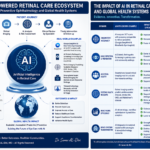

Exploring the future of predictive medicine, intelligent retinal diagnostics, teleophthalmology, precision healthcare, and AI-powered healthcare transformation.
Key Terms
Introduction
Artificial Intelligence (AI) is increasingly transforming modern healthcare systems, and ophthalmology has emerged as one of the most technologically advanced medical specialties driving this global digital revolution. From predictive analytics and retinal imaging to teleophthalmology and precision medicine, AI technologies are progressively reshaping how eye diseases are detected, monitored, and managed worldwide.
The future of ophthalmology may no longer rely solely on reactive disease treatment. Instead, healthcare systems are gradually moving toward predictive medicine, preventive healthcare strategies, personalized treatment pathways, and intelligent healthcare ecosystems supported by machine learning and advanced digital technologies.
As populations age and chronic diseases such as diabetes continue to increase globally, healthcare systems face growing pressure to improve efficiency, accessibility, and sustainability. Artificial intelligence may play a significant role in supporting future ophthalmic care delivery by improving diagnostic workflows, expanding healthcare accessibility, enhancing disease prediction, and strengthening preventive eye healthcare.
Today, AI is no longer considered a distant concept in ophthalmology — it is becoming an increasingly important component of the future of retinal medicine, digital healthcare transformation, and precision eye health.
Predictive Medicine, OCT Imaging, Retina Care, and Digital Healthcare Transformation
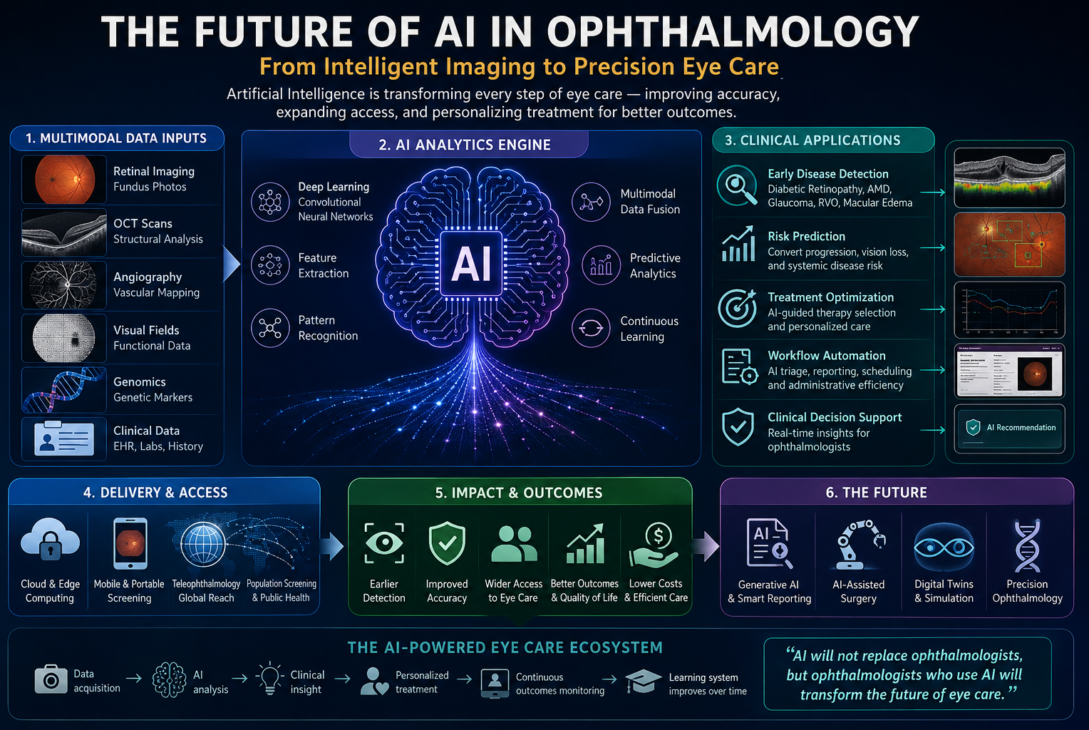
This infographic illustrates how artificial intelligence (AI), predictive medicine, Optical Coherence Tomography (OCT), teleophthalmology, retinal diagnostics, precision eye healthcare, and digital healthcare transformation are increasingly converging to shape the future of ophthalmology and modern retinal medicine globally.
As illustrated in Figure 1, artificial intelligence is increasingly integrating predictive analytics, retinal imaging, teleophthalmology, and precision medicine into future ophthalmic healthcare systems.
The Global Burden of Vision Loss and the Need for Innovation
Visual impairment and blindness remain major global public health challenges. According to the World Health Organization (WHO), over 2.2 billion people worldwide live with some form of vision impairment or blindness, with many cases potentially preventable through earlier diagnosis and timely intervention.
Retinal diseases such as:
- Diabetic retinopathy
- Age-related macular degeneration (AMD)
- Glaucoma
- Retinal vascular diseases
continue to represent leading causes of irreversible visual impairment globally.
At the same time, many healthcare systems face:
- Shortages in specialist workforce capacity
- Increasing patient demand
- Healthcare inequality
- Limitations in access to ophthalmology services
Artificial intelligence may help support healthcare transformation by improving efficiency, enabling earlier disease detection, and expanding access to retinal screening and specialist ophthalmic care.
The Evolution of Digital Ophthalmology
Ophthalmology has become one of the most digitally advanced specialties in modern medicine due to its strong reliance on high-resolution imaging technologies and data-driven diagnostics.
- Optical Coherence Tomography (OCT)
- Ultra-widefield retinal imaging
- AI-assisted image analysis
- Teleophthalmology platforms
- Cloud-based healthcare systems
Modern ophthalmic practice increasingly integrates clinical medicine with intelligent healthcare technologies capable of supporting diagnostic interpretation, workflow optimization, predictive analytics, and personalized healthcare delivery.
Artificial Intelligence and Predictive Medicine
One of the most transformative future applications of AI in ophthalmology lies in predictive medicine and preventive healthcare.
Traditional healthcare models often focus on diagnosing and treating disease after symptoms become clinically apparent. Artificial intelligence may help shift ophthalmology toward earlier prediction of disease progression and preventive intervention strategies.
Specific Clinical Examples
- Diabetic Retinopathy: AI-supported retinal imaging systems may help identify early microvascular retinal changes before severe visual complications occur.
- Age-Related Macular Degeneration (AMD): Predictive analytics may support earlier recognition of disease activity and progression risk.
- Glaucoma: AI-assisted analysis of optic nerve imaging and visual field data may contribute to earlier detection of progressive optic nerve damage.
Real-World Example: Moorfields Eye Hospital and DeepMind
One of the most recognized developments in AI-assisted ophthalmology emerged through collaborations involving Moorfields Eye Hospital and DeepMind, where machine learning systems demonstrated the ability to analyze Optical Coherence Tomography (OCT) scans and assist in identifying retinal pathologies with high diagnostic performance.
- Earlier disease diagnosis
- Retinal workflow optimization
- Intelligent clinical prioritization
- Future decision-support systems
Teleophthalmology and Global Healthcare Accessibility
Artificial intelligence may also contribute significantly to improving global healthcare accessibility through teleophthalmology and remote diagnostic systems.
- Community-based diabetic retinopathy screening
- AI-assisted retinal triage systems
- Remote OCT interpretation
- Digital referral networks
Teleophthalmology may become increasingly important in future healthcare systems focused on preventive medicine, digital healthcare integration, and healthcare equity.
Precision Eye Healthcare and Personalized Medicine
The future of ophthalmology is increasingly moving toward precision medicine and individualized patient care.
Artificial intelligence may help integrate retinal imaging findings, clinical history, genetic information, disease progression patterns, and predictive risk modeling into more personalized healthcare strategies.
- AI systems may assist in optimizing anti-VEGF treatment intervals
- Predictive algorithms may support personalized glaucoma monitoring
- Machine learning models may improve individualized risk assessment
OCT Imaging and Intelligent Diagnostic Systems
Optical Coherence Tomography (OCT) remains one of the most important imaging technologies in modern retinal medicine.
AI-enhanced OCT interpretation may improve:
- Image analysis speed
- Diagnostic consistency
- Disease monitoring
- Clinical workflow prioritization
AI and Healthcare System Transformation
The rise of AI in ophthalmology reflects a much broader transformation occurring across global healthcare systems.
- Workflow optimization
- Preventive medicine
- Intelligent triage systems
- Digital health integration
- Population health management
- Resource prioritization
Ophthalmology may become one of the strongest examples of successful AI integration into precision medicine and sustainable healthcare innovation globally.
Ethical, Regulatory, and Governance Challenges
- Patient privacy
- Healthcare data security
- Algorithm transparency
- Clinical accountability
- Healthcare bias
- Ethical governance
AI systems should support — not replace — clinical expertise and physician judgment.
Responsible implementation requires evidence-based validation, regulatory oversight, interdisciplinary collaboration, and patient-centered healthcare governance.
The Future Outlook of AI in Ophthalmology
- Real-time AI-assisted diagnostics
- Predictive retinal disease modeling
- AI-supported surgical technologies
- Remote retinal monitoring
- Digital healthcare ecosystems
- Expanded precision medicine applications
Takeaway Messages
- Artificial intelligence is rapidly transforming ophthalmology and retinal medicine.
- Predictive medicine may shift ophthalmology toward earlier disease prevention and intervention.
- AI-assisted retinal imaging and OCT analysis may improve diagnostic accuracy and workflow efficiency.
- Teleophthalmology and AI-supported screening may enhance healthcare accessibility globally.
- Precision eye healthcare represents a major future direction in personalized medicine.
- Ethical governance and human clinical oversight remain essential.
- Ophthalmology may become a global model for successful AI integration into healthcare systems.
Questions and Answers
Conclusion
Artificial intelligence is increasingly shaping the future of ophthalmology, predictive medicine, digital healthcare transformation, and precision eye health.
As healthcare systems continue evolving globally, AI technologies may contribute significantly to earlier disease detection, improved healthcare accessibility, personalized medicine, and sustainable healthcare innovation.
However, the long-term success of AI in ophthalmology will depend not only on technological advancement, but also on responsible implementation, ethical governance, interdisciplinary collaboration, and continued commitment to patient-centered care.
Artificial intelligence is no longer merely the future of ophthalmology — it is increasingly becoming part of the evolving reality of modern medicine and digital healthcare transformation.
References
- World Health Organization (WHO) – Blindness and Vision Impairment
- National Health Service (NHS) – Age-Related Macular Degeneration (AMD)
- Moorfields Eye Hospital NHS Foundation Trust – AI Research
- The Lancet Digital Health – AI and Healthcare Transformation
- Nature Medicine – Machine Learning and Clinical Diagnostics
- PubMed – Artificial Intelligence in Ophthalmology
- National Institutes of Health (NIH)
- American Academy of Ophthalmology
- British Journal of Ophthalmology
- International Agency for the Prevention of Blindness (IAPB)
- University College London (UCL) Institute of Ophthalmology
- Harvard Medical School
- Johns Hopkins Wilmer Eye Institute
About the Author
Dr. Samer AL-Diri
Dr. Samer AL-Diri is a UK-trained ophthalmologist, retinal specialist, healthcare strategist, and public health professional with international experience across the United Kingdom, United Arab Emirates, Syria, and the South Pacific region.
His professional interests include:
- Artificial intelligence in healthcare
- Retinal medicine
- Healthcare transformation
- Public health strategy
- Digital health innovation
- Predictive medicine
- Sustainable healthcare systems
Website: drsameraldiri.com