
Comprehensive educational review exploring how Artificial Intelligence is transforming retina care, OCT imaging, precision ophthalmology, healthcare systems, teleophthalmology, and preventive medicine globally.
Author: Dr. Samer AL-Diri, MD
Specialty: Retinal Ophthalmology
Clinical Review: Medically Reviewed
About the Author
Dr. Samer AL-Diri, MD is a retinal ophthalmologist, public health specialist, and healthcare transformation consultant with international clinical and healthcare leadership experience across the UK, UAE, and global health settings.
Professional Background:
UK-trained ophthalmologist with postgraduate education from UCL Institute of Ophthalmology and City, University of London, with expertise in retinal medicine, digital healthcare transformation, preventive ophthalmology, healthcare systems strengthening, and public health innovation.
Key Takeaways
AI Revolution in Ophthalmology
Artificial Intelligence is transforming ophthalmology faster than almost any other medical specialty.
Advanced Retinal Imaging
AI-driven retinal imaging and OCT analysis are improving diagnostic precision and accelerating early disease detection.
Multimodal AI Systems
Foundation AI models now integrate imaging, genomics, and electronic medical records for precision ophthalmology.
Global Healthcare Access
AI-assisted ophthalmology is expanding eye care accessibility in underserved and remote populations worldwide.
Predictive Analytics
Emerging technologies include autonomous retinal screening and predictive disease modeling systems.
Clinical Governance
Ethical governance, cybersecurity, physician oversight, and explainable AI remain essential for implementation.
Introduction
Artificial Intelligence is rapidly reshaping the future of ophthalmology, with retinal imaging and Optical Coherence Tomography (OCT) emerging among the most advanced applications of AI in modern medicine.
Because ophthalmology relies heavily on high-resolution imaging modalities such as OCT, fundus photography, angiography, and visual field analysis, it represents one of the ideal medical specialties for AI integration.
Over the past decade, AI has evolved from a research innovation into a clinically applicable technology capable of supporting diagnosis, disease prediction, workflow optimization, healthcare planning, and surgical guidance.
Leading institutions including Moorfields Eye Hospital NHS Foundation Trust, Stanford Medicine, Johns Hopkins Wilmer Eye Institute, and Google DeepMind have contributed significantly to pioneering AI-driven ophthalmic research.
The Evolving Ecosystem of AI in Retinal Care
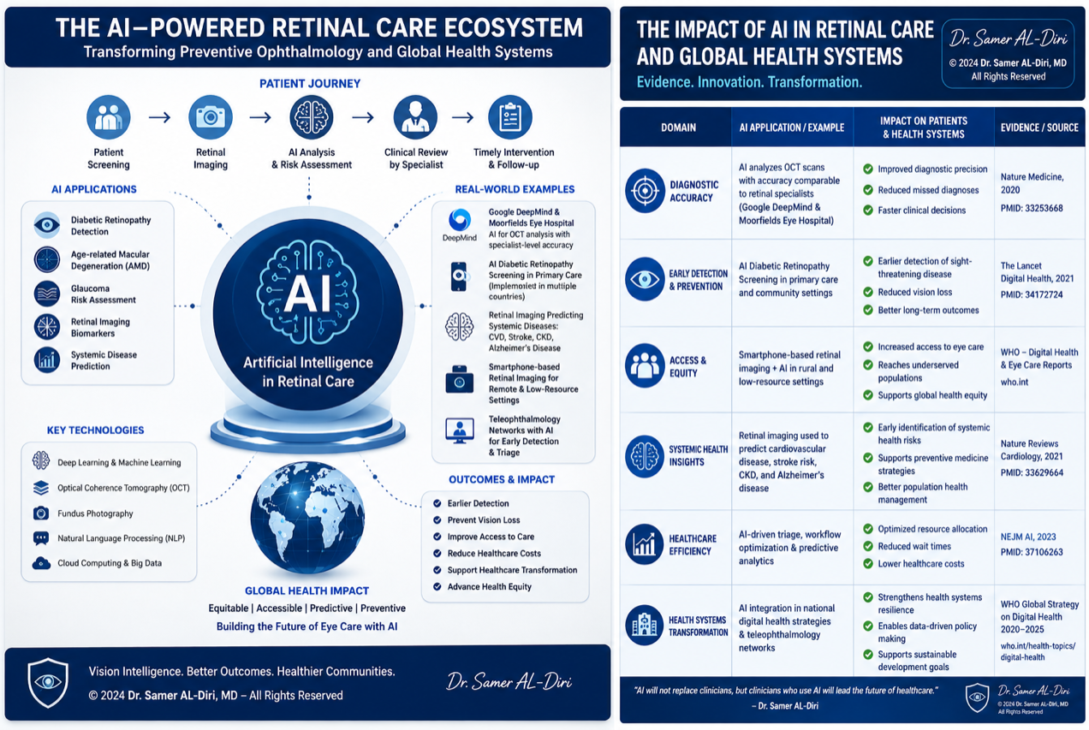
AI-assisted retinal imaging, multimodal diagnostics, teleophthalmology, predictive analytics, autonomous screening, precision medicine, and AI-guided vitreoretinal surgery are rapidly redefining global ophthalmology and preventive healthcare ecosystems.
Why This Matters Globally
Vision impairment affects education, workforce productivity, healthcare expenditure, and quality of life worldwide.
As diabetes prevalence continues to rise globally, healthcare systems are under increasing pressure to expand retinal screening capacity and improve early disease detection.
WHO Global Vision Data:
According to the World Health Organization (WHO), at least 2.2 billion people globally live with vision impairment or blindness, with over one billion cases considered preventable or insufficiently treated.
Artificial Intelligence may become one of the most important technologies supporting preventive ophthalmology, universal healthcare access, and digital healthcare transformation over the coming decade.
Why Ophthalmology Is Ideal for Artificial Intelligence
Ophthalmology is uniquely suited for AI because it generates large quantities of structured digital imaging data that can be efficiently analyzed using deep learning algorithms.
Retinal Diseases Benefiting from AI
- Diabetic Retinopathy
- Age-Related Macular Degeneration (AMD)
- Glaucoma
- Retinal Vascular Disease
- Diabetic Macular Edema
- Retinopathy of Prematurity
AI Clinical Capabilities
- Early disease detection
- Automated image analysis
- Diagnostic decision support
- Workflow optimization
- Predictive analytics
- Precision treatment planning
One of the earliest global breakthroughs was autonomous diabetic retinopathy screening. The FDA-authorized IDx-DR system demonstrated the ability to independently detect diabetic retinopathy without direct physician interpretation.
Landmark research published in Nature Medicine demonstrated that deep learning systems could analyze OCT scans with diagnostic performance comparable to leading retina specialists.
The Rise of Multimodal AI and Foundation Models
The newest frontier in ophthalmology is multimodal artificial intelligence and foundation AI models.
Rather than analyzing a single image, advanced AI platforms now integrate multiple healthcare data sources simultaneously.
Integrated Data Sources
- OCT imaging
- Fundus photography
- Angiography
- Visual fields
- Electronic health records
- Genomic information
Clinical Advantages
- Advanced disease profiling
- Personalized treatment planning
- Improved diagnostic precision
- Cross-platform compatibility
- Predictive medicine
- Systemic disease screening
Research published in Nature Biomedical Engineering demonstrated advanced three-dimensional multimodal foundation models capable of improving OCT interpretation and retinal disease detection with remarkable precision.
Additional studies showed that AI systems may predict systemic diseases including diabetes, hypertension, osteoporosis, and cardiovascular disease using retinal imaging biomarkers alone.
The Retina as a Digital Biomarker:
Emerging research strongly supports the concept of the retina functioning as a non-invasive digital biomarker for systemic health assessment and precision medicine.
Generative AI and Automated Ophthalmology Reporting
One of the fastest-growing innovations in medicine is generative Artificial Intelligence.
Emerging generative AI systems are now capable of producing automated ophthalmology reports by integrating multimodal imaging with clinical data.
Generative AI Applications
- Automated clinical documentation
- AI-generated ophthalmology reports
- Patient communication support
- Clinical workflow optimization
- Predictive analytics
- Healthcare operations management
Potential Clinical Impact
- Reduced administrative burden
- Enhanced workflow efficiency
- Improved documentation quality
- Faster clinical reporting
- Scalable healthcare delivery
- Improved patient accessibility
AI in Vitreoretinal Surgery
Artificial Intelligence is now entering the operating theatre.
Emerging AI-assisted vitreoretinal surgical technologies are being developed to improve surgical precision, intraoperative visualization, robotic guidance, and complication prediction.
AI Surgical Innovations
- Robotic retinal surgery
- Intraoperative analytics
- Fluidics optimization
- AI-guided visualization
- Real-time parameter adjustment
- Predictive complication analysis
Future Surgical Ecosystems
- Digitally enhanced operating theatres
- Machine learning-assisted surgery
- Intelligent surgical platforms
- Precision microsurgery
- Enhanced patient safety
- Robotic collaboration systems
Teleophthalmology and Global Eye Health
One of AI’s greatest public health advantages is scalability.
Millions of patients worldwide still lack timely access to ophthalmic services, particularly in low-resource and remote settings.
AI-powered teleophthalmology may dramatically improve screening coverage by enabling remote retinal analysis through portable imaging technologies.
Global Healthcare Impact:
AI-assisted diabetic retinopathy screening programs are increasingly integrated into community healthcare systems and primary care clinics worldwide.
Public Health Benefits
- Preventable blindness reduction
- Expanded screening coverage
- Earlier disease detection
- Improved healthcare access
- Reduced healthcare inequality
Healthcare System Benefits
- Universal health coverage support
- Humanitarian healthcare scalability
- Digital healthcare transformation
- Resource optimization
- Global eye health strengthening
Ethical Challenges and Clinical Governance
Despite its enormous promise, AI implementation must remain clinically responsible and ethically governed.
Key Ethical Challenges
- Algorithmic bias
- Cybersecurity threats
- Patient privacy
- Medicolegal accountability
- Regulatory governance
- Explainability of AI decisions
Responsible AI Principles
- Physician oversight
- Collaborative intelligence
- Transparent algorithms
- Clinical validation
- Data governance
- Ethical implementation
AI should enhance — not replace — physician expertise.
The future model of ophthalmology will likely involve collaborative intelligence, where ophthalmologists and AI systems work together to improve diagnostic accuracy, efficiency, and patient outcomes.
Future Directions
The next decade may fundamentally redefine ophthalmology.
Emerging Technologies
- Autonomous retinal screening
- Real-time clinical decision support
- Predictive disease modeling
- AI-assisted robotic surgery
- Precision ophthalmology
Long-Term Innovation
- Genomics-integrated diagnostics
- Regenerative retinal medicine
- Explainable AI ecosystems
- Digital healthcare transformation
- Advanced preventive medicine
AI may additionally accelerate advances in gene therapy and regenerative medicine for inherited retinal diseases.
As digital healthcare ecosystems mature, ophthalmology is increasingly positioned to become one of the world’s leading examples of successful AI-driven healthcare transformation.
Conclusion
Artificial Intelligence is rapidly transforming retina care, OCT imaging, and precision ophthalmology.
The integration of AI into healthcare systems has the potential to improve diagnostic accuracy, strengthen preventive medicine, expand healthcare accessibility, and reduce the global burden of avoidable blindness.
The future of ophthalmology will likely depend on the successful integration of clinical expertise, ethical governance, multimodal diagnostics, and digital healthcare innovation.
Final Perspective:
As healthcare systems continue evolving toward more data-driven and patient-centered models, AI-assisted ophthalmology may become one of the defining examples of modern healthcare transformation.
Frequently Asked Questions (FAQ)
Will AI replace ophthalmologists?
No. AI is designed to support ophthalmologists by improving efficiency, diagnostic precision, and workflow optimization rather than replacing physician expertise.
Which eye diseases can AI detect?
AI currently performs best in detecting diabetic retinopathy, glaucoma, age-related macular degeneration, retinal vascular disease, and macular edema.
Why is retina considered ideal for AI?
Retina care relies heavily on imaging technologies such as OCT and fundus photography, making it highly compatible with deep learning analysis.
Is AI already being used clinically?
Yes. Multiple FDA-authorized AI systems are already used clinically in diabetic retinopathy screening and ophthalmic imaging analysis.
What is the future of AI in ophthalmology?
The future includes autonomous screening, predictive analytics, multimodal diagnostics, precision medicine, AI-assisted surgery, and digital healthcare transformation.
Conflict of Interest
The author declares no conflicts of interest related to this publication.
Clinical Disclaimer
This article is intended for educational and informational purposes only and should not replace individualized clinical judgment, professional medical advice, or formal ophthalmic consultation.
Ethics and Data Governance Statement
All referenced technologies and studies discussed in this article emphasize the importance of ethical AI implementation, patient privacy protection, regulatory compliance, and responsible clinical governance.
Suggested Keywords
Artificial Intelligence in Ophthalmology, AI Retinal Imaging, OCT Artificial Intelligence, Digital Health, Precision Ophthalmology, Retina Care, Healthcare Transformation, Preventive Ophthalmology, Teleophthalmology, AI in Healthcare, Retinal Disease Screening, Global Health Systems, AI Diagnostics, Digital Medicine, Healthcare Innovation, Dr. Samer AL-Diri.
References
- Abràmoff MD, Lavin PT, Birch M, Shah N, Folk JC. Pivotal trial of an autonomous AI-based diagnostic system for detection of diabetic retinopathy in primary care offices. NPJ Digital Medicine. 2018.
- Bernardi E, Ferro Desideri L, Shah N, et al. Artificial Intelligence in Vitreoretinal Surgery: Current Applications and Future Directions. Ophthalmology and Therapy. 2026.
- De Fauw J, Ledsam JR, Romera-Paredes B, et al. Clinically applicable deep learning for diagnosis and referral in retinal disease. Nature Medicine. 2018.
- Edwards TL, Xue K, Meenink HCM, et al. First-in-human study of robot-assisted retinal surgery. Nature Biomedical Engineering. 2021.
- Grassmann F, Mengelkamp J, Brandl C, et al. A deep learning algorithm for prediction of AMD severity scale. Ophthalmology. 2020.
- Kaplan A, Haenlein M. Artificial intelligence in medicine and healthcare systems. Business Horizons. 2019.
- Liu Z, Xu H, Lee AY, et al. A three-dimensional multimodal foundation model for OCT. Nature Biomedical Engineering. 2026.
- Poplin R, Varadarajan AV, Blumer K, et al. Prediction of cardiovascular risk factors from retinal imaging. Nature Biomedical Engineering. 2018.
- Shen Y, Chen Q, He X, et al. Automated Report Generation in Ophthalmology. Ophthalmology and Therapy. 2026.
- Tang ZQ, Zhang YH, Ran AR, et al. Vendor-Agnostic AI for Multiple Macular Disease Detection Using 3D OCT Scans. JAMA Ophthalmology. 2026.
- Ting DSW, Pasquale LR, Peng L, et al. Artificial intelligence and deep learning in ophthalmology. British Journal of Ophthalmology. 2019.
- World Health Organization (WHO) – World Report on Vision.
- Zhang X, Li Q, Liang Y, et al. Artificial intelligence framework for multidisease detection via retinal imaging. Nature Medicine. 2026.
About Dr. Samer AL-Diri
Dr. Samer AL-Diri, MD is a retinal ophthalmologist, healthcare transformation advisor, and public health specialist with international expertise across ophthalmology, retinal medicine, healthcare systems strengthening, and digital health innovation.
Professional Recognition & Profiles:
© 2026 Dr. Samer AL-Diri, MD — Educational Publication on AI in Ophthalmology and Digital Healthcare Transformation.