
Healthcare Transformation in the Modern Era
Exploring sustainable healthcare systems, digital innovation, patient-centered care, leadership, workforce resilience, health equity, and healthcare transformation strategies for the future of global healthcare.
Executive Summary
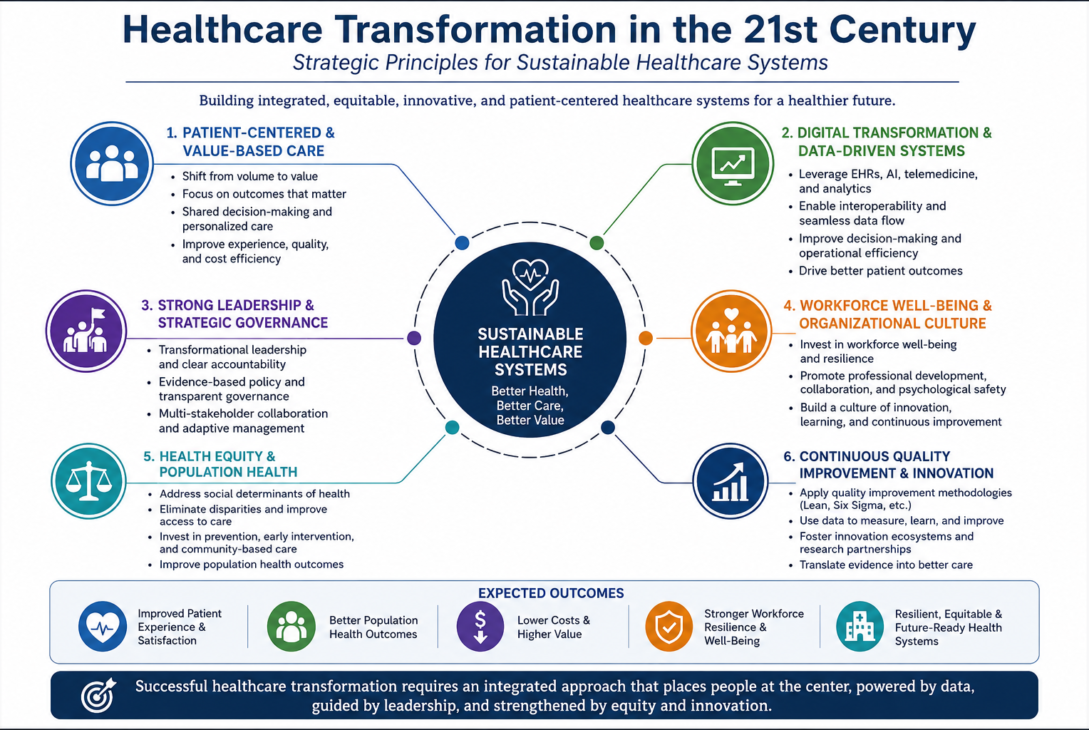
Healthcare transformation has become a strategic global imperative driven by technological disruption, demographic transitions, rising healthcare expenditures, chronic disease burdens, and increasing public expectations. Sustainable healthcare transformation requires integrated systems capable of balancing quality, equity, innovation, workforce resilience, and financial sustainability. Successful healthcare organizations in the 21st century must adopt strategic, patient-centered, and data-driven models to achieve long-term system performance and population health improvement.
Few sectors have experienced changes as rapid and complex as healthcare over the past two decades. Aging populations, rising costs, digital disruption, and growing public expectations are forcing healthcare systems to rethink how care is designed, delivered, and sustained. Today’s healthcare systems are expected not only to deliver clinically effective care, but also to provide services that are equitable, financially sustainable, digitally integrated, and centered around patient needs.
One of the most influential frameworks guiding modern healthcare reform is the “Triple Aim” developed by the Institute for Healthcare Improvement (IHI), which focuses on improving patient experience, population health, and cost efficiency (IHI, 2024). This model later evolved into the “Quintuple Aim,” incorporating workforce well-being and health equity as critical components of sustainable healthcare transformation (Nundy et al., 2022).
Patient-Centered and Value-Based Care
The transition from volume-based to value-based healthcare remains one of the defining principles of contemporary health reform. Historically, many healthcare systems rewarded service volume rather than clinical outcomes. Today, healthcare leaders increasingly recognize that long-term sustainability depends on delivering measurable value to patients.
Research from Harvard Business School emphasizes that successful value-based healthcare systems require integrated care delivery, outcome measurement, appropriate reimbursement models, and advanced health information systems (Porter & Teisberg, Harvard Business School). Patient-centered care also depends on shared decision-making, continuity of care, cultural sensitivity, and responsiveness to patient expectations.
Importantly, healthcare quality can no longer be assessed solely through clinical indicators. Patient experience, accessibility, safety, and long-term outcomes have become equally important measures of system performance.
Digital Transformation and Data-Driven Systems
Digital technologies have become major enablers of healthcare transformation. Electronic health records, artificial intelligence, telemedicine, predictive analytics, and interoperable data systems are improving coordination, operational efficiency, and clinical decision-making across healthcare organizations.
However, technology alone does not guarantee successful transformation. Many healthcare systems continue to struggle with fragmented digital infrastructure, poor interoperability, and clinician resistance to poorly designed systems. Evidence published in BMC Medical Informatics and Decision Making demonstrates that ineffective digital implementation can contribute to clinician burnout and workflow inefficiencies.
Strong Leadership and Strategic Governance
Even the most ambitious healthcare reforms rarely succeed without effective leadership, institutional alignment, and clear accountability. Transformational leaders play a central role in establishing strategic priorities, promoting innovation, and creating cultures of continuous improvement.
Modern healthcare governance requires collaboration among hospitals, public health agencies, regulators, insurers, academic institutions, and community stakeholders. Effective governance frameworks depend on transparency, evidence-based policymaking, stakeholder engagement, and adaptive management.
Systems thinking has become particularly important because population health outcomes are shaped not only by healthcare delivery itself, but also by education, housing, transportation, environmental conditions, and broader social determinants of health.
Workforce Well-Being and Organizational Culture
Healthcare workforce resilience has emerged as a major determinant of system sustainability. Burnout among physicians, nurses, and allied health professionals continues to threaten healthcare quality, workforce retention, and patient safety globally.
Recognizing this challenge, the “Quadruple Aim” and later the “Quintuple Aim” formally incorporated workforce well-being into healthcare improvement frameworks.
High-performing healthcare organizations increasingly invest in professional development, collaborative leadership, psychological safety, and supportive workplace environments.
Organizational culture also strongly influences transformation success. Institutions that encourage innovation, accountability, interdisciplinary collaboration, and continuous learning are generally better positioned to adapt to rapidly evolving healthcare challenges.
Health Equity and Population Health
The COVID-19 pandemic exposed major structural inequities within healthcare systems worldwide. Vulnerable populations experienced disproportionately worse outcomes due to disparities in healthcare access, socioeconomic conditions, and public health infrastructure.
As a result, health equity is now recognized as a central pillar of healthcare transformation. The World Health Organization emphasizes that sustainable healthcare systems must address social determinants of health while ensuring equitable access to essential services.
Population health management also requires stronger investment in preventive medicine, early intervention, chronic disease management, and integrated community-based care.
Continuous Quality Improvement and Innovation
Healthcare transformation is not a single reform initiative, but rather a continuous process of adaptation and improvement. Quality improvement methodologies such as Lean management, Six Sigma, and evidence-based performance measurement continue to support operational excellence and organizational learning.
Innovation ecosystems involving universities, research institutions, healthcare organizations, and technology companies are also accelerating healthcare redesign.
Conclusion
Healthcare transformation in the 21st century requires far more than technological modernization or financial restructuring. Sustainable progress depends on integrated systems that prioritize value-based care, digital innovation, workforce well-being, health equity, strategic leadership, and continuous quality improvement.
The most successful healthcare systems will be those capable of balancing clinical excellence with financial sustainability, operational efficiency with patient-centered care, and innovation with equity.
As global healthcare challenges continue to evolve, organizations that embrace these strategic principles will be better positioned to build resilient, high-performing, and future-ready healthcare systems.
References
- BMC Medical Informatics and Decision Making. (2020). Digital transformation and clinician workflow challenges in healthcare systems.
- Institute for Healthcare Improvement (IHI). (2024). The Triple Aim and Quintuple Aim Frameworks for Healthcare Improvement.
- Nundy, S., Cooper, L. A., & Mate, K. S. (2022). The Quintuple Aim for Health Care Improvement: A New Imperative to Advance Health Equity. JAMA Network.
- Porter, M. E., & Teisberg, E. O. Redefining Health Care: Creating Value-Based Competition on Results. Harvard Business School Press.
- The Lancet Digital Health. (2024). Digital maturity and healthcare system performance.
- World Health Organization (WHO). (2023). Social Determinants of Health and Health Equity Frameworks.
About the Author
Dr. Samer Al-Diri
Dr. Samer Al-Diri, MD, MSc, MPH, is a UK-trained ophthalmologist, public-health professional and strategic healthcare consultant. His work spans healthcare management, health-system transformation, clinical governance, prevention, responsible digital health and eye health.
Website: drsameraldiri.com